




Summary
Manufacturing supply chain resilience is essential for surviving disruptions. This piece presents a practical framework: map multi‑tier suppliers to reveal hidden risks, run regular risk audits, diversify suppliers strategically (including geographic diversification), weigh nearshoring vs. offshoring using total landed cost, and adopt demand sensing (real‑time signals) rather than only historical forecasting. A single connected platform for visibility (e.g., Acumatica) turns these practices into operational reality and shortens disruption response times.
Key points
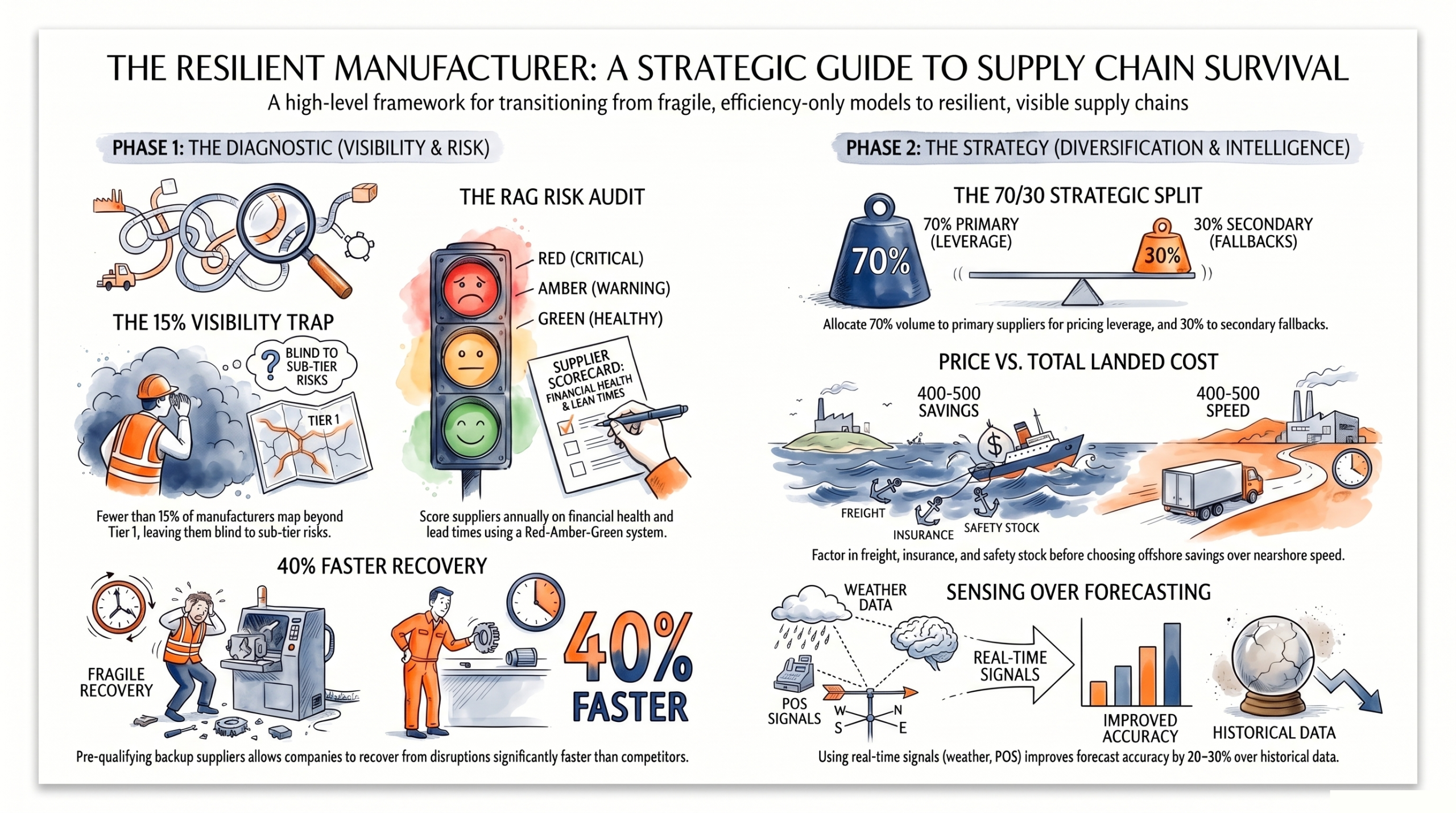
- Visibility first: map beyond Tier 1 (Tier 2/3), flag sole‑sources and geographic concentration, you can’t manage what you can’t see.
- Risk audit: score suppliers on financial health, lead time, and geographic risk (RAG system); review at least annually and after major changes.
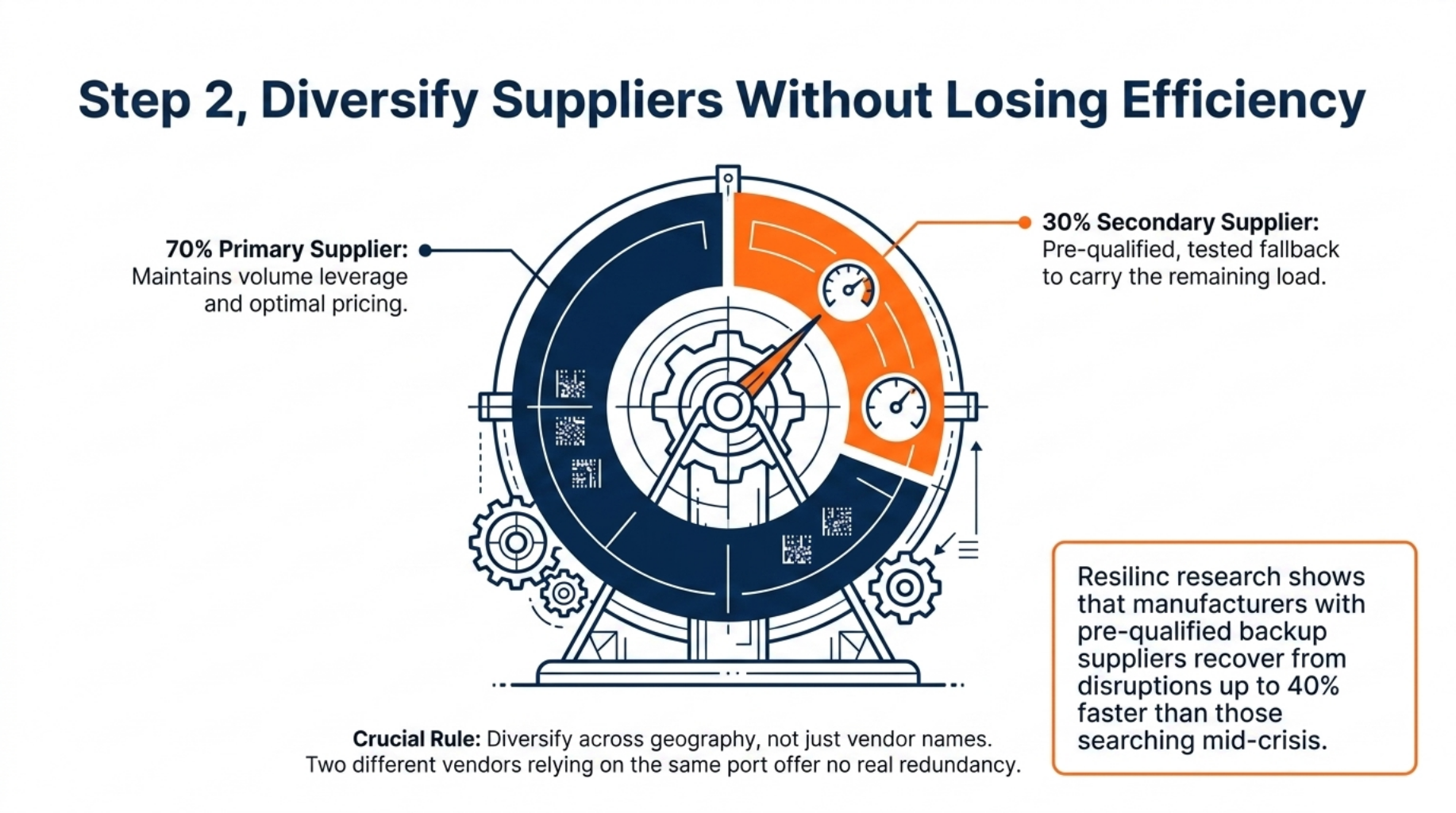
- Strategic diversification: use a primary/secondary split (e.g., ~70/30) and diversify locations, not just supplier names, to ensure true redundancy.
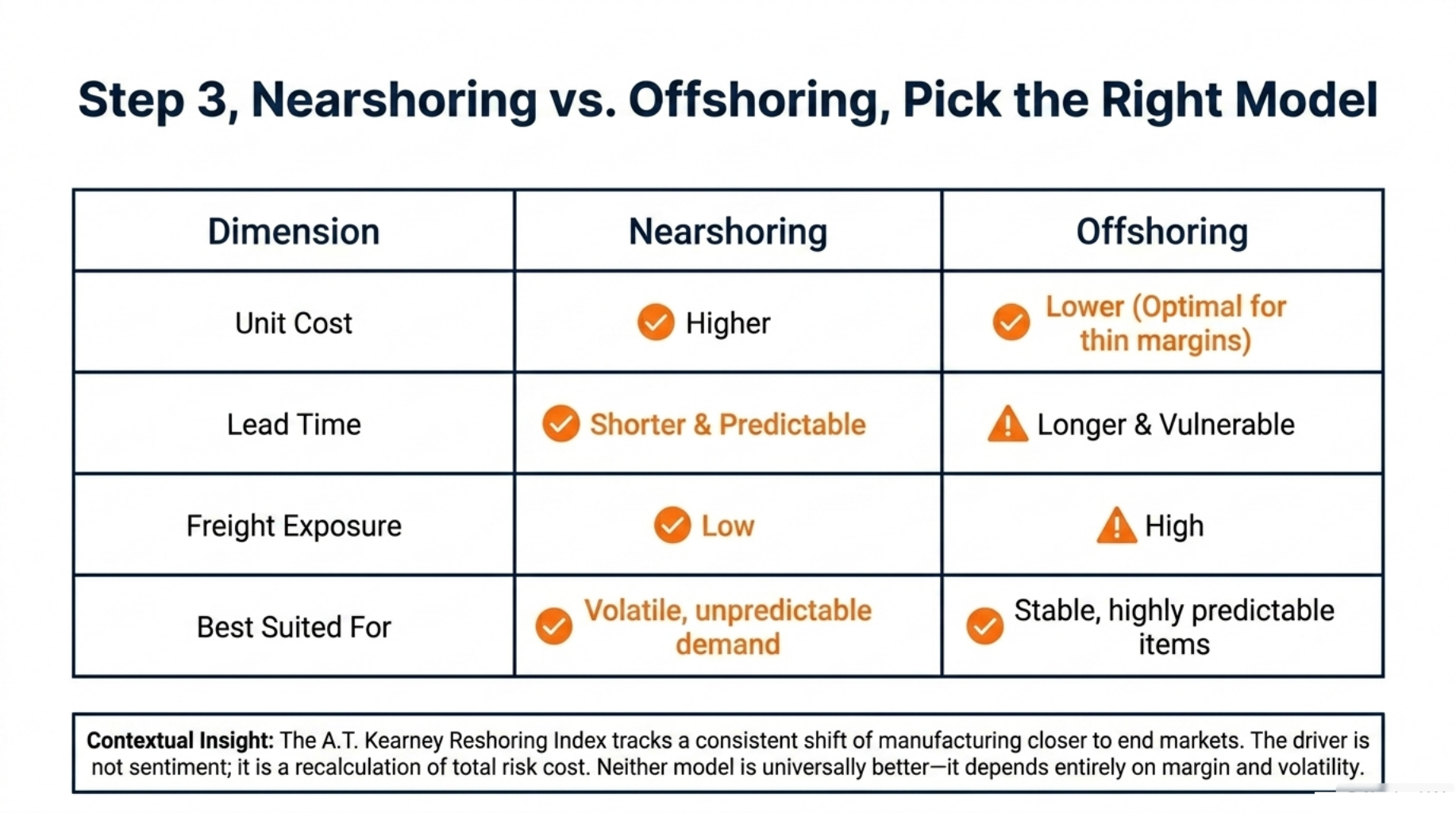
- Nearshoring vs offshoring: choose by total landed cost and demand volatility, nearshoring shortens lead times and reduces freight risk, offshoring can remain optimal for stable low‑margin items.
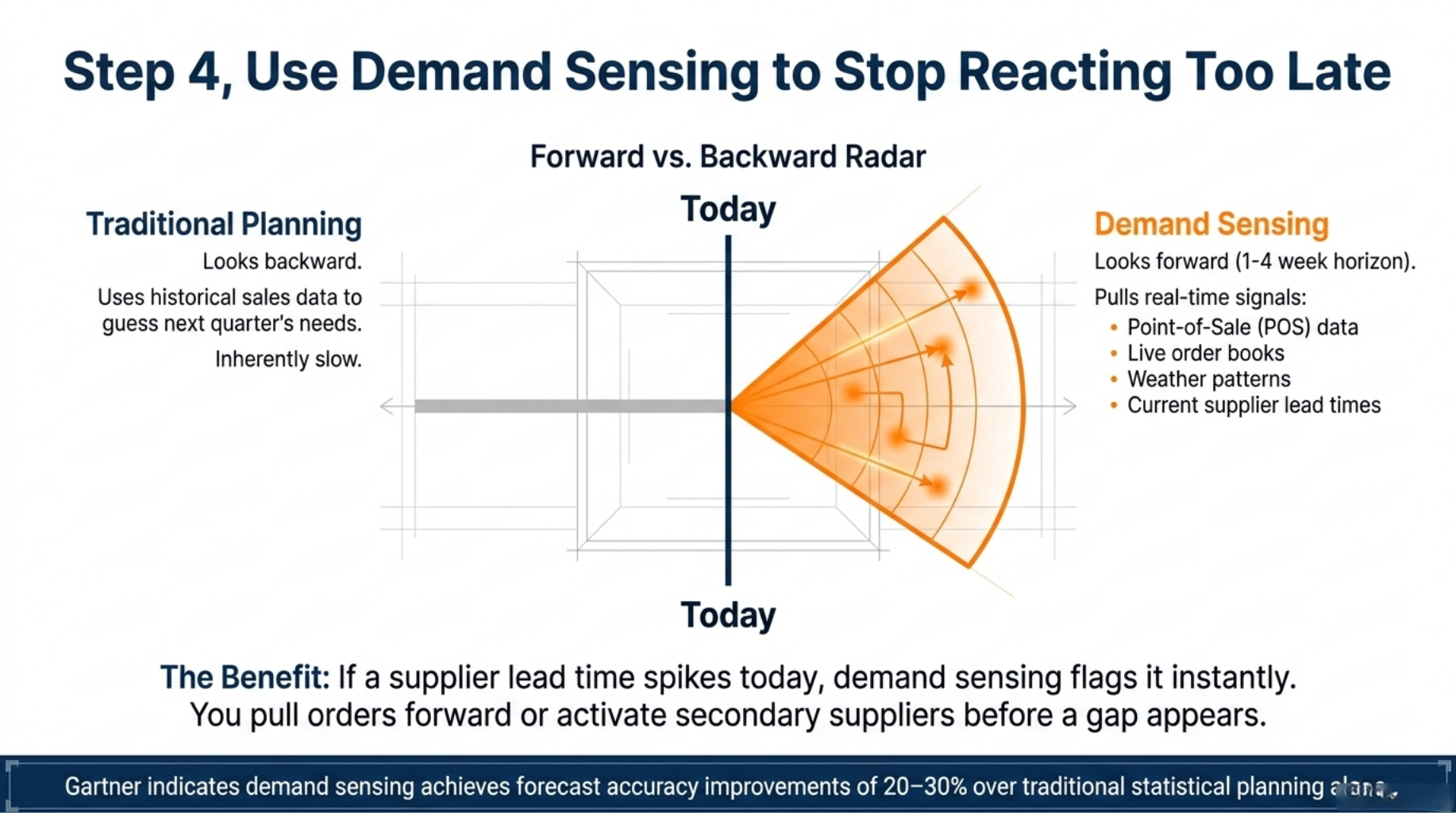
- Demand sensing: incorporate real‑time signals (POS, orders, lead times, weather) to improve short‑term forecast accuracy and react faster to disruptions.
- Digital backbone: a single, connected platform for multi‑tier visibility and live data makes mapping, sensing, and contingency actions effective.
Manufacturing supply chain resilience is no longer a nice-to-have, it is the difference between a business that survives a disruption and one that haemorrhages revenue while competitors fill the gap.
Global manufacturing has exposed just how fragile supply chains become when built purely for efficiency. This post gives you a practical framework to identify your vulnerabilities, diversify your supplier base, and use the right tools to act before a disruption becomes a crisis.
Why Manufacturing Supply Chains Break Down
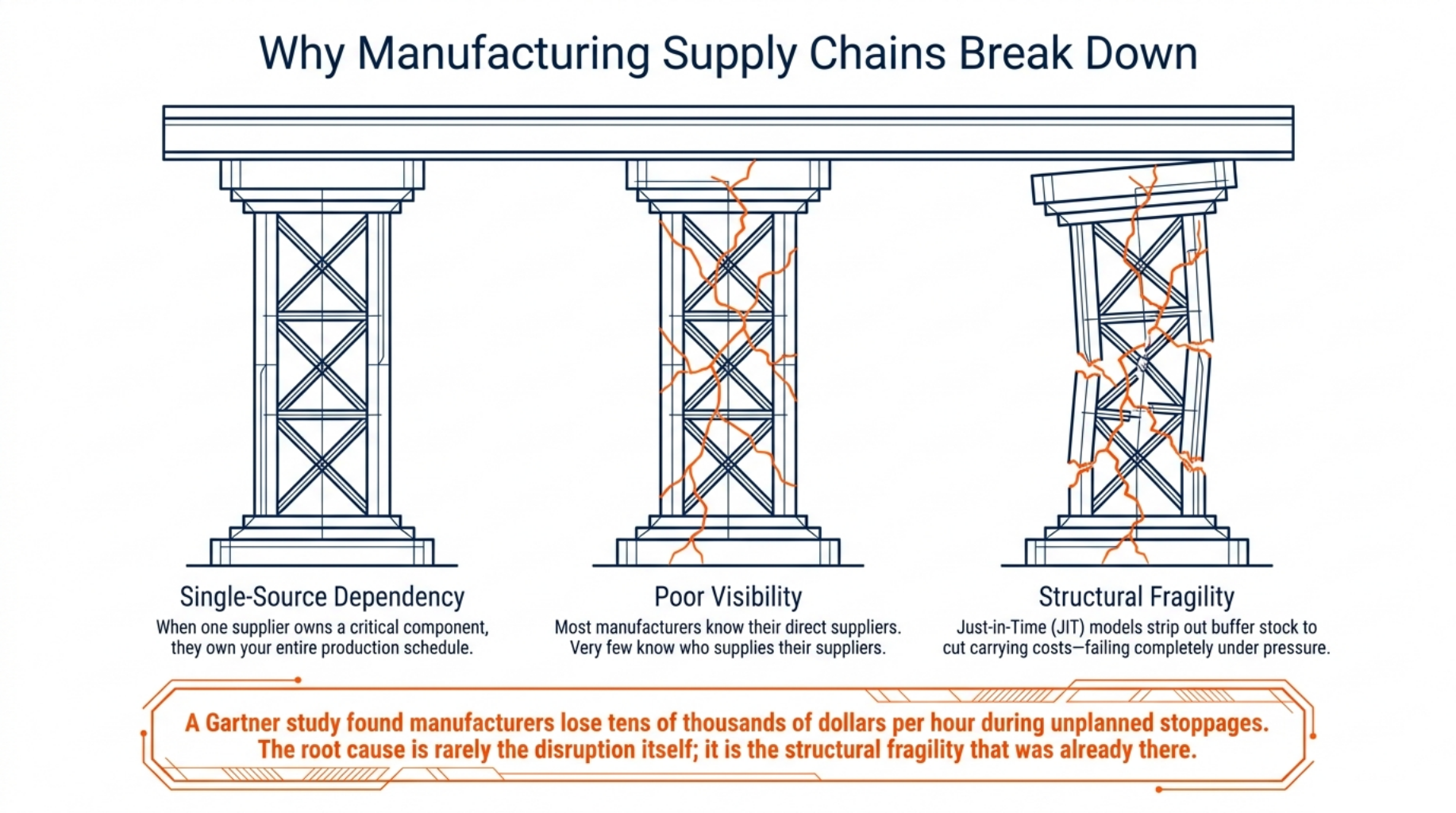
Most supply chain failures share three root causes. The first is single-source dependency, when one supplier owns a critical component, they own your production schedule too. The second is poor visibility.
Most manufacturers can name their direct suppliers, but very few know who supplies their suppliers. The third is structural: just-in-time models strip out buffer stock to cut carrying costs, which works beautifully in stable conditions and fails badly under pressure.
A Gartner study found that manufacturers can lose tens of thousands of dollars per hour during unplanned production stoppages. That number compounds fast when expedited freight, idle labour, and missed customer commitments stack up. The root cause is rarely the disruption itself, it is the structural fragility that was already there.
The Hidden Cost of Supply Chain Disruption
The visible cost of a disruption is lost production. The invisible cost is everything else. Expedited air freight to replace a delayed shipment can wipe out months of margin on a product line. Customers who miss a delivery window often don’t wait, they find another supplier.
A McKinsey analysis found that companies with low supply chain visibility experience customer churn at a significantly higher rate following disruptions than those with multi-tier insight.
Knowing why supply chains break down is only useful if you act on it, and that starts with understanding exactly what your supply chain looks like.
Step 1, Map Your Supply Chain Before You Fix It
You cannot manage risk you cannot see. Supply chain mapping is the diagnostic step that most manufacturers skip because it feels like a project for the IT team. It is not. It is a strategic decision that belongs in the boardroom.
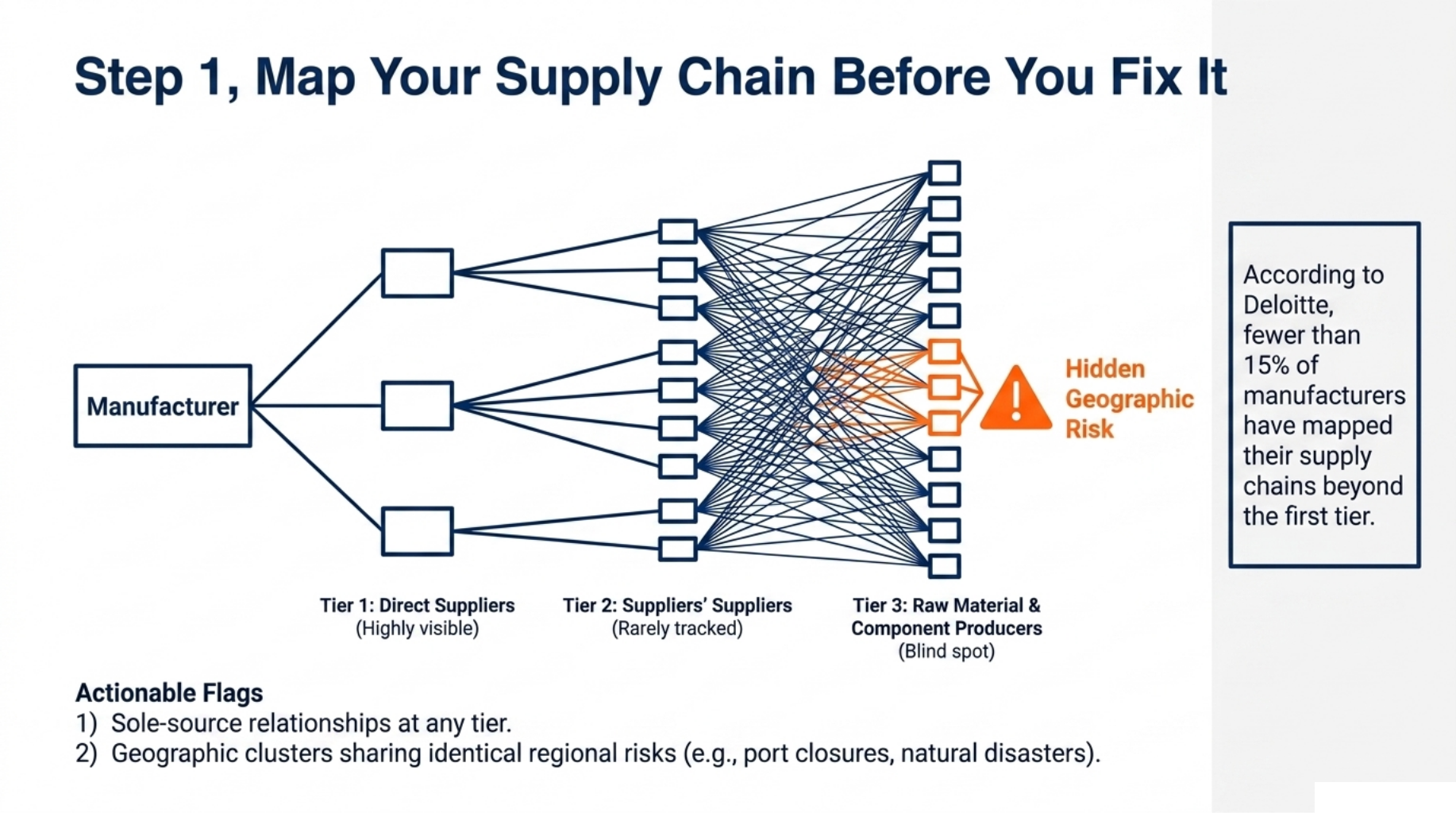
Start with Tier 1, your direct suppliers. Then map Tier 2, the companies that supply your suppliers. Tier 3 goes one level deeper: the raw material and component producers that feed Tier 2. Most manufacturers have no formal visibility beyond Tier 1. According to Deloitte, fewer than 15% of manufacturers have mapped their supply chain beyond the first tier. That means the vast majority are flying blind on the risks that are most likely to blind side them.
When you map, flag two things: sole-source relationships at any tier, and geographic clusters where multiple suppliers share the same regional risk. A port closure or natural disaster can simultaneously affect five suppliers, who all look independent on paper.
How to Run a Supply Chain Risk Audit
Once your map is complete, score each supplier across three dimensions: financial health, average lead time, and geographic risk concentration. Use a simple red-amber-green system. Start with suppliers tied to your highest-revenue product lines, those are where a failure hurts most. Review your audit at least annually, and immediately after any major supplier change or disruption event.
A clear map tells you where the risk sits. The next step is to reduce it without adding unnecessary cost or complexity.
Step 2, Diversify Suppliers Without Losing Efficiency
Supplier diversification feels expensive until you price a production stoppage. The objection most supply chain managers raise is valid: qualifying a new supplier takes time, resources, and volume commitments. The answer is not to diversify everything, it is to diversify strategically.
Use a primary/secondary split. Allocate roughly 70% of volume to your primary supplier to maintain pricing leverage, and qualify a secondary supplier to carry the remaining 30%. This keeps your primary relationship strong while giving you a tested fallback.
Resilinc research shows that manufacturers with pre-qualified backup suppliers recover from disruptions up to 40% faster than those who start supplier searches mid-crisis.
Critically, diversify across geography, not just supplier names. Two different vendors based in the same region, or relying on the same port, offer far less protection than their separate names suggest. A diversified supplier base is only truly diversified when the risks they face are genuinely independent.
Where you source from matters as much as how many suppliers you have, and that brings us to one of the most debated trade-offs in supply chain strategy.
Step 3, Nearshoring vs. Offshoring, Pick the Right Model
Neither nearshoring nor offshoring is universally better. The right model depends on your product, your margins, and how much demand volatility you face. The nearshoring benefits for manufacturing companies are real, shorter lead times, lower freight exposure, and faster response when something goes wrong.
But nearshoring typically carries higher unit costs, and that trade-off does not make sense for every product category.
The A.T. Kearney Reshoring Index has tracked a consistent shift among manufacturers moving portions of their supply base closer to end markets. The driver is not sentiment, it is a recalculation of total risk cost after disruptions that made long lead times catastrophically expensive.
Offshoring still makes sense where unit cost is the dominant decision factor, margins are thin, and the product category has stable, predictable demand. Where demand is volatile and lead time matters, nearshoring wins.
When Nearshoring Makes Financial Sense
Stop comparing unit price. Compare total landed cost: unit price plus freight, customs, insurance, inventory carrying cost during transit, and the cost of safety stock you need to hold because of long lead times. When you add expedite freight risk, the premium you pay to airfreight components when a sea shipment is delayed, offshore savings often evaporate. Run the full model before you decide.
Even the best supplier strategy fails if you are responding to demand signals that are weeks out of date.
Step 4, Use Demand Sensing to Stop Reacting Too Late
Traditional demand planning looks backwards. It uses historical sales data to forecast what you will need next quarter. Demand sensing looks forward, it pulls real-time signals from point-of-sale data, live order books, weather patterns, and current supplier lead times to adjust your short-term plan, usually within a one-to-four-week horizon.
The difference matters enormously for resilience. If a supplier lead time spikes this week, demand sensing flags it now. You can pull forward orders, activate a secondary supplier, or adjust your production schedule before a gap appears.
Gartner research indicates that companies using demand sensing achieve forecast accuracy improvements of 20–30% over those using traditional statistical planning alone.
Demand sensing also cuts the twin costs of being wrong: stockouts that lose sales, and overstock that ties up working capital. Paired with a diversified supplier base, it gives you the reaction speed to treat disruptions as manageable events rather than emergencies.
The framework above only works if your data is connected. That is where the right platform makes the difference.
How Acumatica Gives You the Visibility to Act
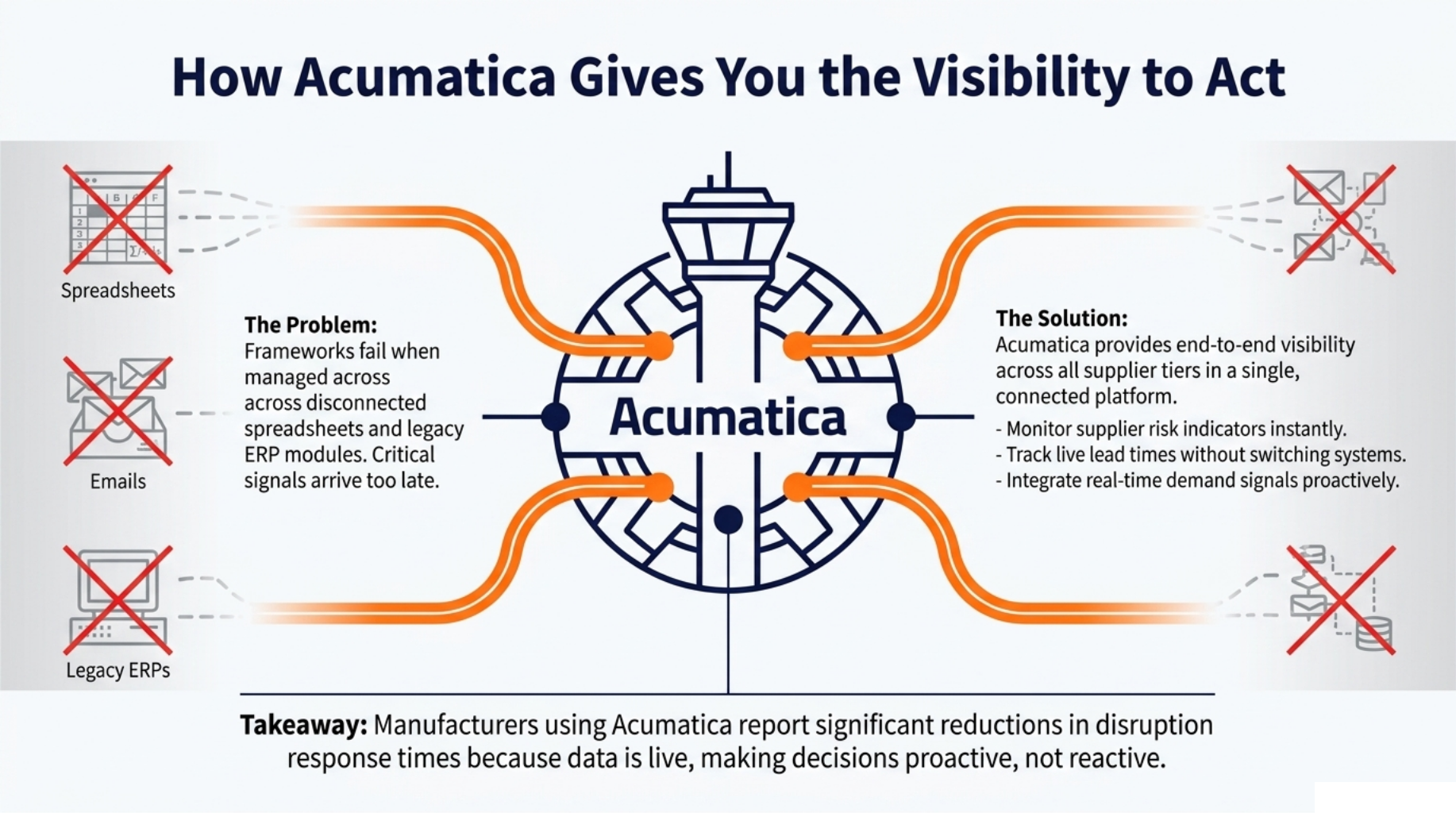
Every step in this framework, mapping supplier tiers, monitoring risk, sensing demand shifts, tracking lead times, depends on having one connected view of your supply chain. Most manufacturers try to manage this across disconnected spreadsheets, email threads, and legacy ERP modules. The result is that critical signals arrive too late to act on.
Acumatica gives supply chain managers end-to-end visibility across all supplier tiers in a single platform. You can monitor supplier risk indicators, track live lead times, and integrate demand signals without switching between systems. Manufacturers using Acumatica report significant reductions in disruption response time because they see problems forming, not after they have already hit production.
The platform also reduces the reporting lag that makes traditional supply chain management reactive by default. When your data is live, your decisions can be proactive. That is the foundation that turns the strategies in this post from good intentions into operational reality.
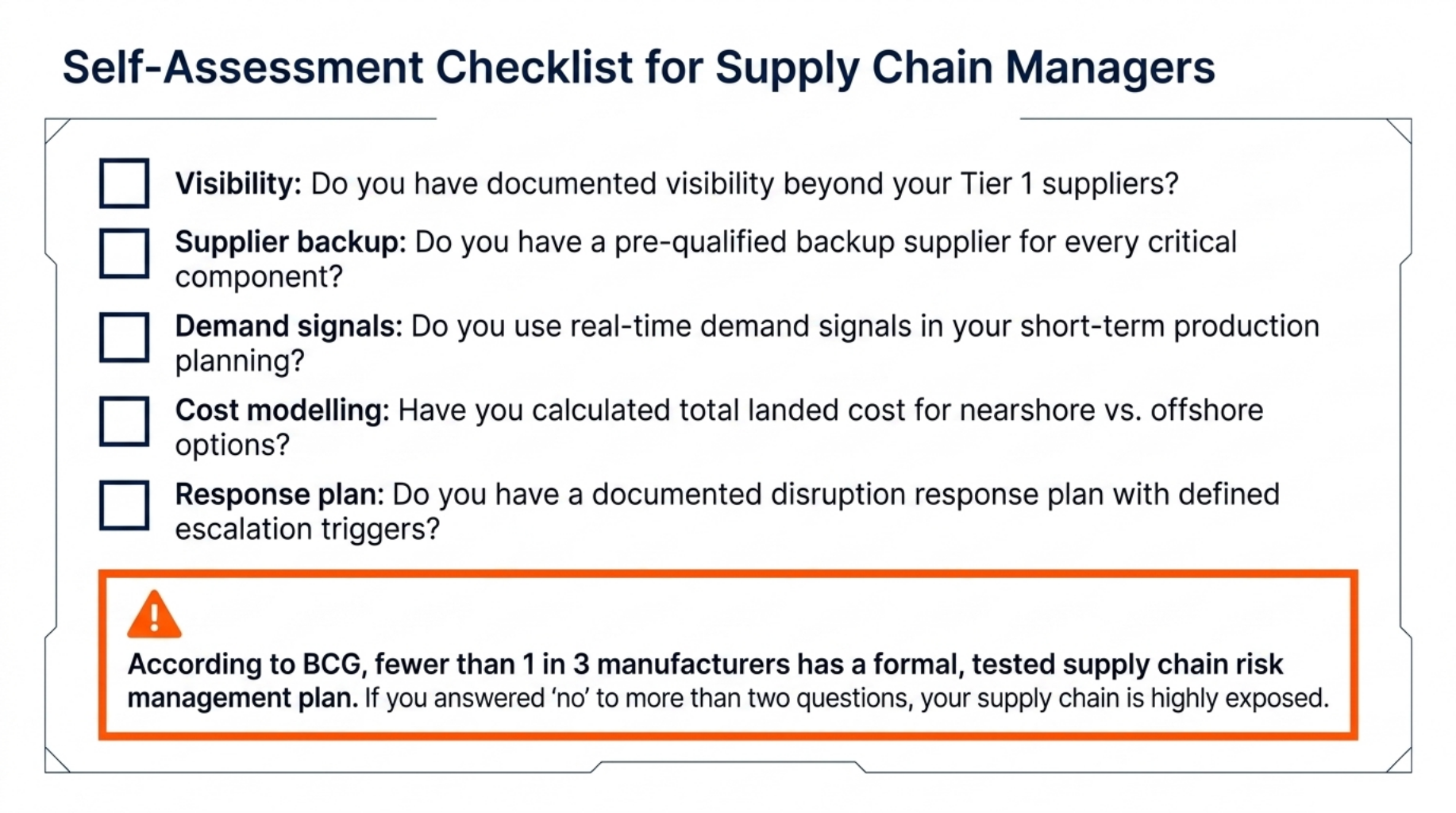
Self-Assessment Checklist for Supply Chain Managers
Use this checklist to rate your current resilience posture. A straight yes/no for each item will show you where the gaps are.
- Visibility: Do you have documented visibility beyond your Tier 1 suppliers?
- Supplier backup: Do you have a pre-qualified backup supplier for every critical component?
- Demand signals: Do you use real-time demand signals in your short-term production planning?
- Cost modelling: Have you calculated total landed cost for both nearshore and offshore sourcing options?
- Response plan: Do you have a documented disruption response plan with defined escalation triggers?
According to BCG, fewer than one in three manufacturers has a formal, tested supply chain risk management plan. If you answered “no” to more than two questions above, your supply chain is more exposed than it needs to be.
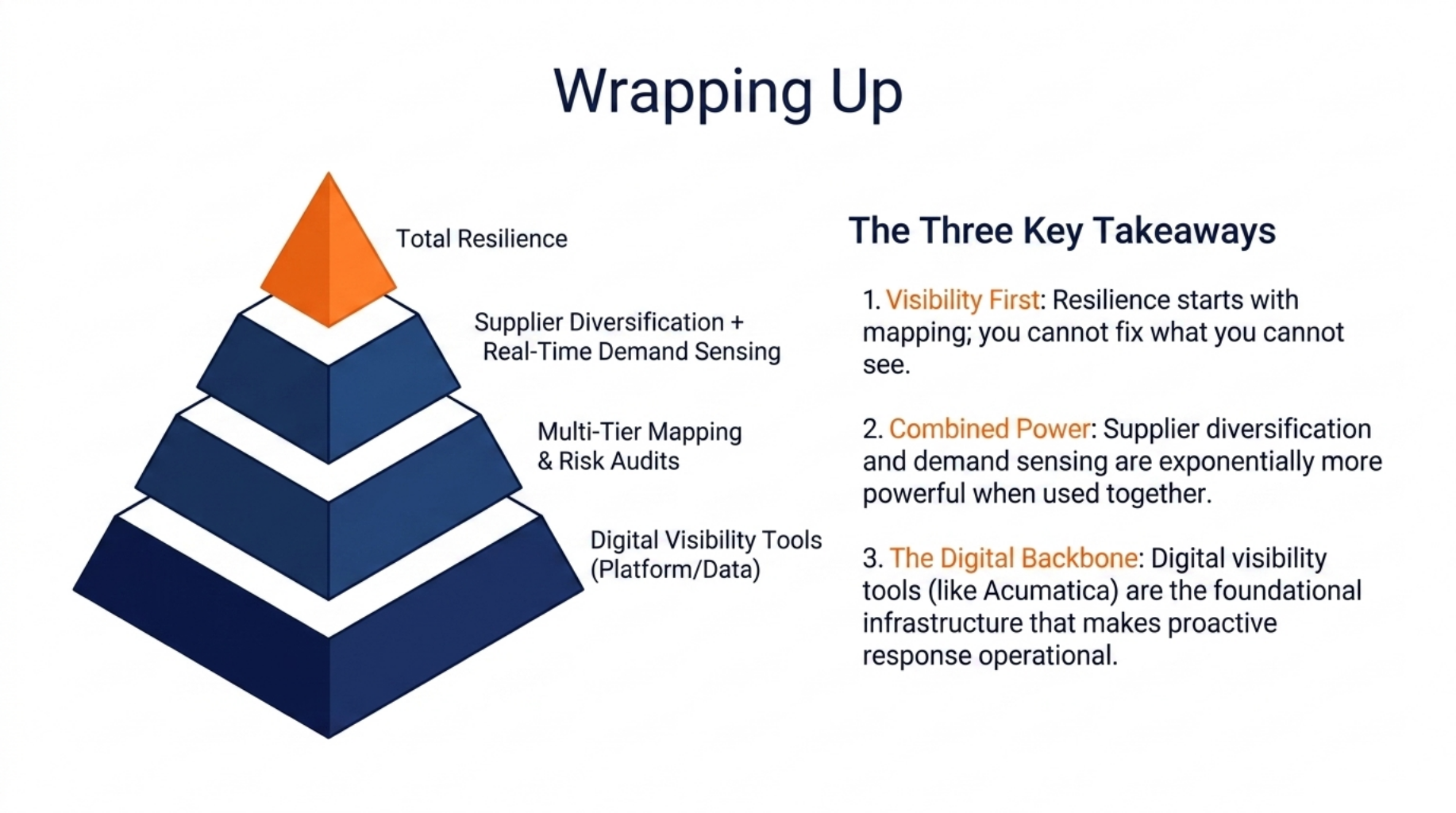
Wrapping Up
Manufacturing supply chain resilience is built in layers. It starts with mapping your full supplier network, not just Tier 1, so you can see where the real risk lives. It strengthens when you diversify suppliers across geography and qualify backups before you need them.
It sharpens when you replace backward-looking forecasts with real-time demand sensing. And it becomes operational when all of that data lives in one connected platform.
The three things to take away:
- Resilience starts with visibility, you cannot fix what you cannot see
- Supplier diversification and demand sensing are most powerful when used together
- Digital visibility tools are the infrastructure that makes everything else work
Ready to see your supply chain in one place? Book a demo with Acumativa and find out how real-time visibility can cut your disruption response time in half.
FAQ
Q1: How do you build a resilient manufacturing supply chain?
A: Build resilience by mapping all supplier tiers, diversifying critical suppliers across regions, and using real-time demand sensing to respond faster to disruptions.
Q2: What are the best supply chain risk management strategies for manufacturers?
A: The most effective strategies combine supplier diversification, supply chain mapping, demand planning, and digital visibility tools to reduce single points of failure.
Q3: What are the nearshoring benefits for manufacturing companies?
A: Nearshoring reduces lead times, lowers freight exposure, and makes it faster to recover from logistics disruptions compared to distant offshore suppliers.
Q4: What is the difference between demand sensing and demand planning?
A: Demand planning uses historical data for long-range forecasts, while demand sensing uses real-time signals to adjust short-term production and procurement decisions.
Q5: How often should manufacturers conduct a supply chain risk audit?
A: Manufacturers should audit their supply chain risk at least once per year and immediately after any significant disruption or major supplier change