



Summary
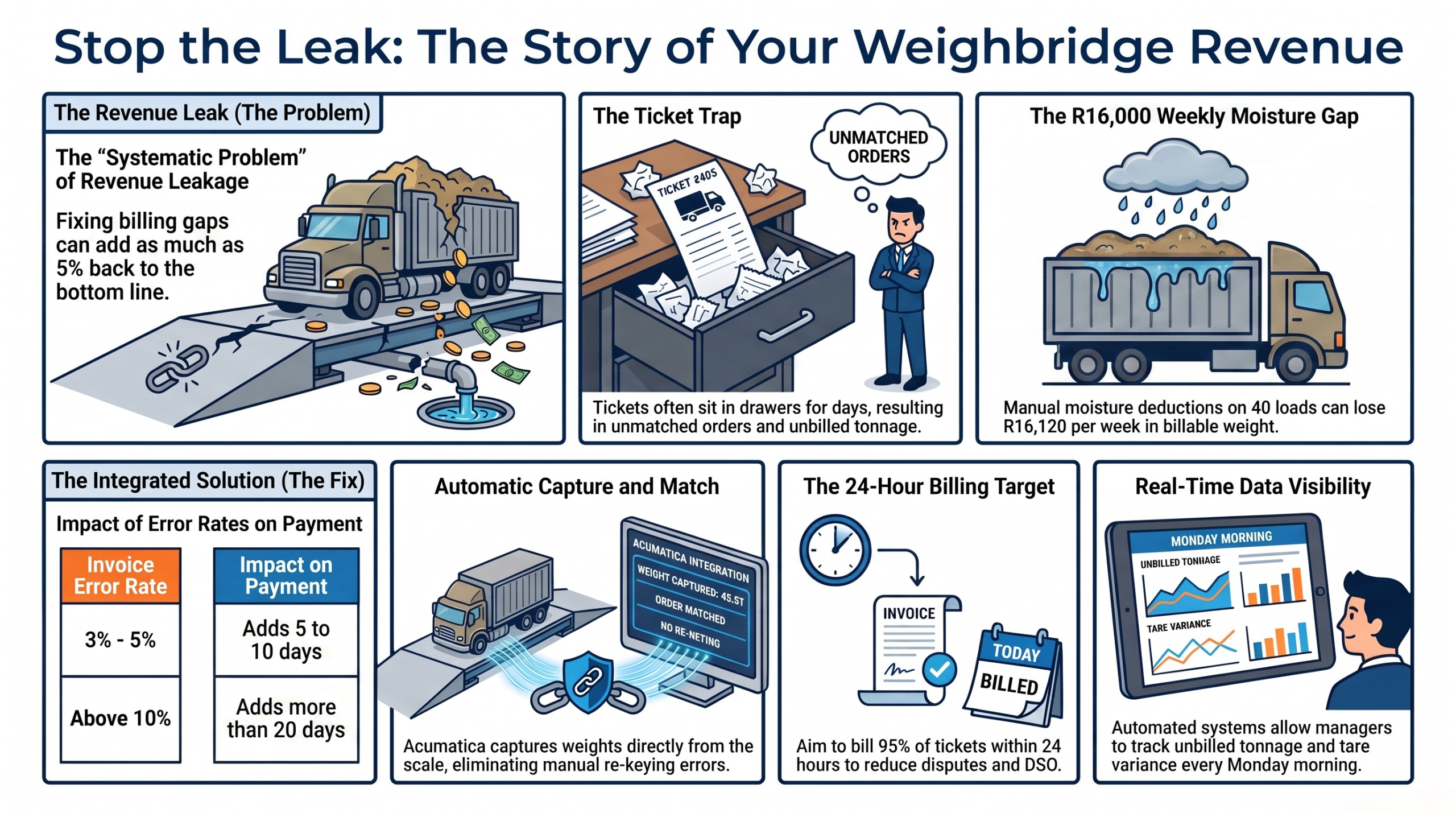
Weighbridge billing gaps can quietly drain significant revenue when tickets are not matched promptly and accurately to sales orders and invoices. Common causes include manual re-keying, missing or inconsistent tare weights, split loads, delayed paperwork, and incorrectly applied deductions or pricing bands. Measuring billing speed, unbilled tonnage, credit notes, and tare variance, and integrating the weighbridge with Acumatica, can close these leaks.
Key points
- Unmatched or delayed weighbridge tickets create unbilled tonnage and cash-flow delays.
- Manual data entry, missing tare weights, split loads, and paperwork gaps cause billing errors.
- Moisture, quality, contamination, and volume-band deductions can reduce billable weight; inconsistent application creates disputes and margin loss.
- Track weekly: tickets billed within 24 hours, unbilled tonnage value, credit-note rate, and tare-weight variance.
- Acumatica can connect weighbridge data to sales orders, pricing rules, and accounts receivable, so each load becomes an accurate invoice line without re-keying.
Introduction
Weighbridge billing accuracy is the gap between the tonnage that leaves your yard and the money that reaches your bank. A truck weighs in. It loads. It weighs out. The driver takes a ticket, the boom lifts, and the load is gone.
Behind that truck, a ticket still has to become an invoice. In most yards, that step runs on paper, memory and a clerk who is already behind. When it fails, nothing breaks and no alarm sounds. You simply bill less than you moved.
This post shows where that money goes. It covers the ticket to invoice process, tare weight variance, split load billing and the deduction rules that turn a weighed load into a smaller billed load. It also shows what to measure, and how Acumatica ties the bridge to the sales order so every load turns into an invoice line.
Where the Money Leaks Between the Weighbridge and the Invoice
A truck leaves the yard. The invoice never follows it.
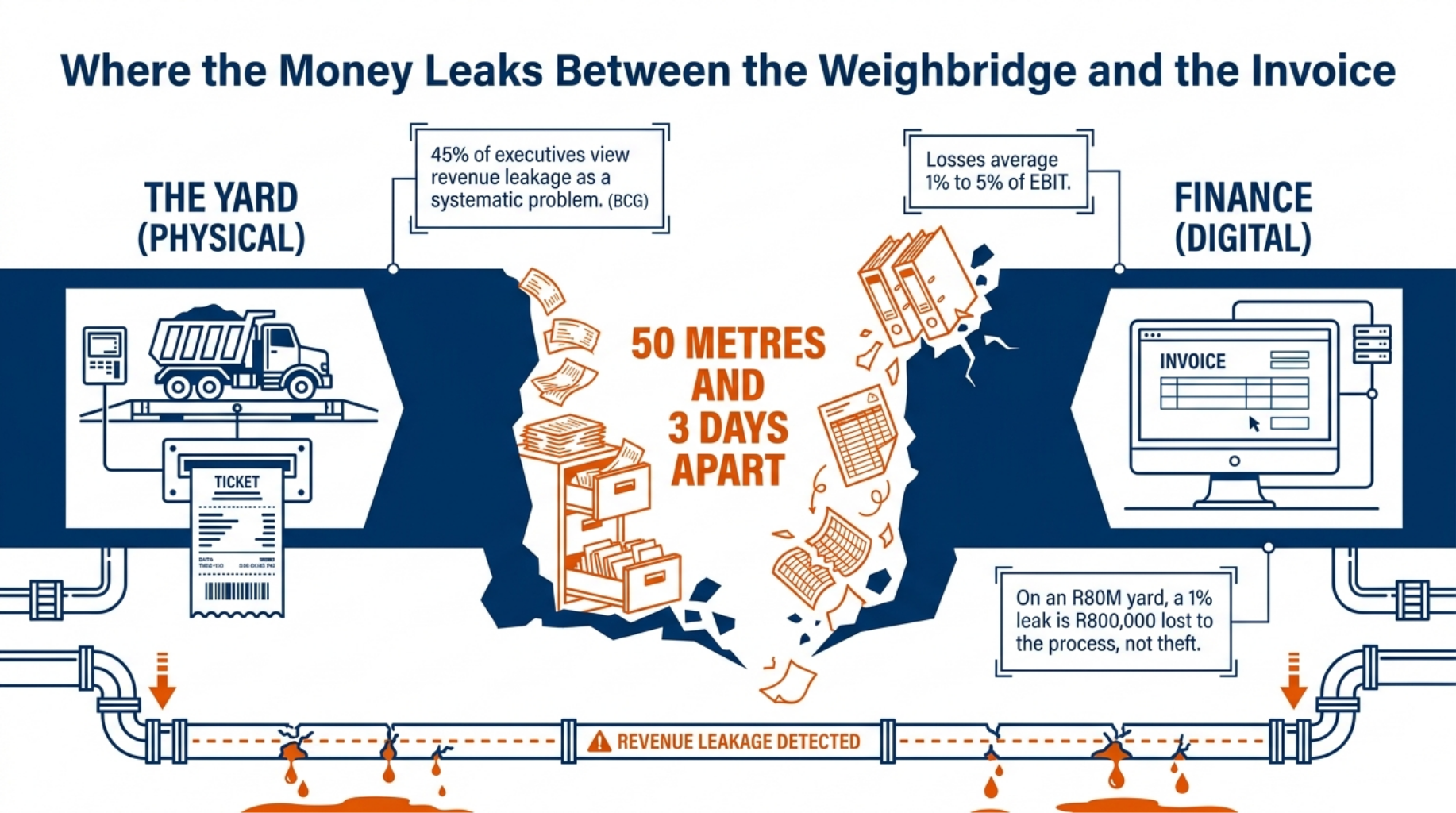
The ticket lives at the bridge. The invoice lives in finance. Those two places are often 50 metres and three days apart.
The weighbridge does its job. It captures a load and prints a number. The order system never hears about it.
So the tickets stack up. They sit in a drawer, a lever arch file or a spreadsheet that one person owns. Month end arrives, someone works through the pile, and whatever cannot be matched to an order gets set aside for later. Later rarely comes.
This is not theft and it is not lazy staff. It is a process with a hole in the middle of it. A Boston Consulting Group survey found that 45% of executives see revenue leakage as a systematic problem in their companies, and BCG estimates that fixing it can add as much as 5% back to the bottom line. Other research puts the loss at 1% to 5% of earnings before interest and tax. On a yard turning over R80 million, even the low end is R800,000 that nobody budgeted to lose.
Manual Re-Keying and Missing Tare Weights
Every ticket typed twice is a chance to type it wrong. The bridge operator writes 32.46 tonnes. The billing clerk types 32.4, or 23.46, or the right number against the wrong customer.
A missing tare weight is worse. Without it, net weight becomes a guess, and the guess is almost always kind to the customer. Clerks fall back on a standard tare for that truck type, which can sit two or three hundred kilograms above the real figure.
Tare weight variance between trips tells you a lot, but only if someone compares the trips. The same truck weighing 200kg heavier empty on Friday than on Monday is a question worth asking. Nobody asks it because nobody has the two numbers on one screen.
Unmatched Delivery Notes and Split Loads
One order, three trucks, three tickets, and one delivery note that covers two of them. That is a normal Tuesday in quarry and aggregate dispatch.
Split loads break the link back to the order line. A 90 tonne order goes out as four loads across two days from two sites. By the time finance sees the paperwork, matching those pieces to the original line takes a phone call and a good memory.
Drivers hand over paper that finance cannot tie to anything. A ticket with no order number, a delivery note signed by someone whose name nobody can read, or proof of delivery that never came back from the customer at all. Each one becomes unbilled tonnage sitting in the yard.
Even when the ticket does reach the right order, the number on it is rarely the number you bill.
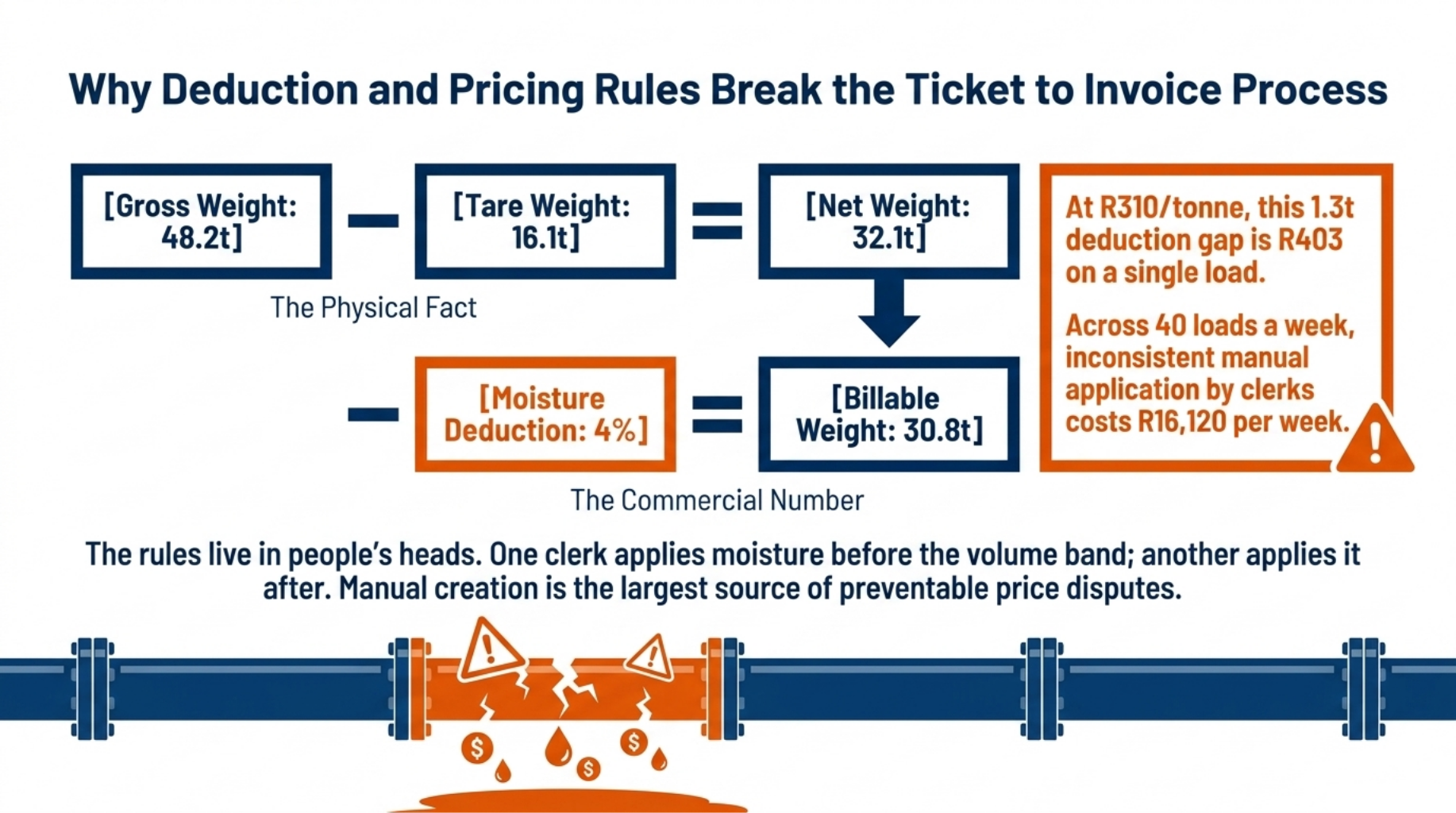
Why Deduction and Pricing Rules Break the Ticket to Invoice Process
The scale says 32 tonnes. The contract says something else.
Gross and net weight capture gives you a physical fact. Bulk material pricing turns that fact into a smaller commercial number.
Here is one worked example. A truck weighs in at 48.2 tonnes and out at 16.1 tonnes, so the net load is 32.1 tonnes. The contract carries a 4% moisture deduction, which brings the billable weight to 30.8 tonnes. At R310 a tonne, that gap is R403 on one load, and 40 loads a week makes it R16,120.
The rules that produce that number usually live in people’s heads. One clerk applies moisture before the volume band. Another applies it after. Both are sure they are right.
Two clerks can bill the same load two ways, and neither version is wrong on purpose. Manual invoice creation is one of the largest sources of preventable disputes, and price mismatches between what the buyer expected and what the invoice shows are among the most common causes.
Moisture and Quality Deductions
Moisture, contamination and grade all cut the billable weight. Wet sand after a Highveld storm can carry several percent of water that the customer has no intention of paying for.
Lab results arrive after the truck has gone. So the invoice waits for a moisture certificate, and the wait can run a week. Meanwhile, the material is already on the customer’s site, poured, crushed or blended into something else.
Deductions applied by hand invite argument. When a customer queries a moisture deduction, your clerk has to prove where the figure came from. If the answer is a note in a diary, you will lose that argument or split the difference.
Price Breaks by Tonnage Band
Bulk material pricing changes once a customer crosses a volume band. The first 500 tonnes go out at R310. Everything past that drops to R295.
Bands run over a month or a full contract, not a single load. So the correct price for today’s load depends on every load that came before it.
Nobody can price load 40 correctly without knowing loads 1 to 39. When the count lives in a spreadsheet, the band gets applied late, applied early, or missed. Applied late, you overcharge and invite a credit note. Missed, you hand back margin that the contract never promised.
Wrong prices are expensive. Slow prices are worse because time turns a billing error into a fight.
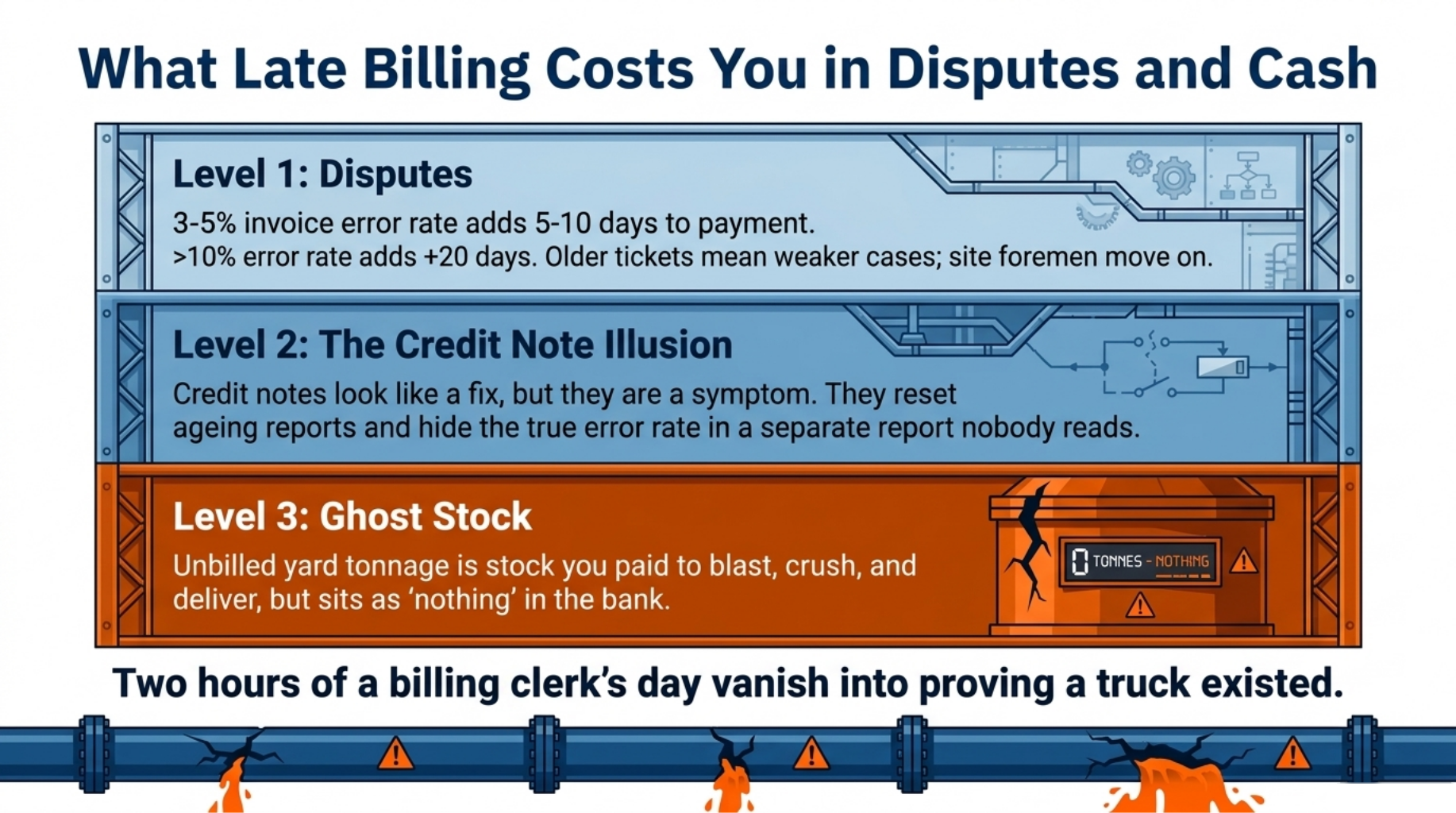
What Late Billing Costs You in Disputes and Cash
A ticket billed in 30 days is a ticket you argue about.
The older the ticket, the weaker your case. A customer who cannot remember the load will not pay for it without a struggle, and after three weeks the site foreman who signed for it may have moved on.
That struggle is common, and most of it is self-inflicted. More than 60% of late payments trace back to administrative errors and the disputes those errors cause. The window to fix them is narrow because invoices still unpaid 30 days after falling due are more likely to stay outstanding past 90 days.
The cost of errors is measurable. An invoice error rate of 3% to 5% adds five to ten days to each disputed invoice, and an error rate above 10% adds more than 20 days. Every dispute restarts the payment clock.
Credit notes look like the fix. They are a symptom. A credit note cancels the argument, resets the ageing on the account, and hides the real error rate from anyone reading the accounts receivable ageing report.
Worse, credit notes make the process look healthy. Invoices go out, invoices get paid, and the reversals sit in a different report that nobody opens on a Monday.
Then there is cash. Unbilled tonnage in the yard is stock you have already lost, converted into product you have already delivered, sitting as nothing at all in your bank account. You paid for the diesel, the blasting, the crusher and the driver, and none of it has come back.
The internal cost is quiet but real. When a load is queried, someone pulls tickets, phones the bridge operator and photographs paperwork to email to the customer. Two hours of a billing clerk’s day disappear into proving that a truck existed.
Sales feels it last. When credit notes keep landing against their accounts, reps stop trusting the margin numbers in front of them. They start discounting from a figure they suspect is wrong, which makes the next quarter worse.
You cannot fix any of this by asking people to try harder. You fix it by putting four numbers on a page.
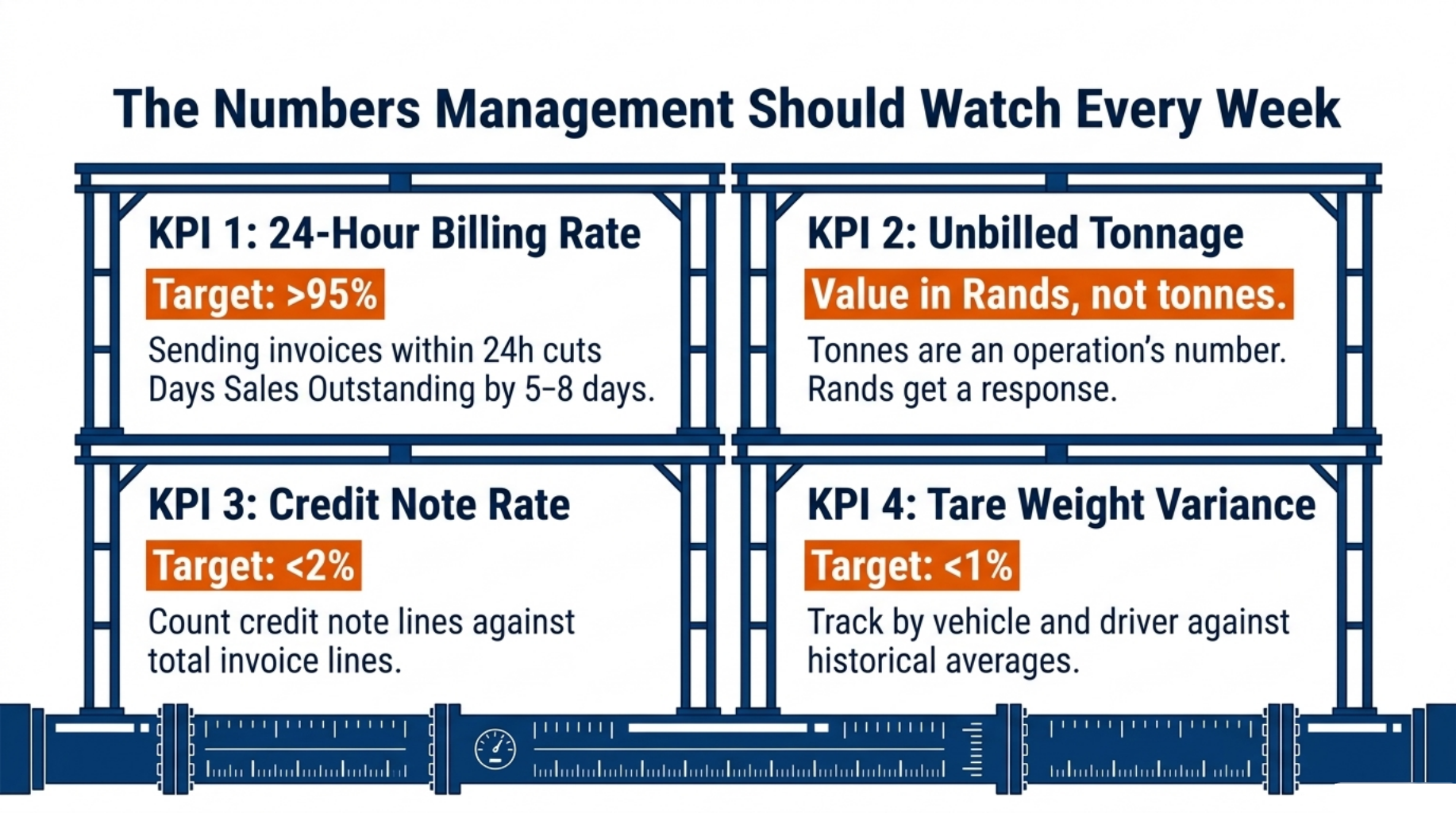
The Numbers Management Should Watch Every Week
You cannot fix what nobody reports on Monday morning.
Ask for these four measures by name, every week, per site.
- Tickets billed within 24 hours. Show it as a share of all tickets, not a raw count. Sending invoices within 24 hours of delivery cuts days sales outstanding by five to eight days on its own.
- Unbilled tonnage in the yard. Value it in rands, not tonnes. Tonnes are an operation’s number. Rands get a response.
- Credit note rate. Count credit note lines against total invoice lines, monthly.
- Tare weight variance. Track it by vehicle and by driver, against that vehicle’s own average.
Set targets before you start: 95% billed within 24 hours, credit note rate under 2%, tare variance inside 1%.
How to Read These Numbers Together
One number alone will mislead you. Read them in pairs.
A high 24-hour billing rate with a rising credit note rate means speed without accuracy. Your team is clearing tickets to hit the target and cleaning up the damage later. That is not an improvement, it is a reshuffle.
A low billing rate with a low credit note rate means the opposite. Your clerks are careful, and the process is slow because they are checking things the system should check for them. That is a tooling problem, not a people problem.
Unbilled tonnage climbing on one site while the others hold steady points at one process. Maybe that bridge lost its network link, or the operator is new, or one customer sends trucks without order numbers. Fix the site, not the company.
Tare variance that spikes for a single vehicle usually means a mechanical fault or a load left on the bed. Tare variance that spikes for a single driver is a different conversation.
Track the trend for a quarter before you judge anyone. One bad week means a public holiday or a broken printer.
Measuring the gap tells you how much you are losing. Closing it takes a system that carries the ticket all the way through.
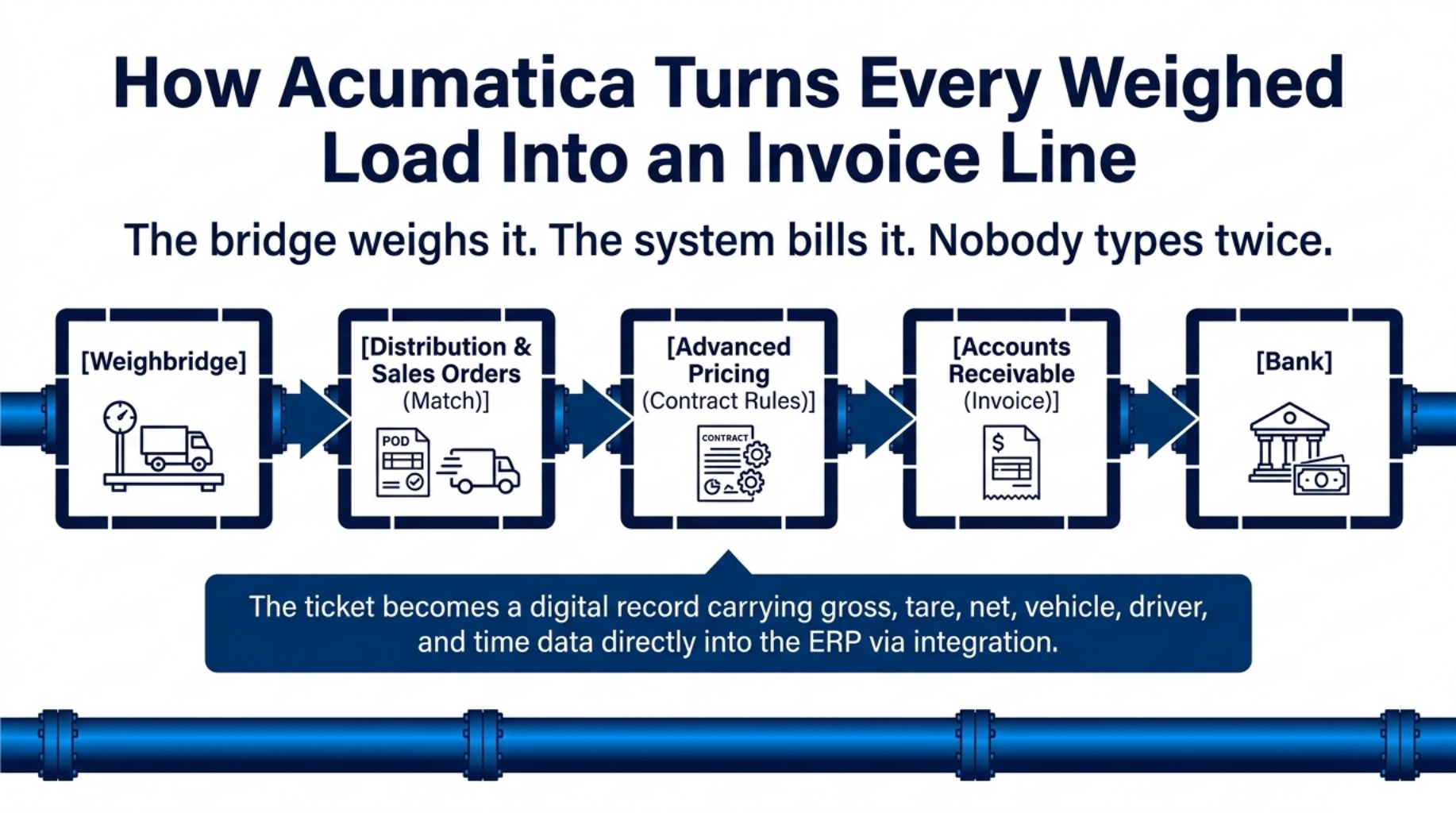
How Acumatica Turns Every Weighed Load Into an Invoice Line
The bridge weighs it. The system bills it. Nobody types twice.
Acumatica connects the weighbridge to the sales order, the pricing rules and accounts receivable. The flow runs in one line: capture, match, price, invoice, collect.
The bridge feeds Acumatica through an integration, so the ticket becomes a record instead of paper. It carries the gross weight, the tare, the net, the vehicle, the driver and the time.
Each ticket lands against a sales order line before the truck reaches the gate. The modules doing the work are Distribution and Sales Orders for the match, Advanced Pricing for contract rules, and Accounts Receivable for the invoice.
The result is simple to test. Ask any vendor to show you a customer in quarrying, agriculture or waste, and ask what their billing cycle looked like before and after.
Capture and Match at the Gate
Gross and net weight capture flows straight into the order. No second keystroke, so no second chance to fat finger a number.
The system flags a ticket with no matching order before it is filed. The bridge operator sees the problem while the truck is still on the pad, which is the only moment when fixing it is cheap.
Split loads roll up against one order line without hand sorting. Four tickets across two days and two sites attach to the same 90 tonne line, and the line shows what has been delivered and what is still owed. Delivery note matching stops being a memory exercise.
Price, Invoice and Collect Without Re-Keying
Contract deductions and tonnage bands apply from stored rules, not memory. The moisture percentage, the grade adjustment and the volume break are set up once against the customer contract and applied the same way on every load, on every shift.
Accounts receivable picks up the invoice as soon as the load is confirmed. Same day, not month end, so the customer receives it while the material is still visible on their site.
Every invoice line carries the ticket behind it. When a query comes in, your clerk opens the line, sees the ticket, the weights, the time and the signature, and answers in two minutes instead of two hours.
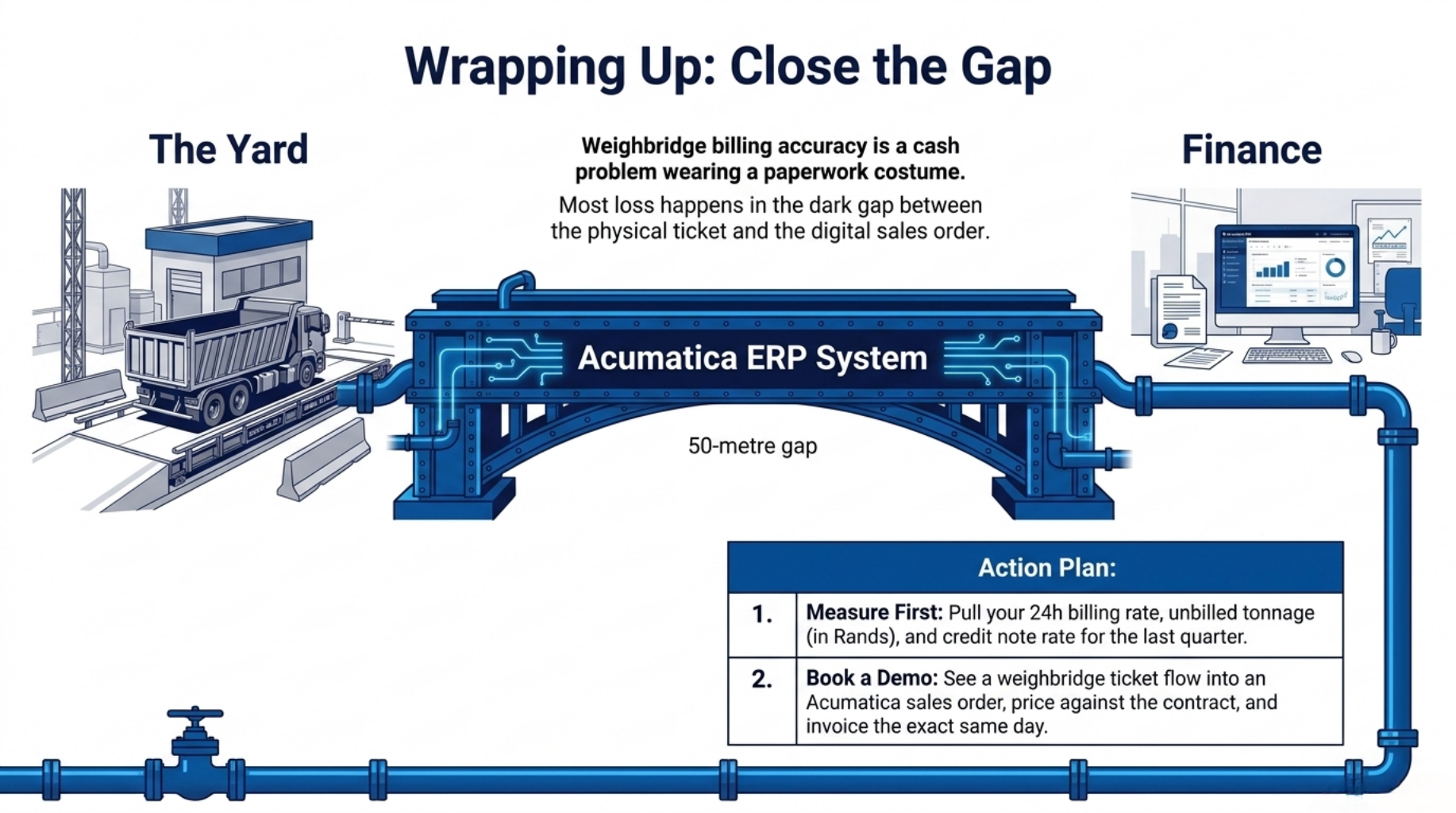
Wrapping Up
Weighbridge billing accuracy is a cash problem wearing a paperwork costume. The tonnes left. The invoice did not.
Most of the loss happens in the gap between the ticket and the sales order, where nobody is watching and no report exists.
Start by measuring. Pull tickets billed within 24 hours, unbilled tonnage valued in rands, and your credit note rate for the last quarter. Those three numbers will tell you the size of the hole before you spend a cent fixing it.
Then close it. Book a demo to see a weighbridge ticket flow into an Acumatica sales order, price against the contract and invoice the same day the load leaves your yard.
FAQ
Q1: What is weighbridge billing accuracy?
A: It is the share of weighed loads that reach the customer as a correct invoice, priced to contract and issued on time.
Q2: Why do weighbridge tickets go unbilled?
A: Tickets go unbilled when they are never matched to a sales order, most often after split loads, missing tare weights or manual re-keying.
Q3: How do you calculate net billable weight on a bulk load?
A: Subtract the tare weight from the gross weight, then apply the contract deductions for moisture, grade or contamination.
Q4: How fast should a weighbridge ticket become an invoice?
A: Aim to bill 95 percent of tickets within 24 hours of the load leaving site because dispute rates climb with every day of delay.
Q5: Can Acumatica connect to an existing weighbridge system?
A: Yes, Acumatica can take weight data from the weighbridge and match it to sales orders, pricing rules and accounts receivable without manual capture.