




Short summary
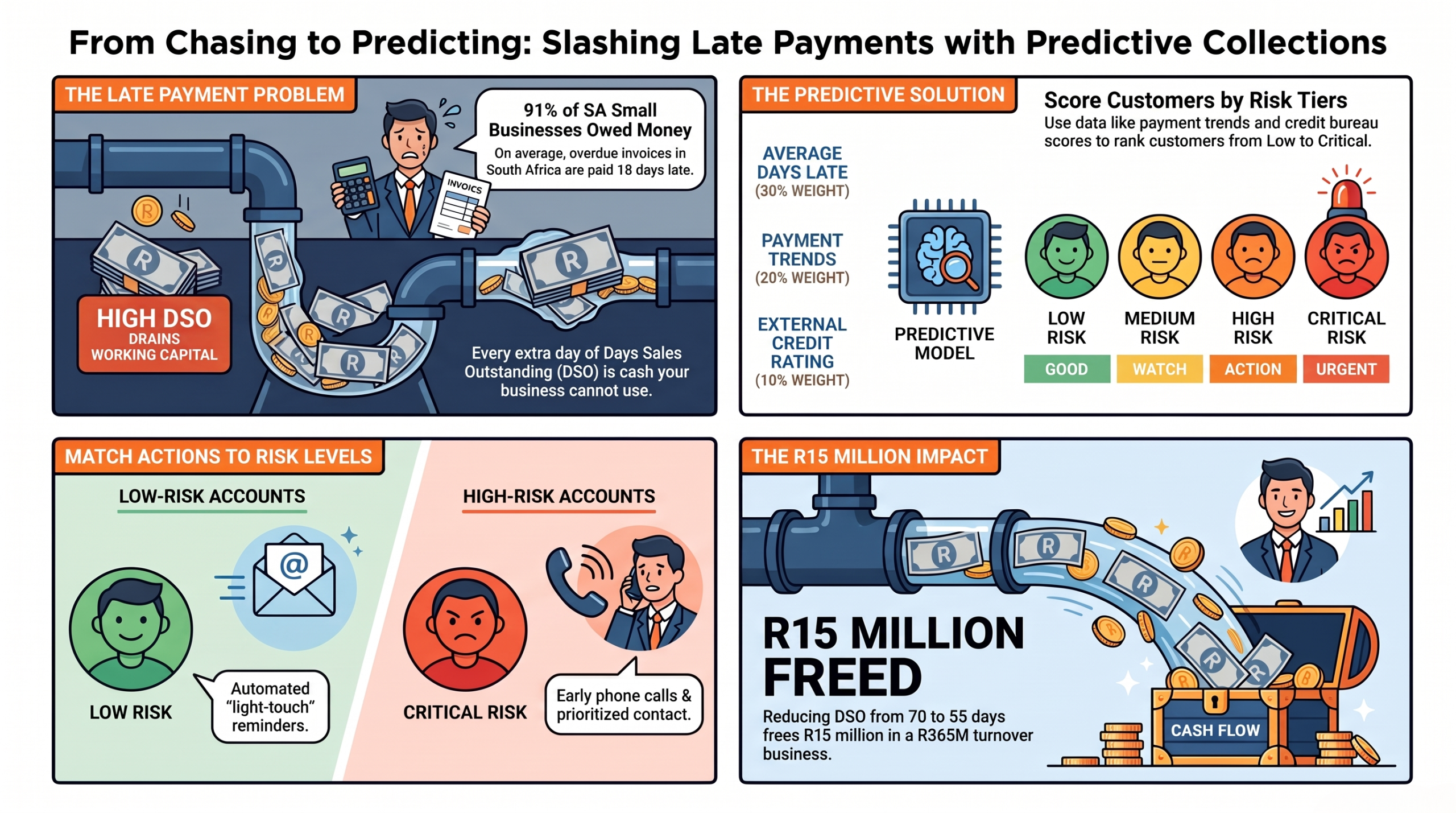
Predictive collections use payment history, customer behavior, disputes, credit exposure, and external credit data to identify which invoices are likely to be paid late. By prioritising high-risk accounts, automating appropriate reminders, and resolving disputes earlier, South African finance teams can reduce DSO, free working capital, and improve customer relationships.
Key points
- Late payments are widespread: South African businesses report widespread overdue invoices, while government departments also carry substantial unpaid invoices.
- DSO directly affects cash flow: In the example, reducing DSO from 70 to 55 days frees R15 million and could save about R1.6 million annually in overdraft interest.
- Risk-based collections outperform generic reminders: Customers can be scored using payment delays, payment trends, credit utilisation, exposure, disputes, and credit-bureau data.
- Match action to risk: Low-risk customers receive light reminders; high- and critical-risk accounts receive calls, credit reviews, payment plans, or credit holds.
- Acumatica can support the process: Its credit limits, dunning workflows, aging reports, payment links, dashboards, and integrations help automate collections and monitor DSO, CEI, bad debt, and aging performance.
Introduction
Predictive collections help South African finance teams see which invoices will run late and act before cash gets stuck. Instead of chasing every overdue account in the same order, you use data to know who needs a nudge, who needs a call, and who will pay on time without help.
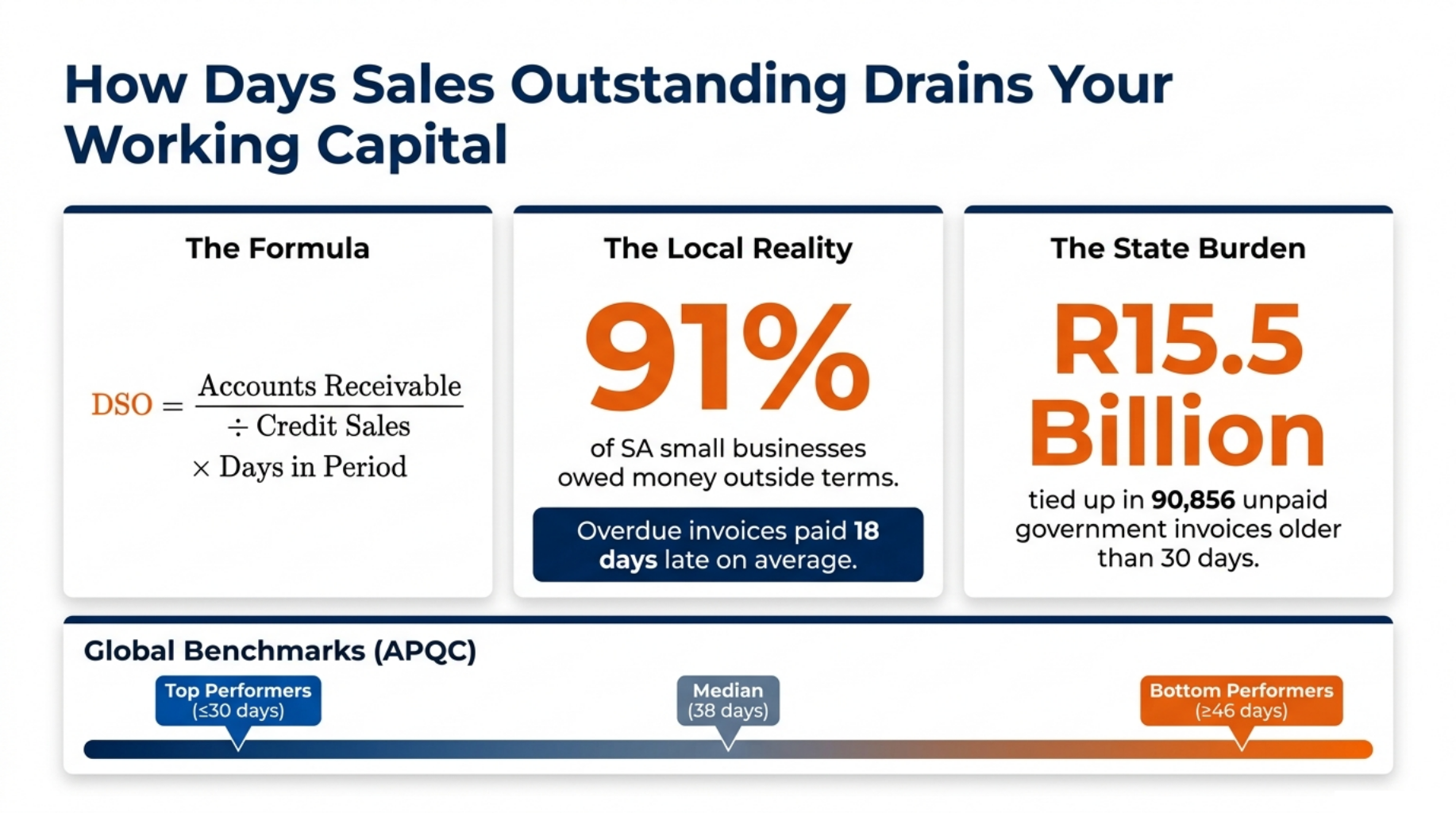
Late payment is part of daily life for local businesses. Xero research found that 91% of South African small businesses are owed money outside their payment terms, and overdue invoices are paid 18 days late on average. Even the state struggles: National Treasury reported 90,856 government invoices older than 30 days still unpaid in a recent quarter, worth R15.5 billion.
This guide shows you how days sales outstanding hurts working capital and why old collection methods fall short. You will get a risk scoring framework, a worked DSO example in rand, a policy checklist for local customer segments, and a clear path to run it all in Acumatica.
How Days Sales Outstanding Drains Your Working Capital
Every extra day of DSO is cash your business cannot use.
Days sales outstanding (DSO) tells you how many days it takes, on average, to turn a sale into cash. The formula is simple:
DSO = (accounts receivable ÷ credit sales) × days in period
So how do you compare? Global benchmarks from APQC show top performers get paid in 30 days or less, bottom performers take 46 days or longer, and the median sits at 38 days. Many South African firms offer 30 day terms, so a DSO well above that is a warning sign.
A high DSO hurts in three ways. First, you may need an overdraft to pay staff, SARS, and suppliers while customers hold your cash. With the prime lending rate at 10.5%, that borrowing is not cheap. Second, the longer an invoice ages, the less likely you are to collect it at all.
Where DSO Fits in the Cash Conversion Cycle
The cash conversion cycle shows how long cash is tied up in your operations. It works like this: DSO plus days inventory outstanding, minus days payables outstanding.
Of those three parts, DSO is often the fastest to fix. Cutting stock takes months of planning, and stretching supplier terms can damage trust with the smaller local businesses you rely on. Collecting faster from customers frees cash you have already earned.
So if DSO matters this much, why do so many teams struggle to bring it down?
Why Traditional Collections Fall Short
Generic reminders treat your best and worst payers the same.
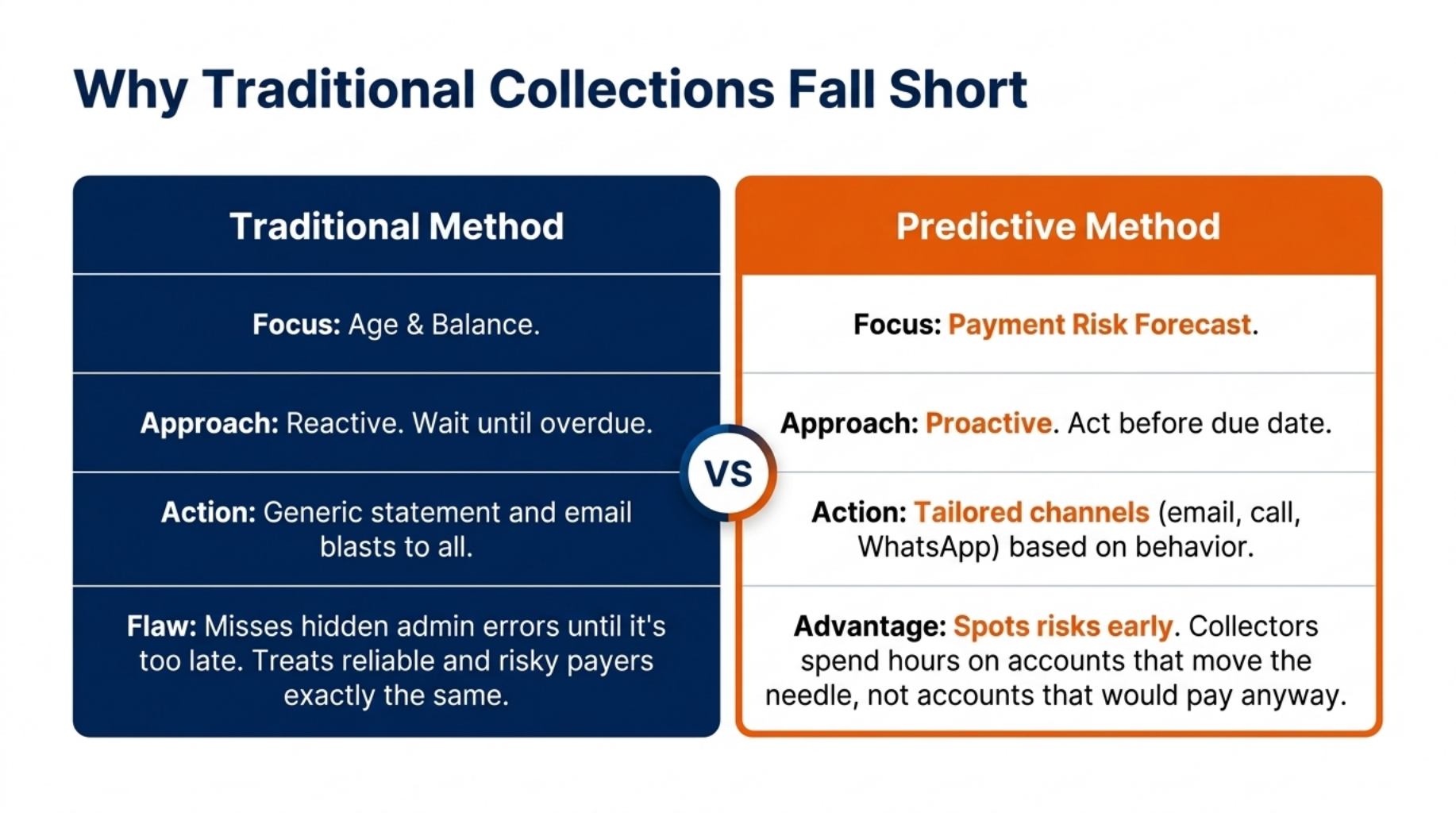
Most collections teams follow a familiar routine. They pull an age analysis, copy it into a spreadsheet, and sort by invoice age or balance. Then they send the same statement and reminder email to everyone and phone whoever feels most urgent.
The trouble is that age and balance do not tell you risk. A large retailer that always pays on day 32 gets the same attention as a small customer sliding into trouble. Collectors spend hours chasing accounts that would have paid anyway.
Worse, warning signs only show up once invoices are overdue. Many delays are simple admin problems, not cash problems. When National Treasury looked at why departments paid late, the most common reasons were misfiled, misplaced, or unrecorded invoices and weak internal controls. A generic reminder does not fix that. Predictive models help you spot it early.
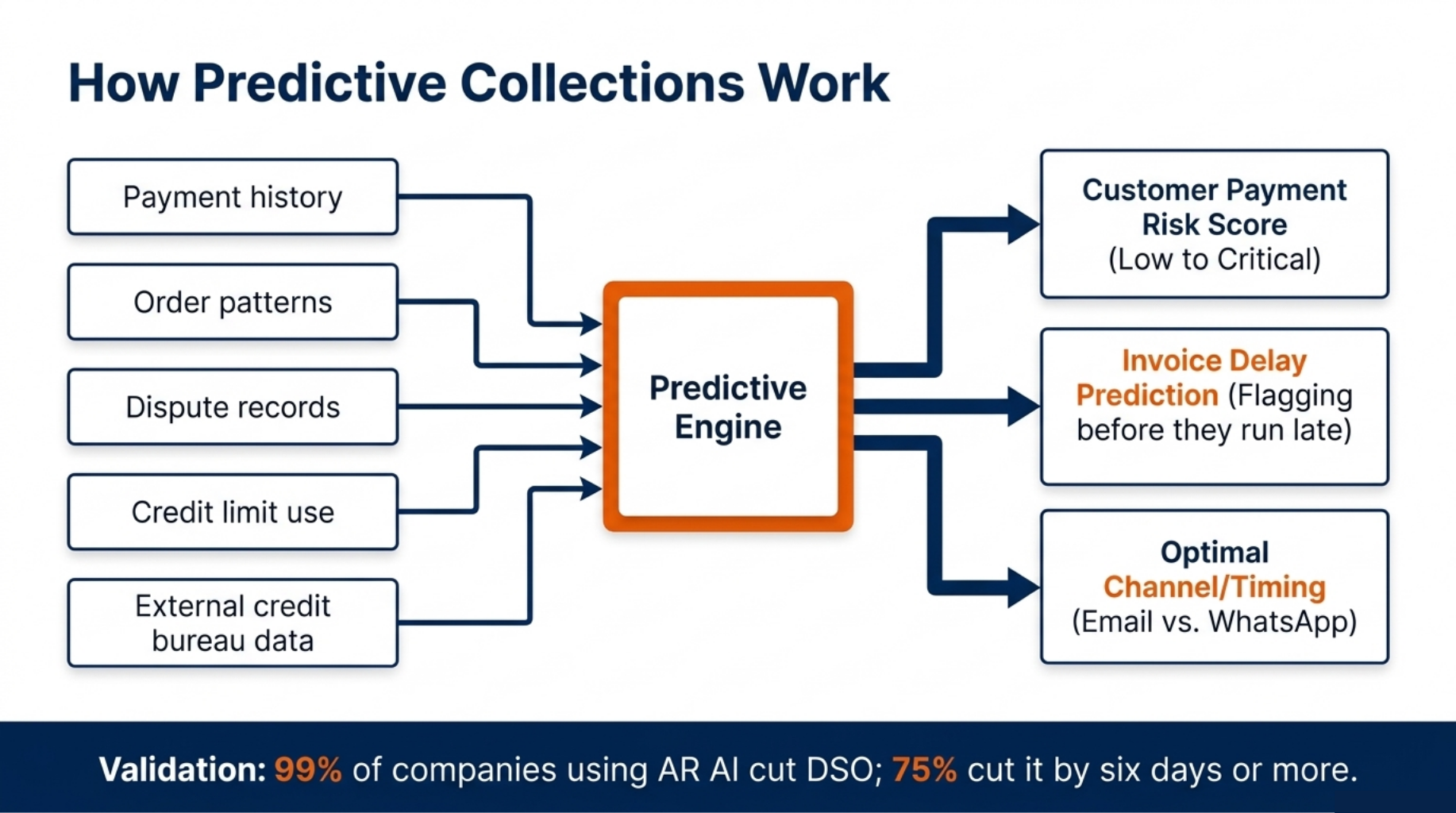
How Predictive Collections Work
Know who will pay late before the due date arrives.
Predictive collections use your past payment data to forecast what will happen next. The model looks at how each customer has paid before and spots patterns a person would miss.
It draws on payment history, order patterns, dispute records, credit limit use, and credit bureau data. From this, it gives each customer and each open invoice a payment risk score. The scores update as new payments, orders, and disputes come in, so your view stays current.
The results hold up. A Wakefield Research study for Billtrust surveyed 500 finance leaders at large North American firms and found that 99% of companies using AI in accounts receivable had cut their DSO, with 75% cutting it by six days or more. The same methods apply to South African businesses of any size.
The model gives you three useful outputs.
Scoring Customers by Payment Risk
Each customer gets a score that places them in a tier, from low to critical risk. A customer who pays on time every month sits at the low end. One who has started paying later each quarter moves up the scale.
This credit risk scoring does more than guide collections. It also helps you set credit limits and payment terms for new orders, so you stop adding risk before it grows.
Flagging Invoices Likely to Run Late
The model predicts how many days late each open invoice is likely to be. That means you can see a problem before the due date, not after.
For example, if an invoice due in ten days has a high chance of running 20 days late, your team can reach out now. A quick check that the invoice has a valid order number and reached the right person often solves the issue.
Choosing the Best Time and Channel
The model also learns when and how each customer tends to respond. Some pay after an email at month end. Others ignore email and only act after a phone call or a WhatsApp message.
Based on past results, the system suggests the best channel and timing for each follow up. Your team stops guessing and starts using what works.
To put these scores to use, you need a clear framework that links each score to an action.
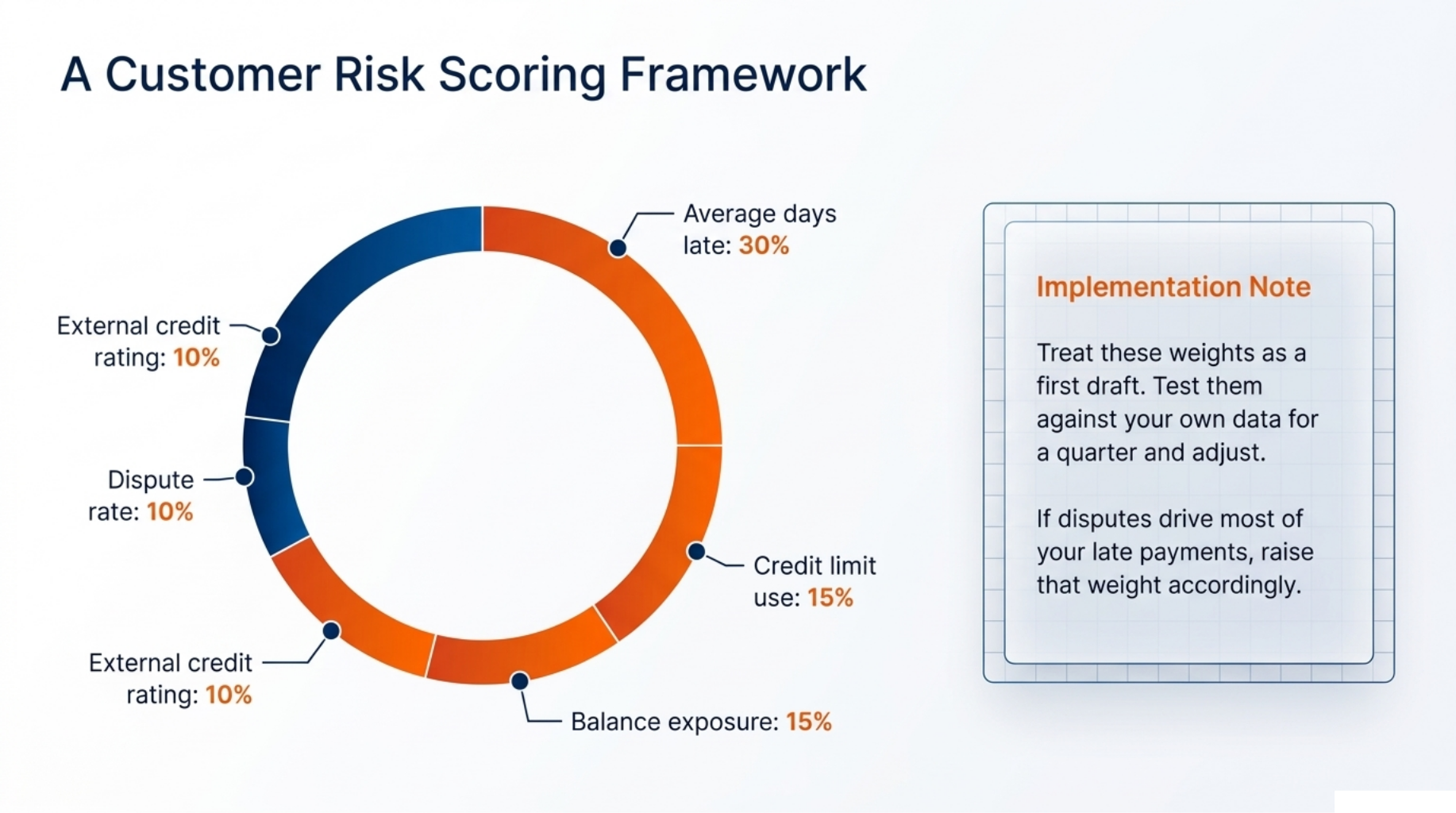
A Customer Risk Scoring Framework
Score risk with data, then match the action to the score.
A good framework uses a handful of factors, each with a weight. For the external rating, South Africa has four main registered credit bureaus: TransUnion, Experian, Compuscan, and XDS, all regulated by the National Credit Regulator. TransUnion and XDS both offer business credit data. Here is a starting model you can copy:
| Factor | What it measures | Suggested weight |
|---|---|---|
| Average days late | How late the customer pays on average | 30% |
| Payment trend | Whether payments are getting faster or slower | 20% |
| Credit limit use | How much of their limit they are using | 15% |
| Balance exposure | How much they owe you in total | 15% |
| Dispute rate | How often they dispute invoices | 10% |
| External credit rating | Their business score from a credit bureau | 10% |
Score each factor from 1 to 10, multiply by the weight, and add the results. Then place each customer in one of four tiers: Low, Medium, High, or Critical.
Treat these weights as a first draft. Test them against your own data for a quarter and adjust. If disputes drive most of your late payments, raise that weight.
Matching Actions to Each Risk Tier
Each tier needs a set action so your team knows what to do:
- Low: Light touch reminders and standard payment terms.
- Medium: An early reminder a few days before the due date.
- High: A phone call before the due date, shorter terms, and a credit review.
- Critical: Credit hold, escalation to a manager, and a payment plan.
With tiers in place, automation can carry out most of this work for you.
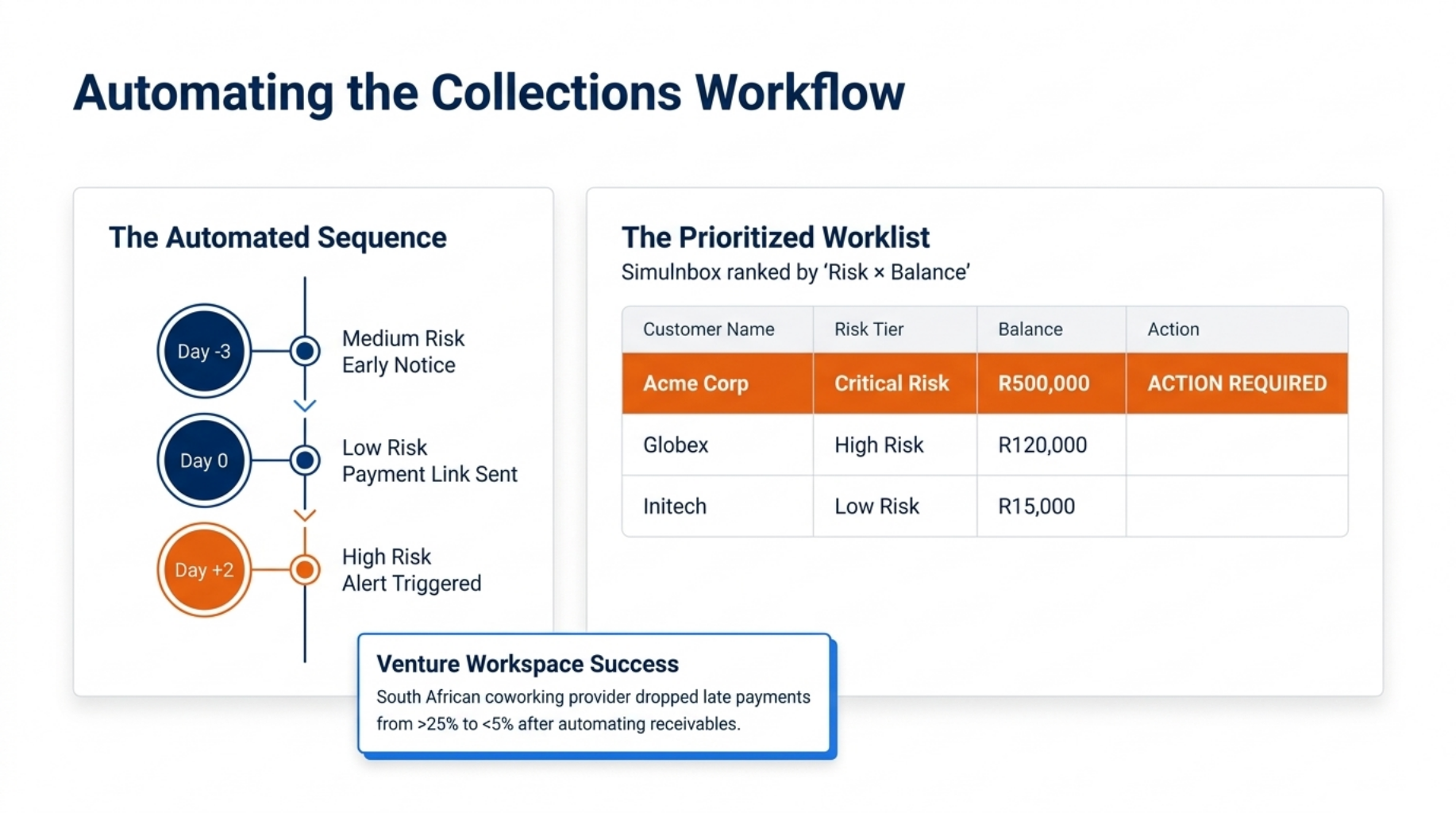
Automating the Collections Workflow
Let automation handle the routine so people can handle relationships.
Accounts receivable automation covers three jobs: building worklists, sending reminders, and routing disputes. Each one saves your team time for work that needs a human.
Reminders go out on a schedule set by risk tier. Low risk customers might get one friendly note on the due date with a payment link. High risk customers get an earlier reminder and a call slot on a collector’s list.
Local businesses are already seeing the gains. Venture Workspace, a South African coworking provider, had more than 25% of payments coming in late. After automating its receivables and tracking DSO, late payments dropped to under 5%. Keep people in charge of key and sensitive accounts, though. Automation should support your team, not replace its judgement.
Using AI to Prioritise Customer Collections
A prioritised worklist ranks accounts by risk multiplied by balance, not by age alone. A R500,000 invoice with high risk rises to the top, while a small, low risk invoice drops down.
Each morning, collectors open a list that starts with the calls most likely to bring in cash. They spend their best hours where it counts.
Handling Disputes Faster
Disputes stall payment until someone fixes them. Tag each dispute with a reason code, such as pricing error, missing order number, or short delivery.
Over time, the codes show you root causes you can fix at the source. Fast dispute handling also stops invoices from aging while they wait in someone’s inbox.
Once the workflow runs, you need the right numbers to know if it works.
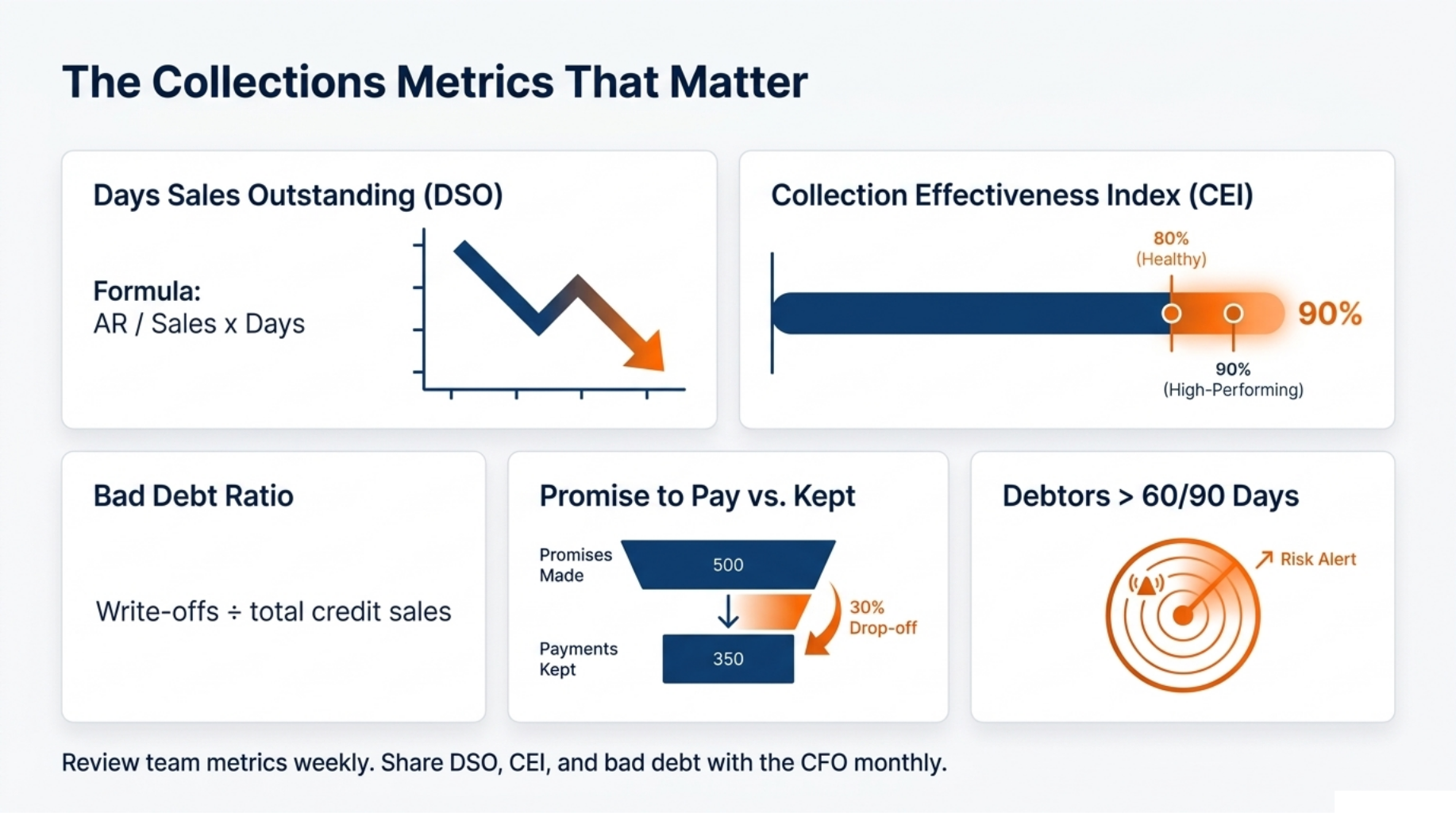
The Collections Metrics That Matter
You cannot improve what you do not measure each week.
Track five metrics. Any more and the signal gets lost.
- DSO: How fast you turn sales into cash. Use the formula from earlier.
- Collection effectiveness index (CEI): (Opening debtors + credit sales − closing total debtors) ÷ (opening debtors + credit sales − closing current debtors) × 100. This shows the share of collectable debtors you brought in. A CEI above 80% is generally seen as strong, and 90% or higher points to a high performing team.
- Bad debt ratio: Write-offs ÷ total credit sales. This tells you how much revenue you lose for good.
- Promise to pay rate and promise kept rate: The share of contacts that end in a promise, and the share of promises customers keep.
- Share of debtors past 60 or 90 days: Your early warning for bad debt.
Review team metrics, such as promises and aging, each week. Share DSO, CEI, and bad debt with your financial director or CFO each month.
Now let us see what these numbers look like when predictive collections start to work.
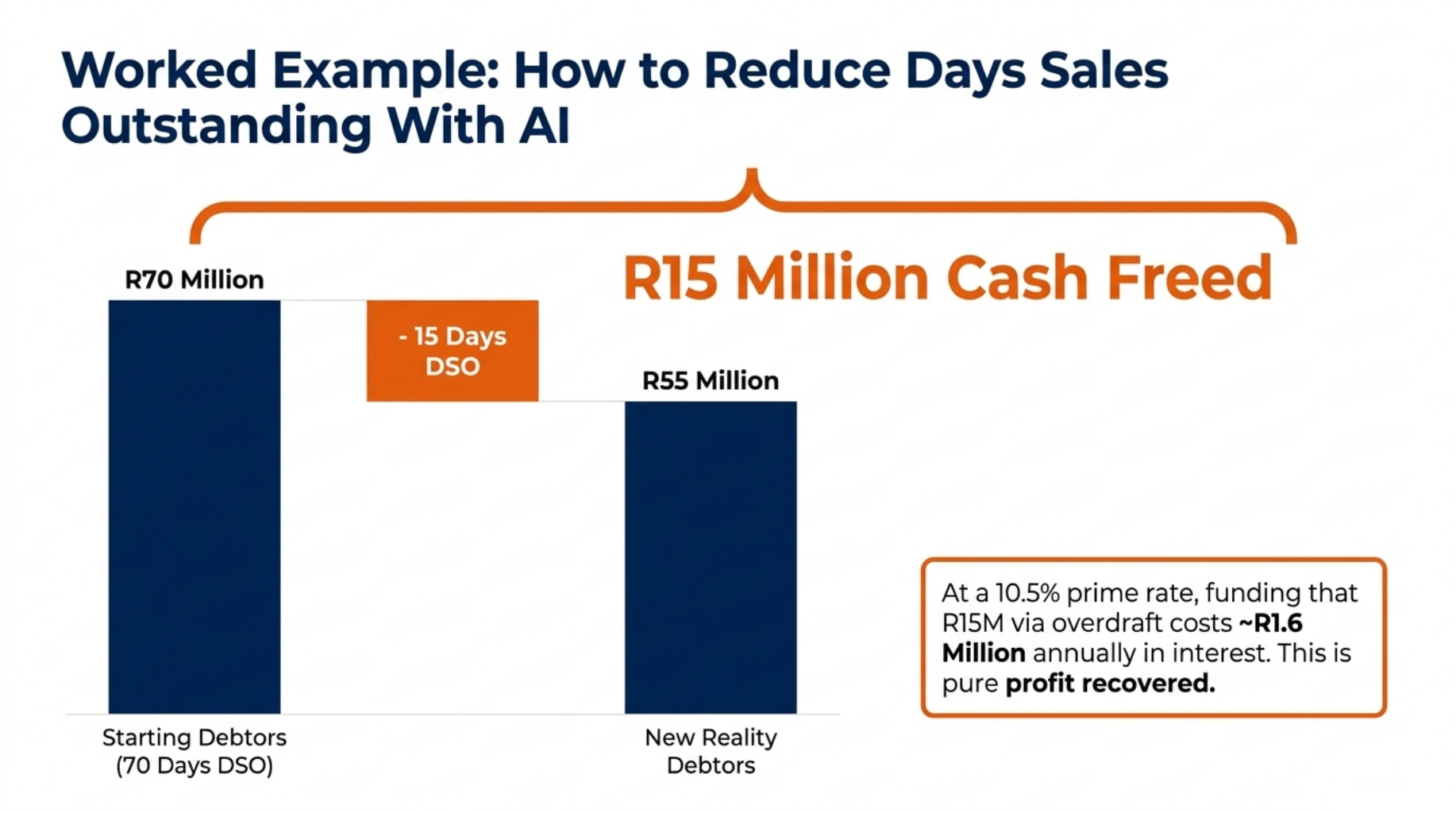
Worked Example: How to Reduce Days Sales Outstanding With AI
Fifteen fewer days of DSO can free R15 million.
These are sample figures to show the math. Your numbers will differ.
- Start: A South African distributor has R365 million in annual credit sales and R70 million in debtors.
- Current DSO: (R70M ÷ R365M) × 365 = 70 days.
- Daily sales: R365M ÷ 365 = R1 million. So every day of DSO holds R1 million in cash.
- Target: After six months of predictive collections, DSO falls to 55 days.
- New debtors: 55 × R1M = R55 million.
- Cash freed: R70M − R55M = R15 million.
If that R15 million was funded by an overdraft at prime, the business also saves around R1.6 million a year in interest. The gain comes from fewer invoices slipping past due, faster dispute fixes, and collectors focused on the accounts that move the needle.
To hold these gains, you need policies that fit each type of customer.
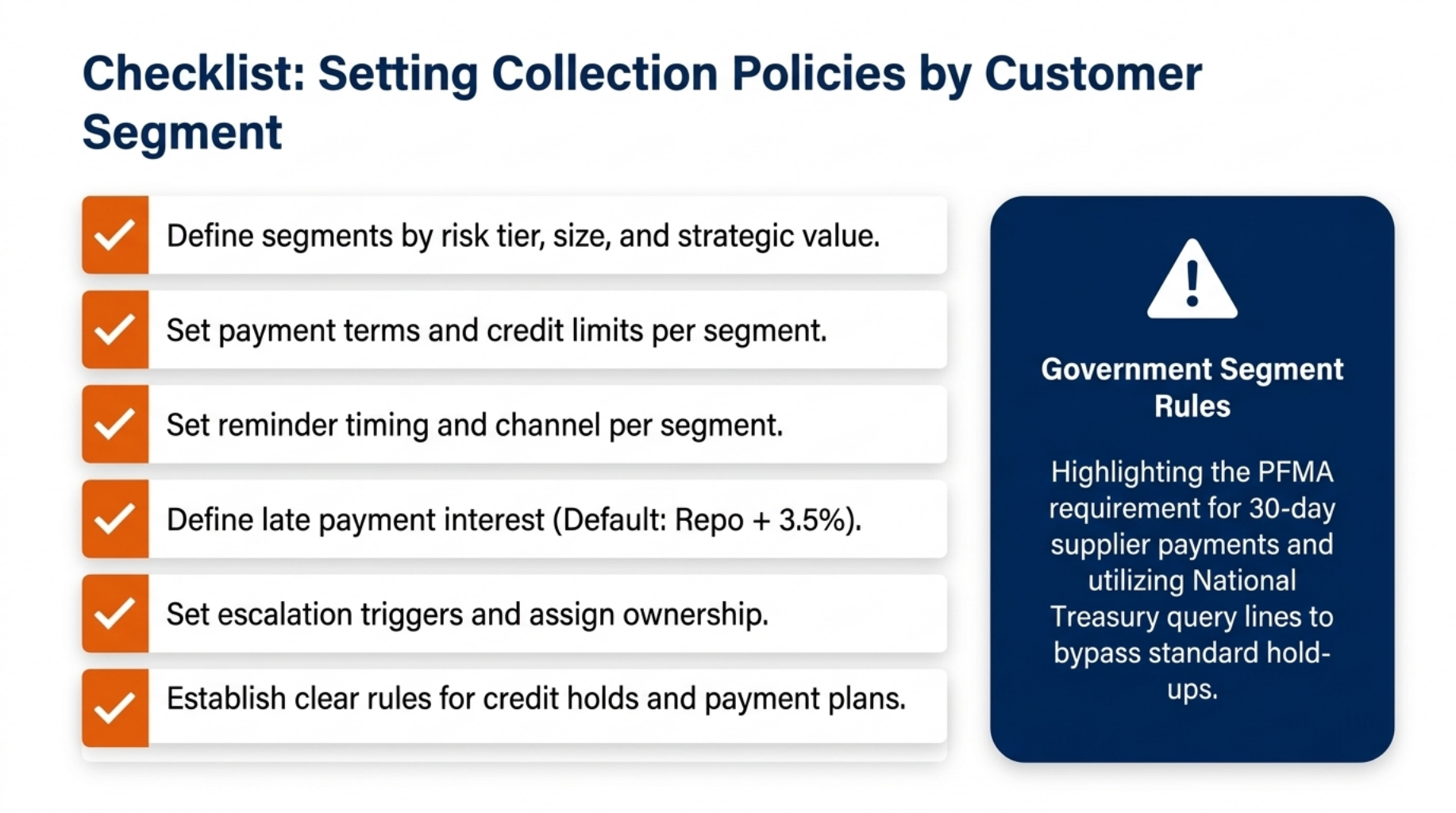
Checklist: Setting Collection Policies by Customer Segment
One policy for every customer leaves cash on the table.
Use this checklist to build a policy for each segment. Tie every item to the risk tiers from your framework.
- Define segments by risk tier, customer size, and strategic value
- Create a separate segment for government and state owned customers
- Set payment terms and credit limits for each segment
- Set reminder timing and channel for each segment
- Set late payment interest in your terms and conditions
- Set escalation triggers and name who owns each one
- Set rules for credit hold and payment plans
- Review each policy every quarter against your metrics
Government customers need their own rules. The PFMA requires national and provincial departments to pay suppliers within 30 days, and National Treasury runs a dedicated query line for suppliers who are paid late. For late interest, the Prescribed Rate of Interest Act sets the default rate at repo plus 3.5% where your contract is silent, so state your own terms clearly.
Good policies also protect something just as valuable as cash: your customer relationships.
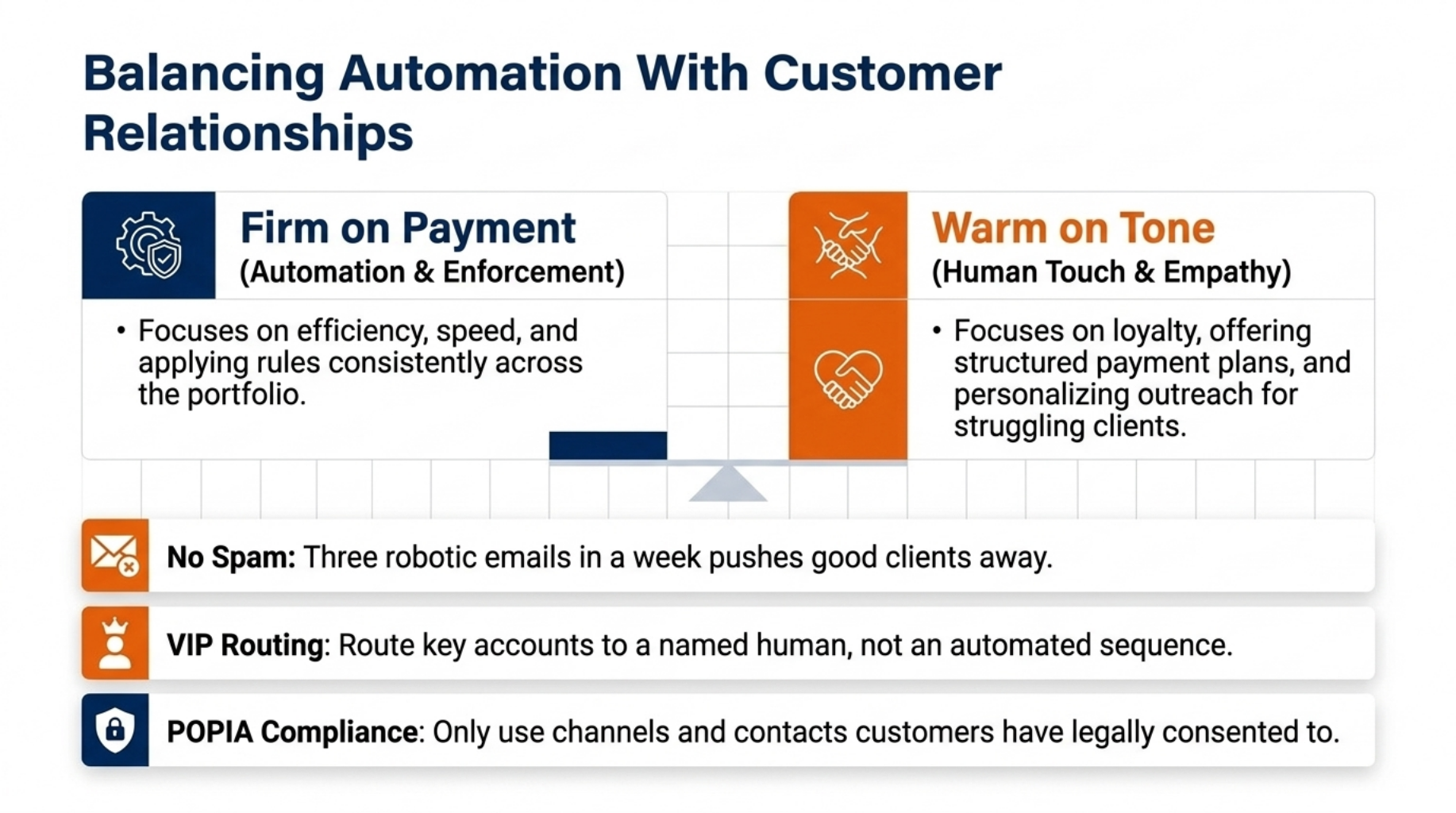
Balancing Automation With Customer Relationships
Firm on payment, warm on tone.
Good data lets you be kinder, not harsher. When you know a loyal customer is hitting a rough patch, you can offer a payment plan before the debt spirals.
Tailor your tone to each customer’s history and value. A long term customer who is five days late needs a friendly check in, not a letter of demand. Route key accounts to a named person, not an automated sequence.
Watch out for reminder spam. Three emails in a week with a robotic tone can push a good customer to a competitor. Also make sure your outreach respects POPIA, so only contact the people and channels your customers have agreed to.
With the method clear, the next question is where to run it. That is where Acumatica comes in.
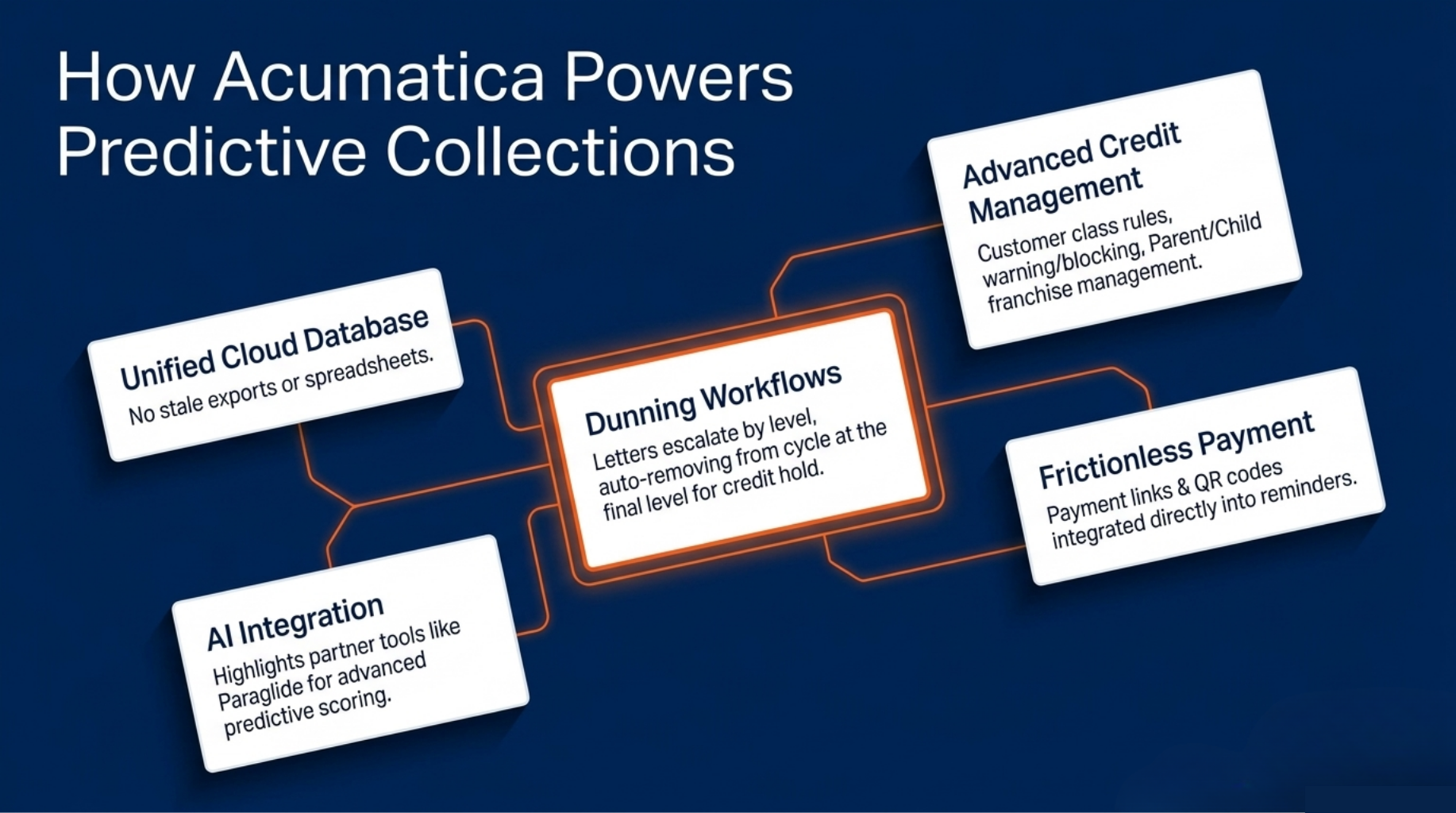
How Acumatica Powers Predictive Collections
Your collections data already lives in your ERP. Put it to work.
Predictive models are only as good as the data behind them. Acumatica keeps debtors, sales, and customer data in one cloud database, so there are no exports or stale spreadsheets.
The native tools map to the framework in this guide. Acumatica supports customer credit limits, warning or blocking rules, parent and child credit management for groups and franchises, dunning letters, overdue charges, and aging reports. You can set credit rules by customer class and override them for individual customers, which fits a segment based policy. Acumatica can also send payment links and QR codes to help customers pay faster.
Dunning letters escalate by level. Once a customer reaches the final level, Acumatica removes them from the dunning cycle and lets you place the account on credit hold. Dashboards track aging, DSO, and past due balances so leaders see trends at a glance.
For AI scoring and smart outreach, Acumatica also connects to partner tools. For example, Paraglide is an AI accounts receivable platform that integrates with Acumatica to take collections beyond static reminders.
Getting Started With Predictive Collections in Acumatica
Start with clean data and one segment, then scale.
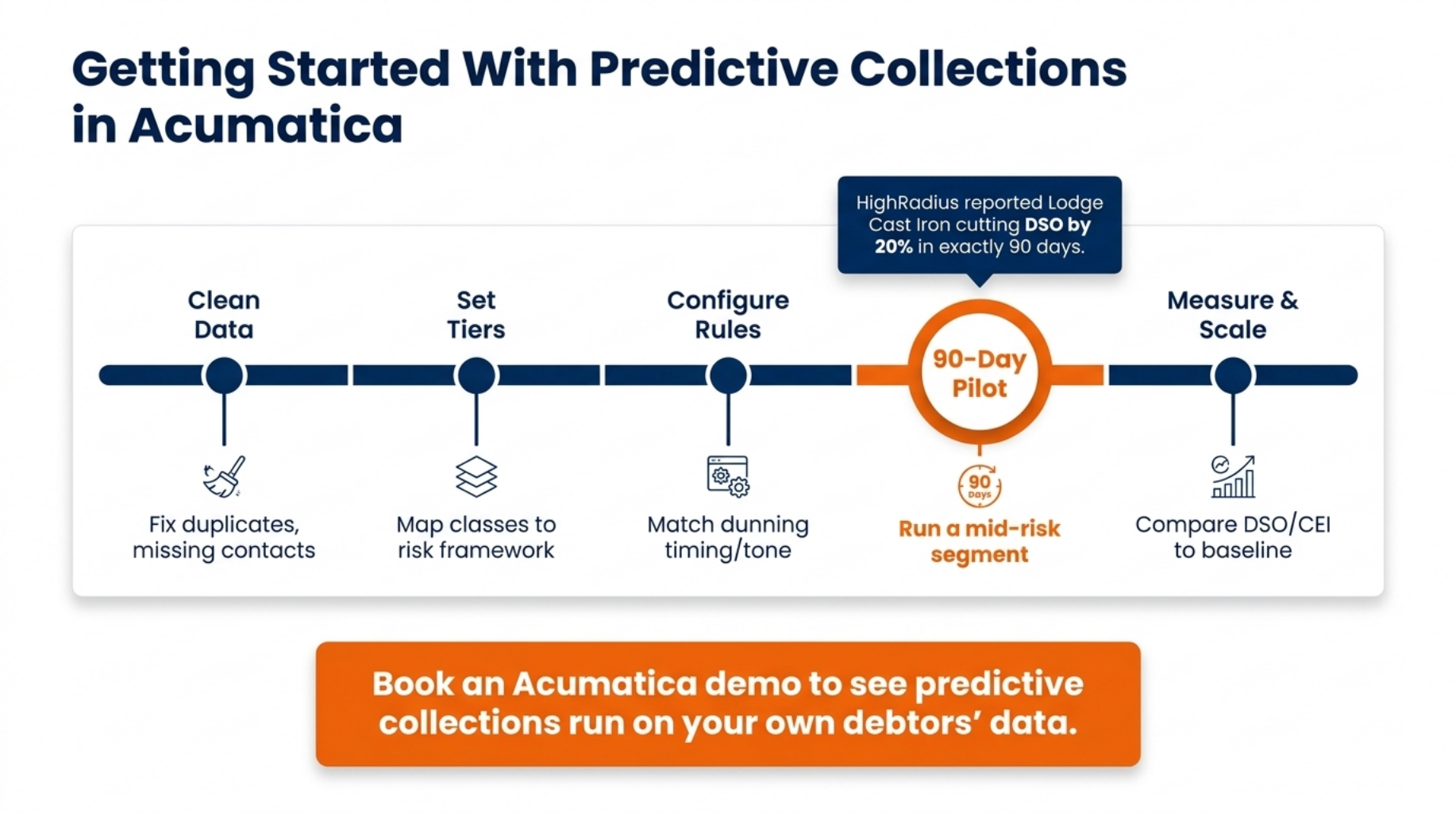
You do not need to change everything at once. Follow these steps:
- Clean your data. Fix duplicate customers, missing contacts, and wrong payment terms.
- Set up customer classes and risk tiers. Use the scoring framework as your starting point.
- Configure dunning and reminder rules. Match timing and tone to each tier.
- Pilot one segment. Pick a group of mid risk customers and run the new process for 90 days.
- Measure and expand. Compare DSO and CEI against your baseline, then roll out to other segments.
A 90 day pilot is long enough to see real change. HighRadius reports that Lodge Cast Iron cut DSO by 20% within 90 days. A local Acumatica partner can help you set up rules, dashboards, and AI add-ons so you get there faster.
Wrapping Up
Predictive collections shift your team from chasing late invoices to preventing them. Risk scores, prioritised worklists, and segment policies work together to cut DSO and bad debt without harming the customers you want to keep.
In a market where late payment is the norm and borrowing costs are high, every day of DSO counts. Acumatica gives you the data and tools to run collections at scale, from credit rules to dunning letters to live dashboards.
Ready to see it in action? Book an Acumatica demo to see predictive collections on your own debtors data.
Frequently Asked Questions
What is predictive collections?
Predictive collections uses AI and payment history to forecast which customers and invoices are likely to pay late so teams can act early.
How can AI reduce days sales outstanding?
AI reduces DSO by ranking accounts by risk, timing reminders to each customer, and flagging late invoices before the due date.
What is a good collection effectiveness index?
A CEI above 80% is often seen as healthy, and top teams aim for 90% or more.
What data does predictive analytics for accounts receivable use?
It uses payment history, invoice details, order patterns, dispute records, credit limits, and business credit bureau data.
Will automated collections hurt customer relationships?
No, if you match tone and channel to each customer, respect POPIA, and keep a person in charge of key accounts.