



Summary
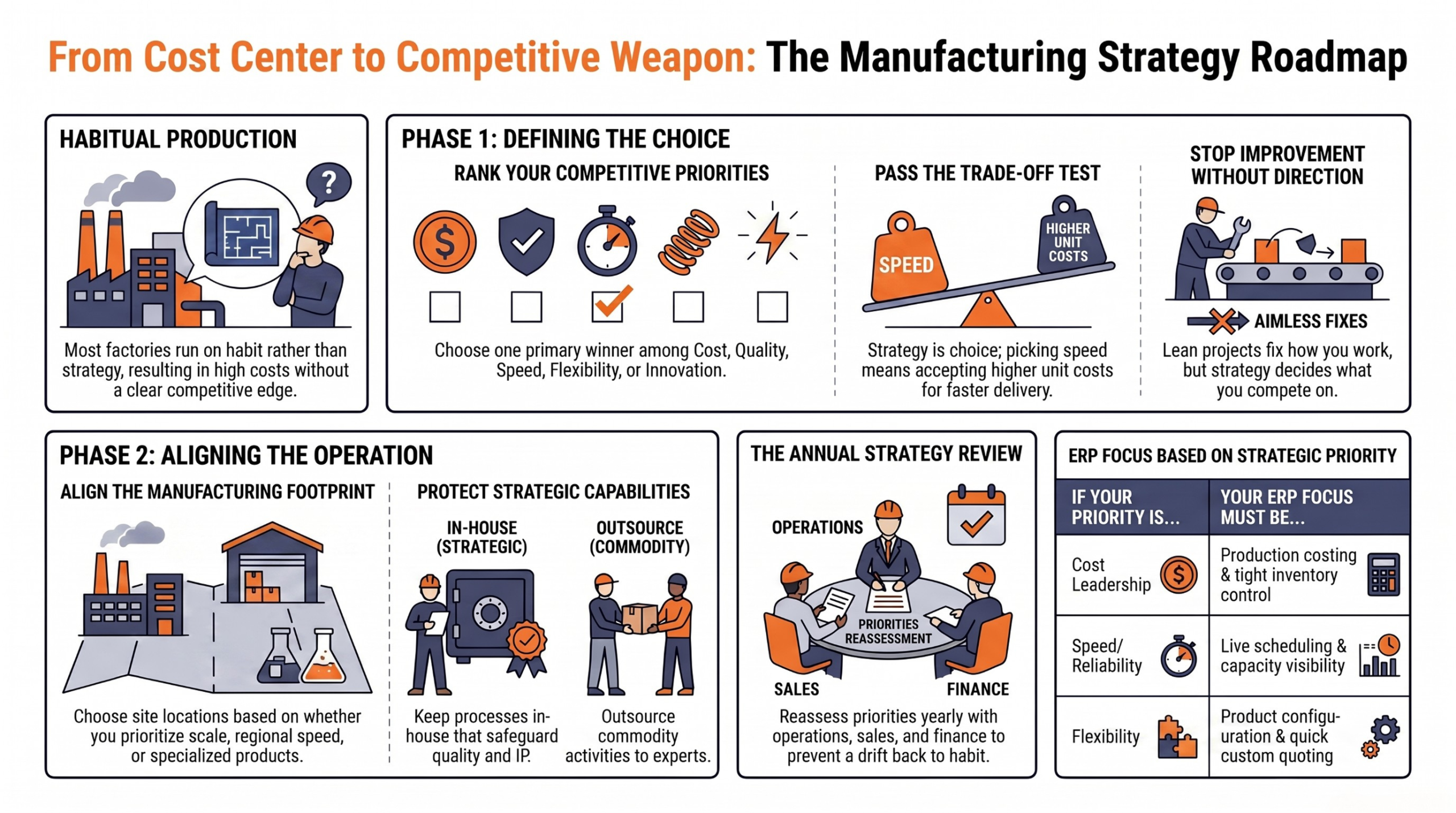
A manufacturing strategy is a deliberate set of choices that connects factory capabilities to customer needs and competitive advantage. Plants must prioritise what they want to win on, such as cost, quality, speed, flexibility, or innovation—and align their footprint, make-or-buy decisions, technology investments, metrics, and software systems accordingly.
Key Points
- Strategy is more than an operating plan: It defines what the factory will excel at and what trade-offs it accepts.
- Rank competitive priorities: Plants cannot be cheapest, fastest, most flexible, and highest quality simultaneously. Priorities should reflect why customers choose or reject the company.
- Align the manufacturing footprint: Choose centralised, regional, or product-focused facilities based on cost, speed, freight, capacity needs, and customer location.
- Make-or-buy decisions should protect strategic capabilities: Keep processes that safeguard quality, speed, intellectual property, or customer value; outsource activities where suppliers have stronger scale or expertise.
- Invest in technology only when it advances a stated priority: Require measurable benefits, reliable data, operator involvement, training, and defined payback periods.
- Review the strategy annually: Include operations, sales, and finance; reassess priorities, footprint, suppliers, technology projects, and market changes.
- Use integrated data systems: Accurate costing, capacity, scheduling, inventory, and delivery information help turn strategy into daily decisions.
Introduction
Most plants run without a manufacturing strategy. They run on habit. The machines were bought years ago, the layout was set by whoever had the floor plan, and the schedule is built the way it has always been built.
None of that is wrong on its own. The problem is that it adds up to nothing. Your operation absorbs most of your capital and most of your people, yet it gives you no clear edge over the firm down the road.
This guide shows you how to fix that. You will learn how to choose competitive priorities, plan your manufacturing footprint, decide what to make and what to buy, and judge technology spend against a single test. You will also get a simple annual review that keeps the plan alive once the meeting ends.
Let us start with what the term actually means.
What a Manufacturing Strategy Really Means
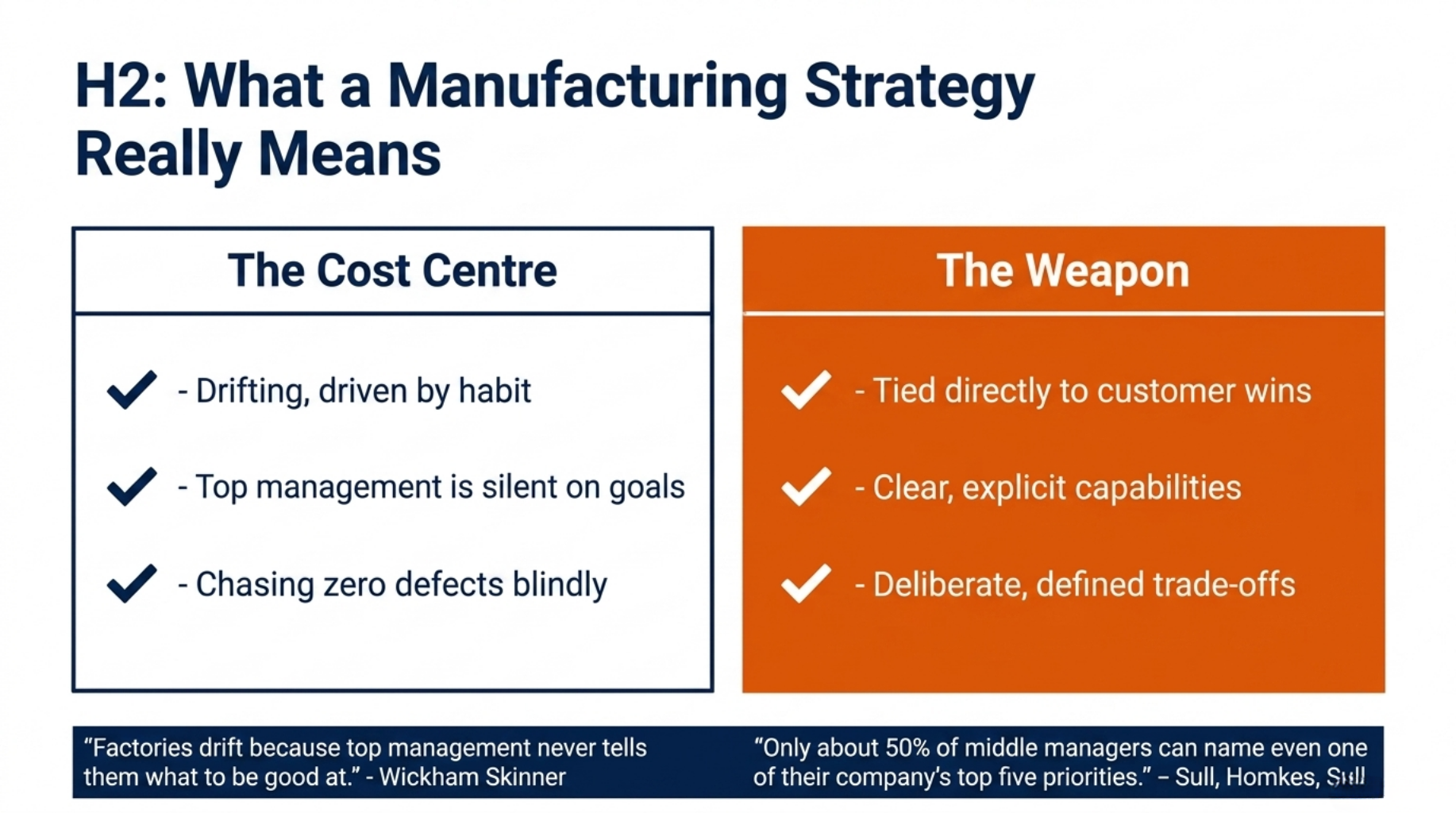
Your factory is either a weapon or a cost centre.
A manufacturing strategy is the set of choices you make about how you produce, tied directly to how you win customers. It answers where you build, what you build in house, what capabilities you invest in, and what you are willing to be worse at.
That last part is the hard part. Strategy is choice, and every choice closes another door. If you pick low cost, you accept longer lead times on custom work. If you pick speed, you accept higher unit cost.
A production plan is not a strategy. Neither is a capital budget. Those are outputs of a strategy, and if you have no strategy, they are just guesses with numbers attached.
Wickham Skinner made this point in Harvard Business Review decades ago. He argued that factories drift because top management never tells them what to be good at. The research since has not been kind to us. Work by Sull, Homkes and Sull found that only about half of middle managers could name even one of their company’s top five priorities.
Think of a plant that spent two years cutting scrap and boosting machine uptime. Real gains. Then it lost its biggest account to a rival who quoted a three-week lead time instead of nine. Nobody had ever told the plant that speed was what the customer bought.
When the choices are not written down, every department picks its own direction. Purchasing chases price. Quality chases zero defects. Sales promises whatever closes the deal.
Strategy vs Operational Improvement
Lean projects fix how you work. Strategy decides what you compete on. They are not the same thing.
Both matter. But improvement without direction is expensive motion. You can make the wrong capability very efficient and still lose the tender.
So the first decision is what you are trying to be good at.
Pick Your Competitive Priorities
You cannot be cheapest, fastest and most flexible at once.
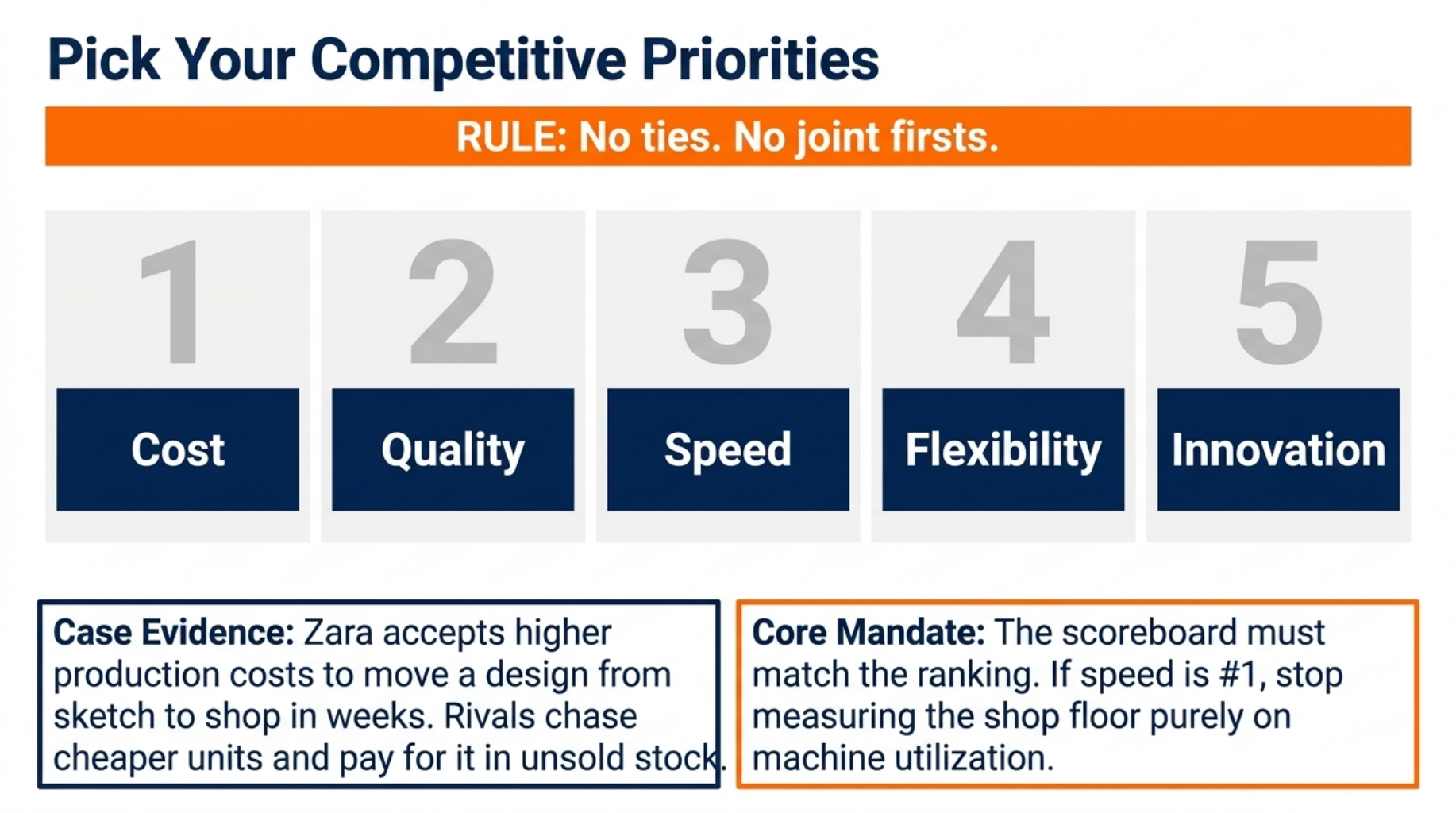
There are five competitive priorities in manufacturing: cost, quality, speed, flexibility and innovation. Every plant claims all five. No plant delivers all five.
The trade-offs are real, and they show up in your numbers. Small batches give you flexibility and push up your unit cost. Big runs cut cost and stretch your lead time on anything custom.
Buffer stock protects delivery dates and ties up cash. High inspection rates protect quality and slow throughput. There is no version of this where you win everywhere.
So rank all five from one to five. No ties, no joint firsts. Then answer one more question: when the budget gets cut in the middle of the year, which single priority do you protect?
Base the ranking on what your best customers actually pay for, not on what they say in meetings. Look at your last ten lost quotes. Were you beaten on price, on lead time, or on your inability to take a modified spec?
For most industrial buyers, delivery reliability sits close to price in importance. Purchasing surveys keep finding the same thing. A supplier who is slightly dearer but always on the date will beat a cheaper supplier who slips.
Zara built a whole business on this idea. It accepts higher production costs to move a design from sketch to shop in weeks. Its rivals chase cheaper units and pay for it in unsold stock.
Then check your metrics. If speed is your top priority, but the shop floor is measured on machine utilisation, your people will build big batches and your lead times will stay long. The scoreboard has to match the ranking.
A Quick Trade-Off Test
Ask your team what you would give up to cut lead time in half. Higher stock levels? Smaller runs? An extra shift?
If the answer is “nothing, we would just get better”, the ranking is not honest. Real priorities cost you something.
Once you know what you are competing on, you can decide where to build.
Decide Your Manufacturing Footprint
Where you build shapes what you can promise customers.
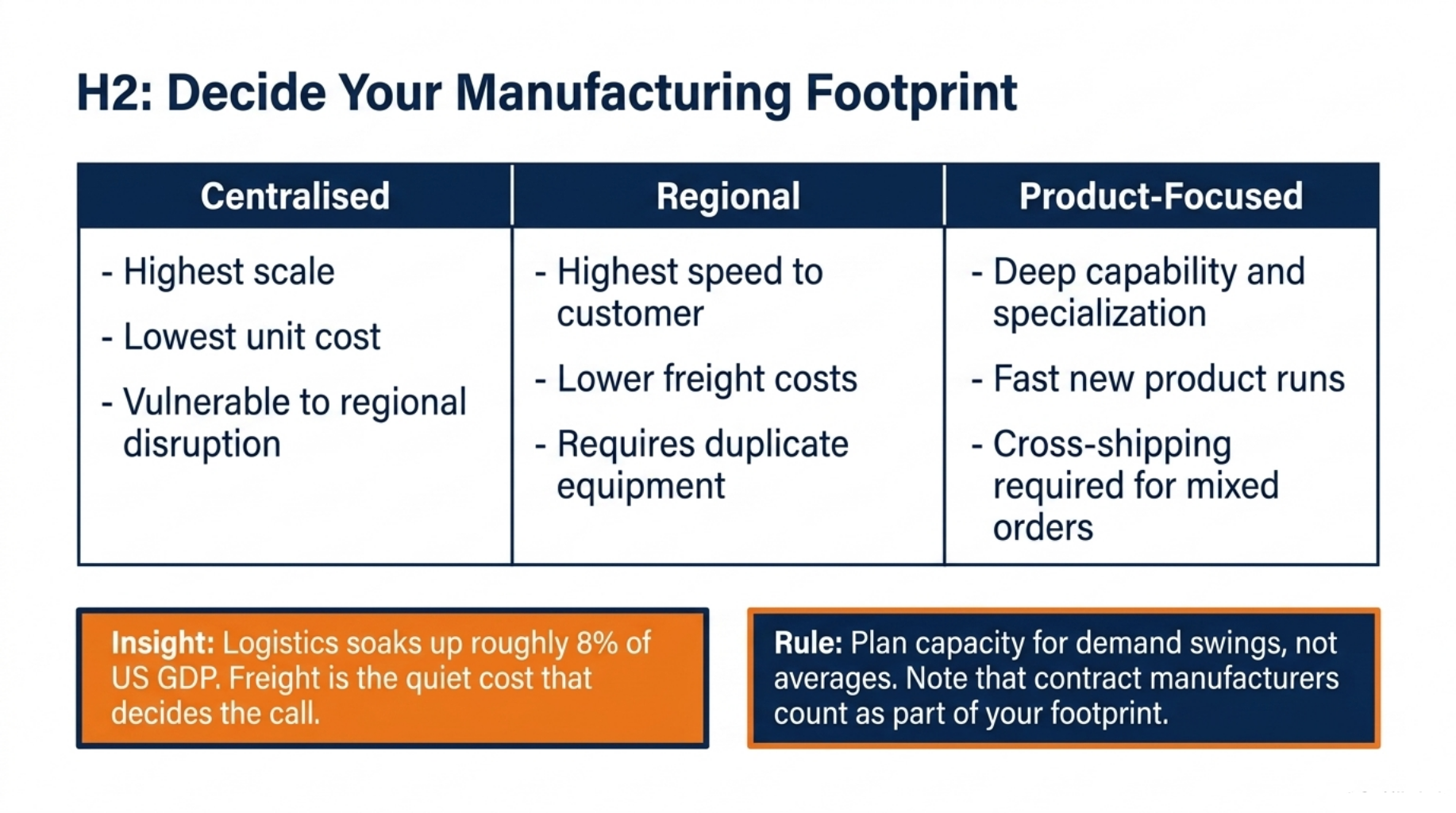
Your manufacturing footprint is the map of where production happens. You have three broad choices. One central plant, several plants split by region, or several plants split by product line.
Each one serves a different priority. A single large plant gives you scale and the lowest unit cost. Regional plants give you speed and lower freight to the customer. Product focused plants give you deep capability and faster new product runs.
Freight is the quiet cost that decides many of these calls. Logistics soaks up a meaningful share of landed cost in most industries, and the Council of Supply Chain Management Professionals tracks it running at roughly eight percent of GDP in the United States. On heavy or bulky goods, the freight bill can wipe out a labour-saving.
Start with an honest audit. List every site and write down what it is genuinely best at today, not what it was built for.
Then weigh the full landed cost against speed to customer. Include labour, freight, duties and the cost of holding stock closer to the buyer. The Reshoring Initiative tracks a steady flow of firms moving production back nearer their customers for exactly this reason.
Plan capacity for demand swings, not for the average. A plant sized for average demand runs overtime in peak and idles in the trough.
Also count your contract manufacturers as part of the footprint. If a third party makes a fifth of your output, it is part of your capacity plan whether you treat it that way or not.
Which raises the next question.
Choose What to Make and What to Buy
Own the steps your customers pay a premium for.
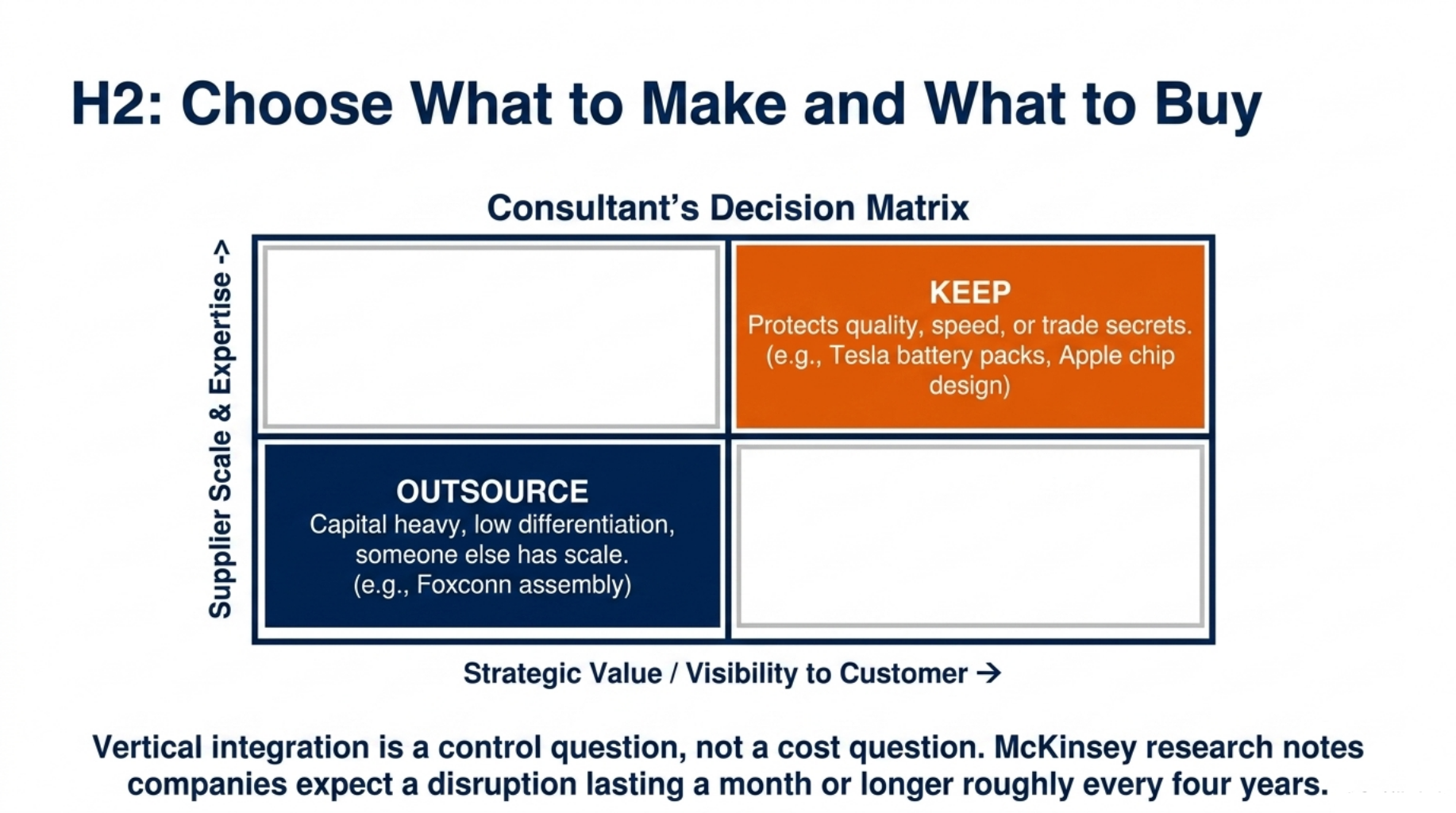
Vertical integration is a control question before it is a cost question. The real issue is which steps you cannot afford to hand to somebody else.
The rule is simple. Keep the steps that protect quality, speed or your trade secrets. Buy the rest.
Tesla makes its own battery packs and drive units because those steps define the product. Apple designs its chips and lets Foxconn assemble the phones. Both firms integrated where the value set and outsourced where it did not.
Score each step in your process on three things. Margin contribution, supply risk, and how visible it is to the customer.
In source where suppliers keep failing you on quality or lead time. Outsource where the step needs heavy capital, adds little you can charge for, and someone else already runs it at scale.
Watch the hidden costs before you bring work in house. You are buying machines, hiring skills you may not have, and taking on idle capacity when volumes dip. Many firms discover that a machine running at forty percent looks very different on the P&L than it did in the business case.
Review supplier concentration once a year. McKinsey research found that companies can expect a disruption lasting a month or longer roughly every four years. If one supplier holds a step you cannot replace in that time, that is a strategic exposure, not a purchasing problem.
Next comes the spending that everyone argues about.
Build a Technology Investment Framework
Buy technology that serves the strategy, not the brochure.
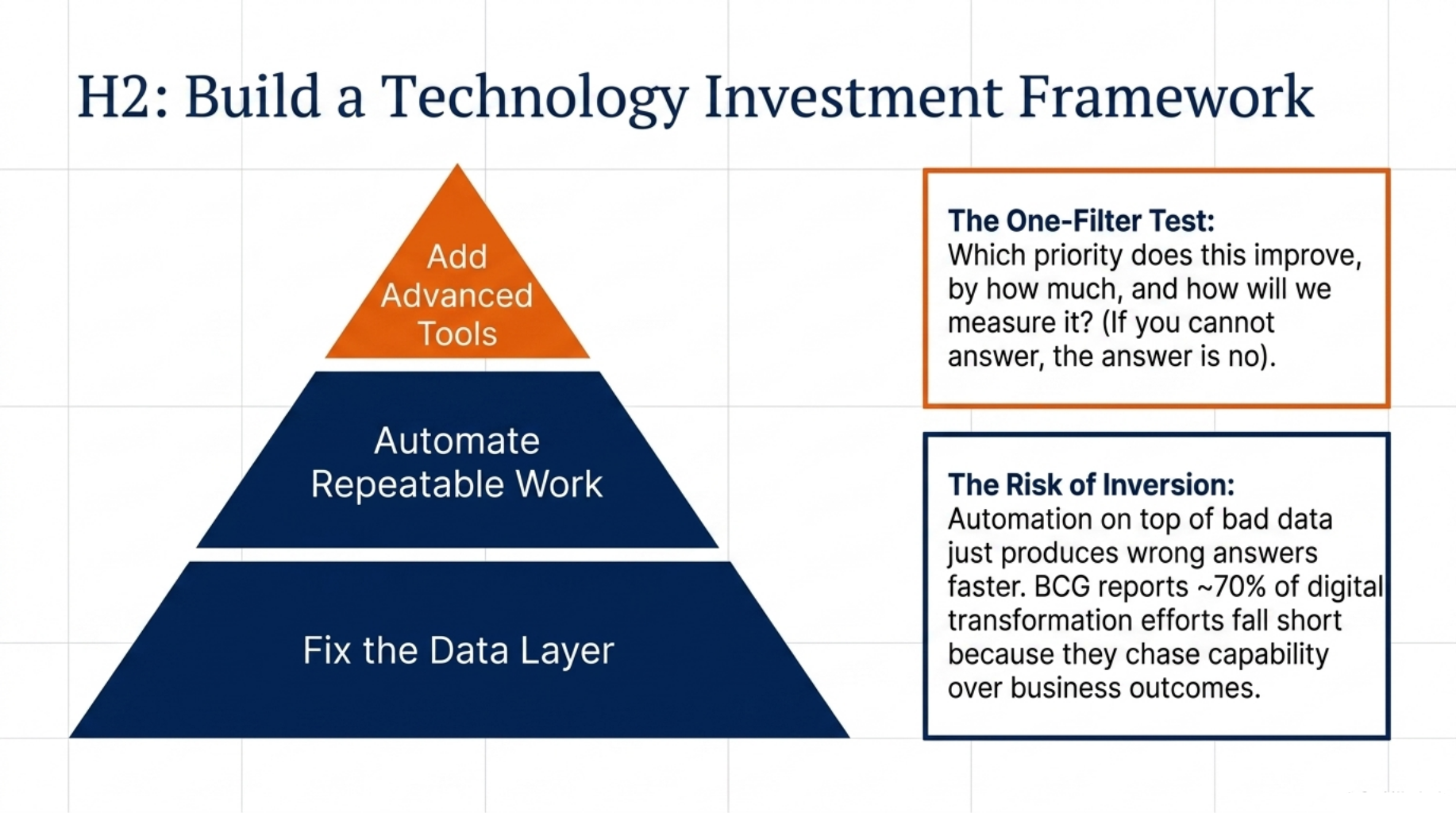
Every technology request should pass one filter. Which priority does this improve, by how much, and how will we measure it?
If nobody can answer the first part, the answer is no. That single rule kills more bad spending than any approval workflow.
Then rank spending in tiers. Fix the data layer first, because automation on top of bad data just produces wrong answers faster. Automate the repeatable work second. Add advanced tools last.
The failure rate here is well documented. BCG has reported that around seven in ten digital transformation efforts fall short of their targets. The common thread is projects picked for their capability rather than for a business outcome.
Set a payback window before you sign. Then hold the project to it and review the actual numbers a year later.
Budget for training as a line item, not as an afterthought. A machine nobody trusts gets switched to manual mode within a month. The operators decide whether your investment works, so bring them in early.
Now for the part most executives skip.
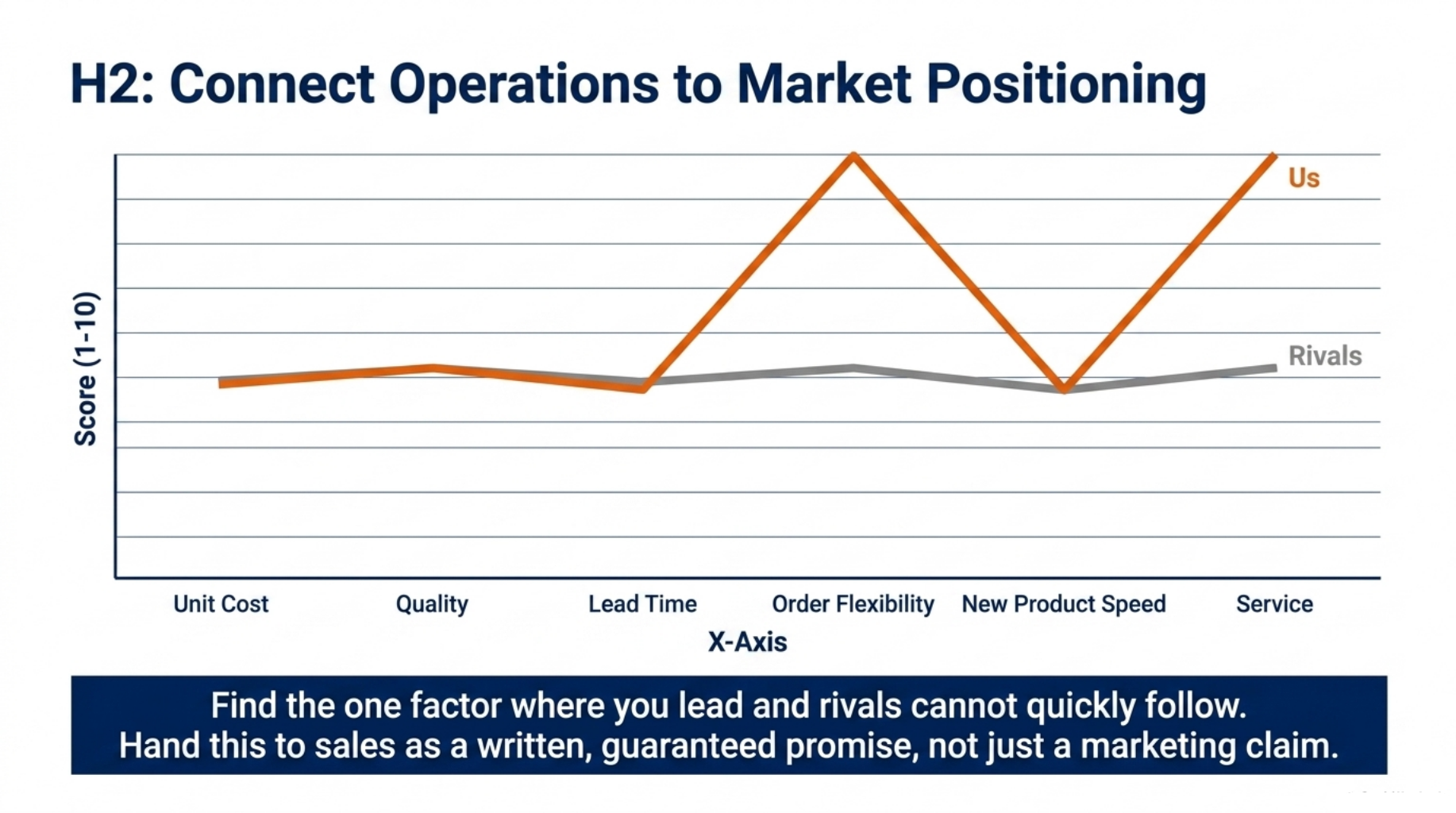
Connect Operations to Market Positioning
The plant makes the promise the sales team sells.
Kim and Mauborgne popularised the strategy canvas in Blue Ocean Strategy. You can adapt it for manufacturing in about an hour.
Draw six factors along the bottom. Unit cost, quality, lead time, order flexibility, new product speed, and service.
Score yourself from one to ten on each. Then score your two closest rivals using what you know from lost bids, customer feedback and public information. Join the dots into three lines.
Now read the picture. You are looking for one factor where you lead and where rivals cannot follow quickly because it sits in your equipment, your layout or your people.
That factor is your positioning. Hand it to sales as a written promise, not a claim. A guaranteed ten-day lead time with a credit if your miss is a promise. “Fast turnaround” is noise.
Then look at any factor where you sit below the customer’s minimum. Those are not opportunities. They are disqualifies, and no strength elsewhere makes up for them.
Trumpf, the German machine toolmaker, is a useful example. It repositioned around fast custom configuration and service response rather than fighting on machine price alone.
A canvas is only useful if you look at it again.
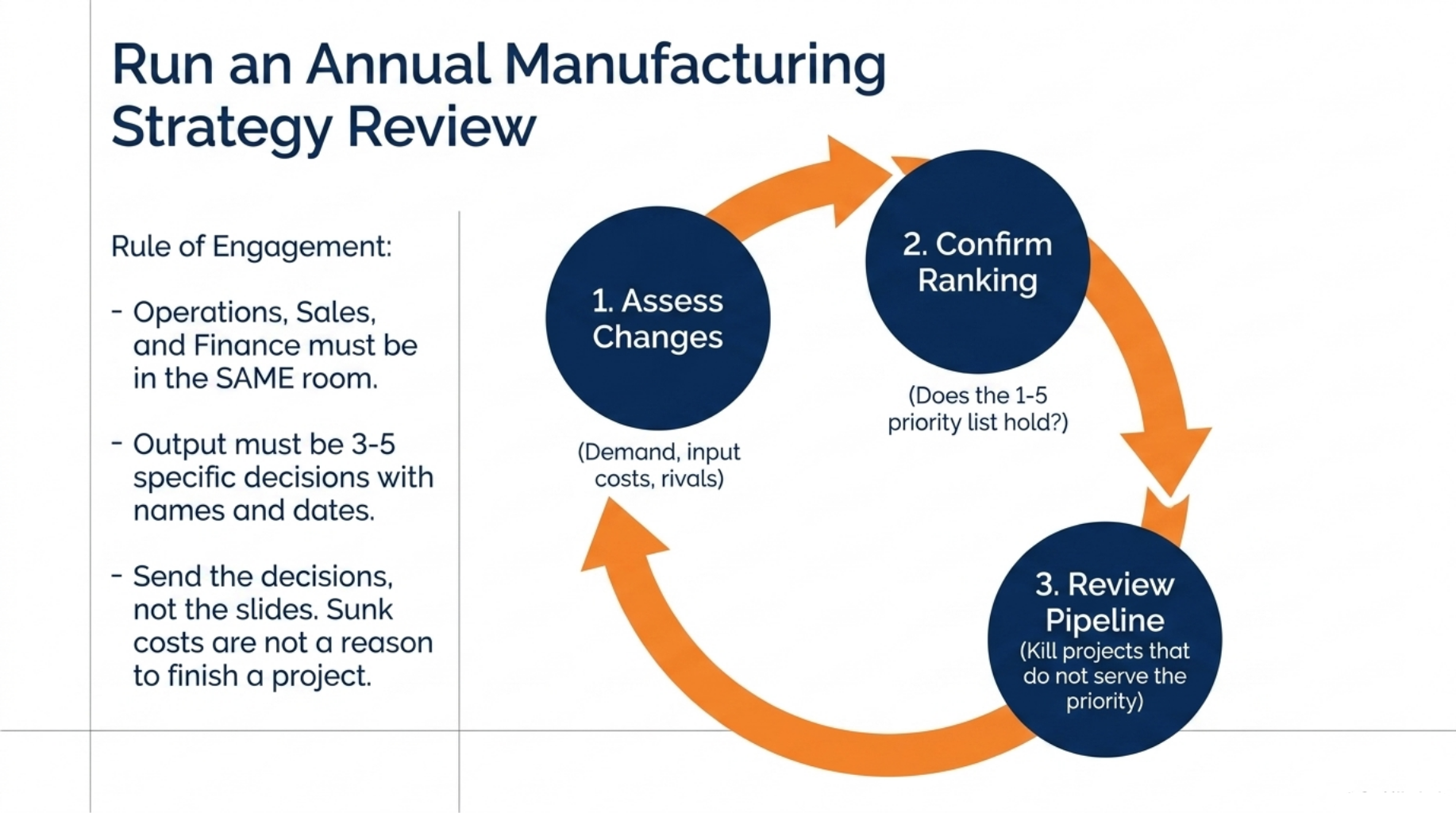
Run an Annual Manufacturing Strategy Review
A strategy nobody reviews becomes a document nobody follows.
Book half a day, once a year. Put operations, sales and finance in the same room. No separate meetings.
Run the agenda in this order. First, what changed since the last review in demand, input costs, supply and rival behaviour. Second, does the priority ranking still hold?
Confirm or change that ranking before you discuss anything else. Every later decision hangs off it.
Then review the footprint, you make and buy split, and the technology pipeline against that ranking. Kill any project that no longer serves the top priority, even if it is half built. Sunk cost is not a reason to finish.
Close with three to five decisions. Each one gets a name and a date. Research on strategic planning consistently finds that firms who review on a fixed cycle adapt faster than those who plan once and file it.
Send the decisions, not the slides. Nobody reads the deck.
Of course, none of this works if you cannot see your own numbers.
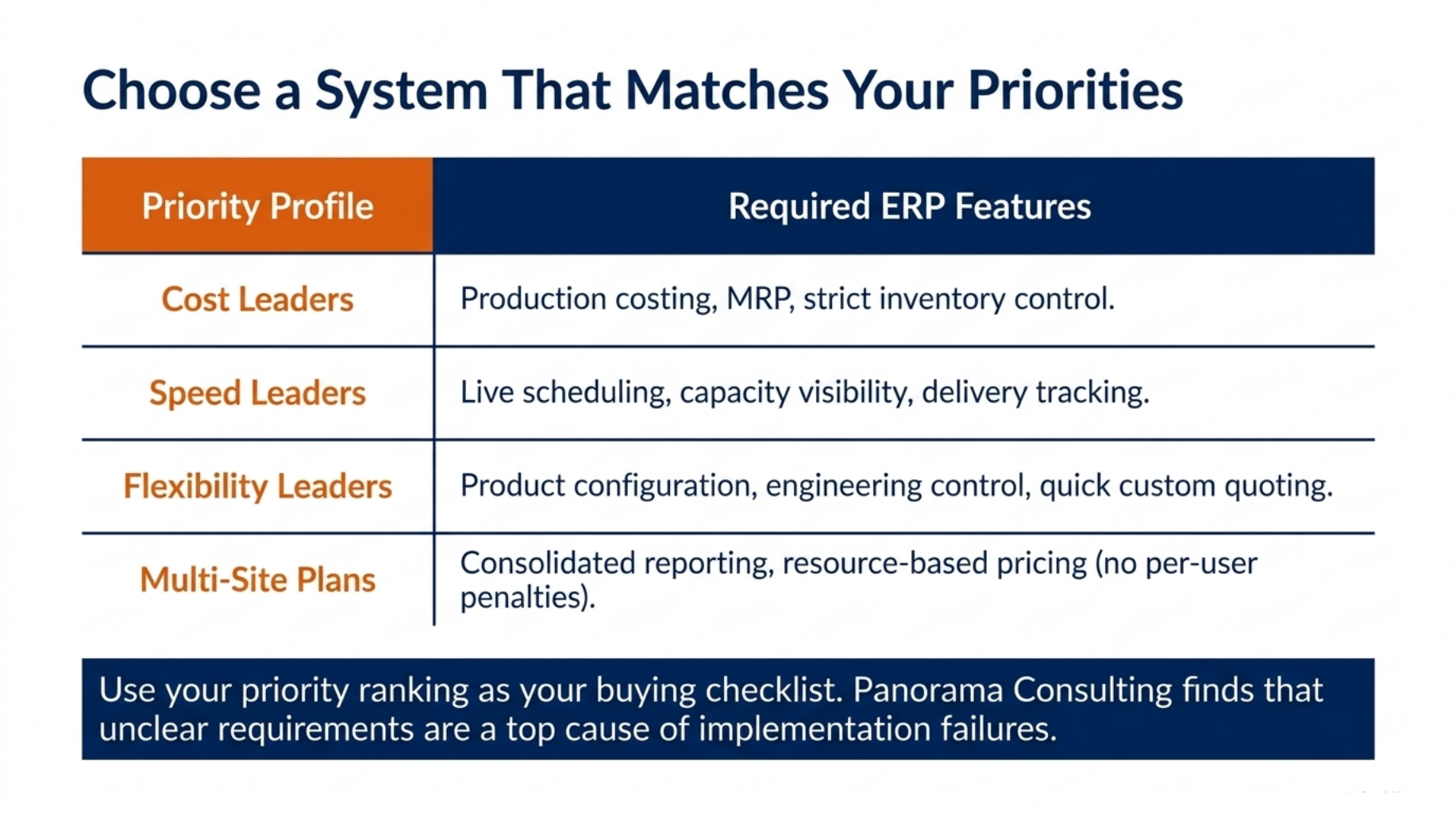
Choose a System That Matches Your Priorities
Pick the system that fits how you plan to win.
Use your priority ranking as the buying checklist. It is a better filter than any feature list.
- Cost leaders need strong production costing, material requirements planning and tight inventory control.
- Speed leaders need live scheduling, capacity visibility and delivery tracking.
- Flexibility leaders need product configuration, engineering change control and quick quoting on custom work.
- Multi site plans need one system across every plant, with consolidated reporting.
Then check the growth terms. If your footprint plan adds a site or doubles headcount, ask what that does to the licence cost. Acumatica prices on resources rather than per user, which suits manufacturers who expect to add people and plants.
Skipping the requirement mapping is what causes pain later. Panorama Consulting’s implementation research keeps finding that a large share of projects run over budget or over time, and unclear requirements sit near the top of the causes.
Wrapping Up
A manufacturing strategy is a ranked set of choices, not a wish list. You pick what you compete on, and you accept what that costs you elsewhere.
Your footprint, you make and buy split, and your technology spend must all serve that top priority? If any one of them pulls a different way, it is quietly cancelling the others out.
Then review the choices on a fixed cycle, or they drift back to habit within a year.
If you want to see whether your operation can actually deliver the promises you are making, start with the data. Book a demo of Acumatica Manufacturing Edition and see your costing, capacity and delivery numbers in one place.
FAQ
Q1: What is a manufacturing strategy?
A: A manufacturing strategy is the set of choices about capacity, sourcing, technology and priorities that decide how your operations help the business win customers.
Q2: What are the competitive priorities in manufacturing?
A: The five competitive priorities are cost, quality, speed, flexibility and innovation, and most firms can lead on only one or two at a time.
Q3: How do I decide between making a part and buying it?
A: Keep the steps that protect quality, speed or trade secrets, and buy the steps that need heavy capital but add little value your customers can see.
Q4: How often should a manufacturing strategy be reviewed?
A: Review it once a year with operations, sales and finance in the room, and review it sooner if demand, cost or supply shifts sharply.
Q5: How does an ERP system support manufacturing strategy?
A: An ERP system links production, costing, inventory and orders in one place so you can see whether your operations are delivering on the priority you chose.
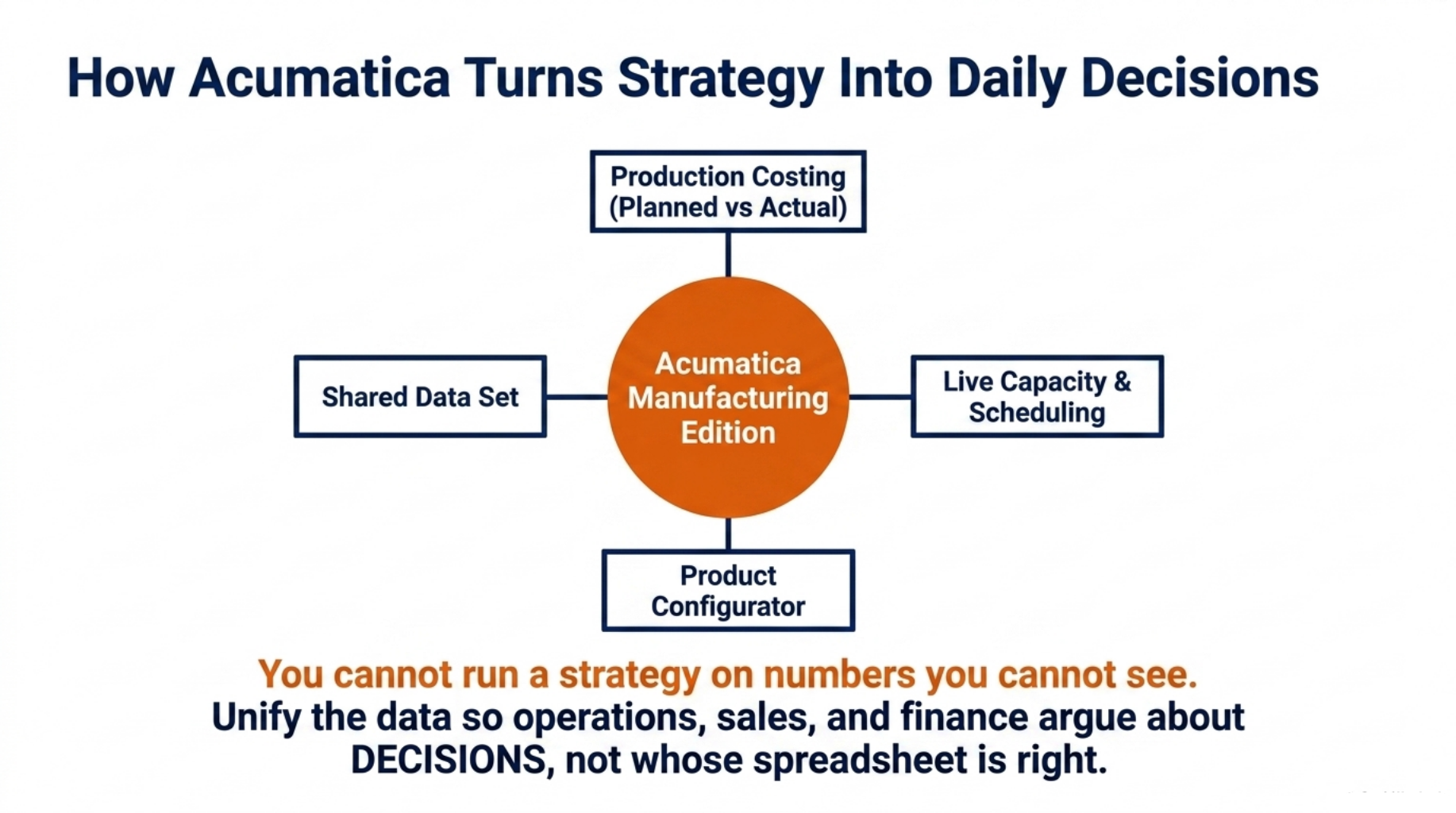
How Acumatica Turns Strategy Into Daily Decisions
You cannot run a strategy on numbers you cannot see.
Here is where most plans die. You choose cost leadership, then find your true production cost sits in three spreadsheets and one person’s head.
Acumatica Manufacturing Edition links production, inventory, costing and orders in one system. That matters because your priorities only mean something when they show up in daily numbers.
Real production costing tells you whether the cost priority is actually holding. You see planned against actual on materials, labour and overhead by job, not just a monthly variance you cannot explain.
Live capacity and schedule data supports the delivery promises your sales team makes. Before quoting a date, you can see what the shop can take.
The product configurator and shop floor data support flexible orders. Custom specs stop being a disruption and start being a normal order type with a known cost.
One shared data set is the quiet win. When operations, sales and finance argue, they argue about the decision instead of about whose spreadsheet is right. Acumatica publishes customer stories from manufacturers describing exactly that shift, and they are worth reading before you decide.
That leads to the last question.