




Summary
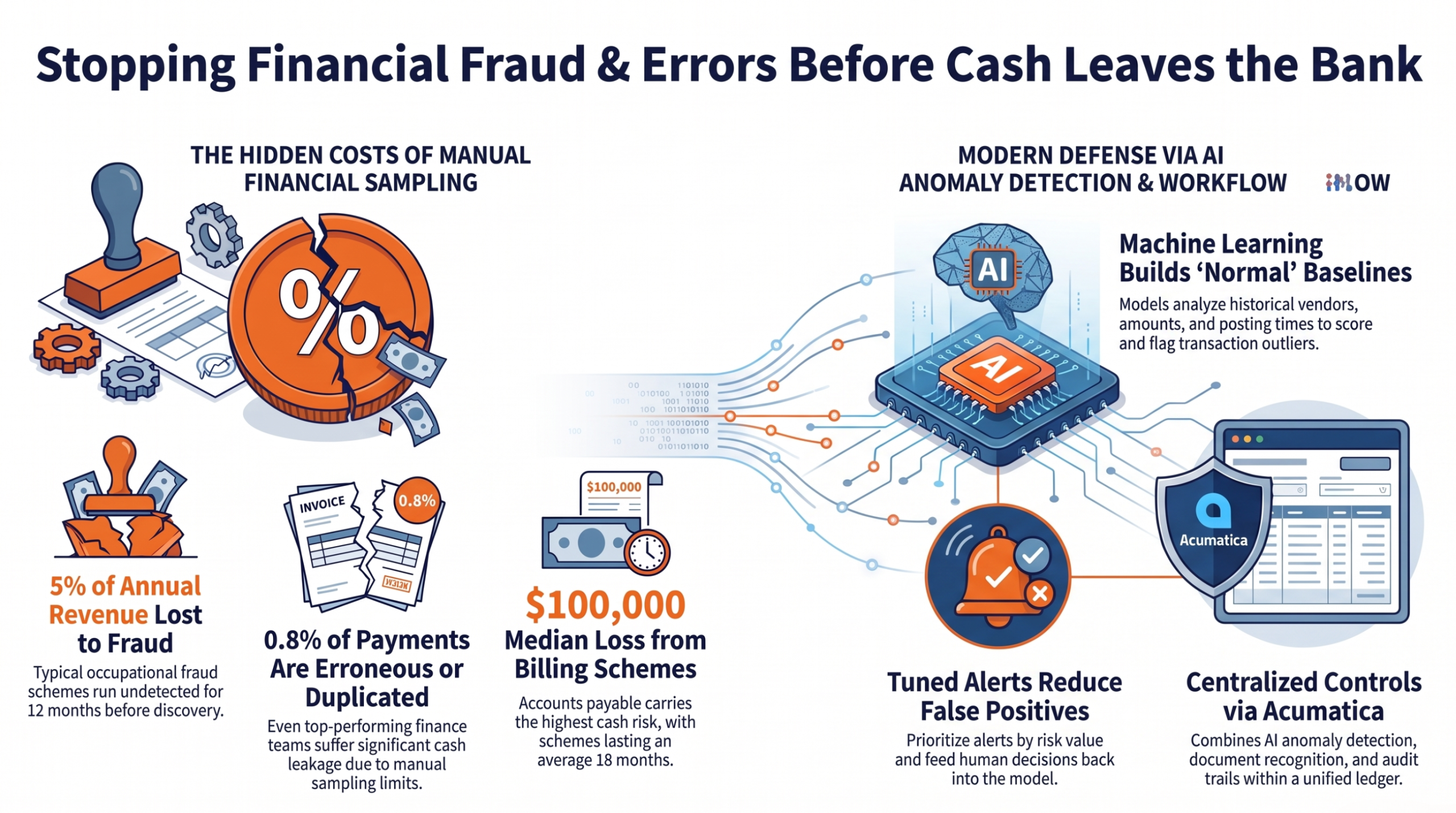
Financial anomaly detection helps finance teams identify fraud, errors, and unusual transactions that manual sampling can miss. By combining rules, machine learning, strong internal controls, and a documented review workflow, organizations can reduce duplicate payments, false alerts, audit risk, and financial losses. Acumatica supports this through anomaly detection, invoice recognition, role-based permissions, and audit trails.
Key points
- High-risk areas include payables, expenses, payroll, and journal entries—especially duplicate invoices, vendor bank changes, split purchases, ghost employees, and unusual journal postings.
- Effective detection combines fixed rules with models that learn normal transaction patterns and flag outliers.
- Alerts should be ranked by risk, reviewed through a defined process, and continuously tuned to reduce false positives.
- Segregation of duties, approval controls, audit trails, and documented decisions remain essential; anomaly detection complements rather than replaces them.
- Acumatica provides a centralized financial data source with AI-assisted anomaly detection and controls, making payables a practical starting point.
Introduction
Financial anomaly detection finds the errors and fraud that manual review misses. Picture a clean month end close. Every report ties out, the team signs off, and one vendor has been paid twice.
Nobody failed in that story. Finance teams handle high-volume and tight deadlines, and most reviews check a sample, not every line. A second copy of an invoice with a new number slides through.
Fraud and errors look ordinary. They look like normal invoices, normal claims, and normal journals. That is why they last so long.
This post covers three things. You will see where risk hides, how to tune alerts, so your team keeps reading them, and how to build a review process finance can trust. We also show how Acumatica supports each step.
The Real Cost of Undetected Financial Errors
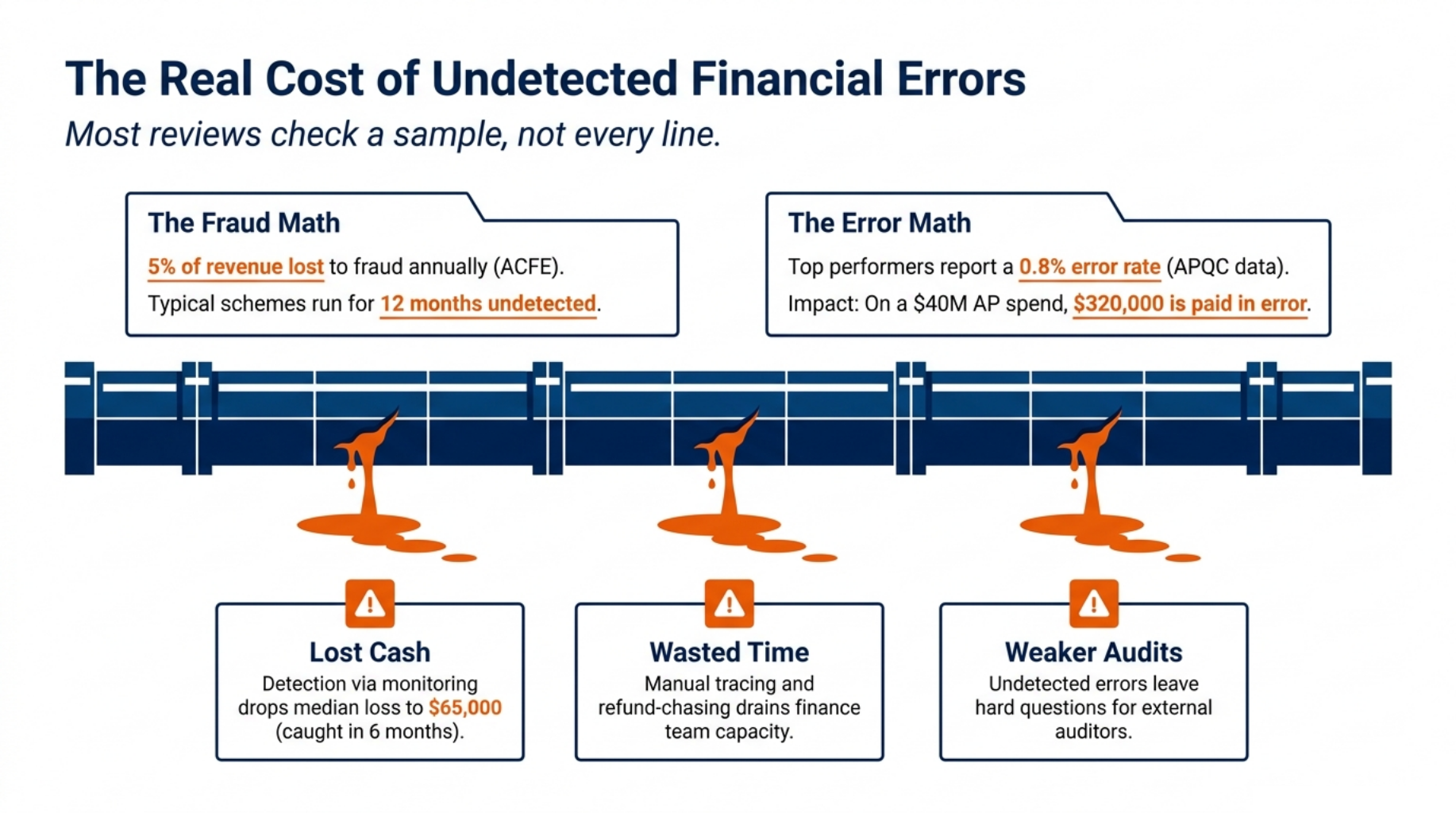
Undetected errors cost you in three ways: lost cash, wasted time, and weaker audit results.
Start with the cash. The Association of Certified Fraud Examiners (ACFE) estimates that organisations lose about 5% of revenue to fraud each year. A typical scheme runs for 12 months before anyone finds it.
Honest mistakes add to the bill. APQC benchmark data shows that even top performers report 0.8% of their annual payments as duplicate or erroneous. Traditional fraud detection in finance leans on samples, so many of these slip by.
Run the numbers on your books. A firm that pays 40 million a year to suppliers would see 320,000 paid in error, even at the top performer rate. APQC data puts weaker teams above 2%.
Then comes the cleanup. Someone must trace each payment, contact the vendor, and chase a refund. That work pulls your team off daily tasks and leaves hard questions for the auditors.
Timing changes the cost. ACFE data shows that frauds caught through monitoring had the lowest median loss of any detection method, at $65,000, and ran for a median of six months.
Fewer losses start with knowing where to look.
Where Risk Hides in Payables, Expenses, Payroll, and Journal Entries
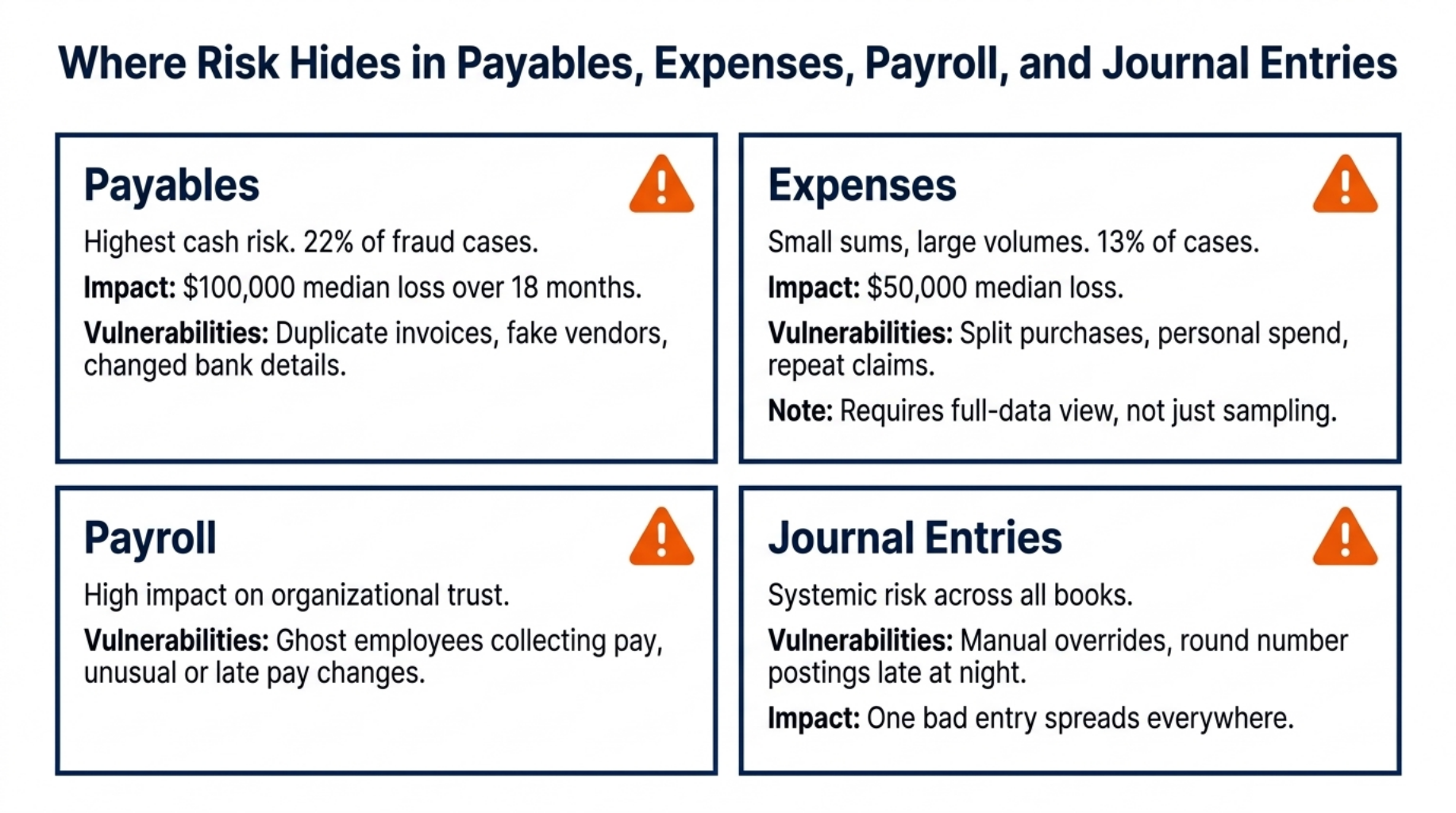
Risk lives where volume is high and review is thin. The ACFE sorts fraud into schemes, and billing schemes, where a false or inflated invoice gets paid, were among the most common, at about 22% of cases. Payables, expenses, payroll, and journals each have their own weak spots.
Payables and Expenses
Payables carry the biggest cash risk. Accounts payable fraud often starts with a duplicate invoice, a fake vendor, or a changed bank detail. In the ACFE data, billing schemes had a median loss of $100,000 and lasted about 18 months.
Expenses move smaller sums in larger numbers. Split purchases, personal spend, and repeat claims are the usual patterns. The ACFE puts expense reimbursement schemes at about 13% of occupational fraud cases, with a median loss of $50,000. Because the claims are small and many, expense fraud prevention needs a look at every claim, not a sample.
Payroll and Journal Entries
A ghost employee is a name on the payroll that does not match a real worker. Someone adds the name and collects the pay. The ACFE files this under payroll fraud, next to unusual pay changes.
Journal entries require care because they reach every report. A manual override or a round number posting late at night can shift results across the books. One bad entry spreads.
Financial Risk Matrix
| Area | Common issue | Likelihood | Impact | Best control |
|---|---|---|---|---|
| Payables | Duplicate invoices, changed bank details | High | High | Duplicate checks and bank change approval |
| Expenses | Split purchases, repeat claims | High | Medium | Policy limits and receipt matching |
| Payroll | Ghost employees, late pay changes | Low | High | Split duties and a review before each pay run |
| Journal entries | Manual overrides, late postings | Medium | High | Approval rules and posting alerts |
Read the table from the top. Start with payables, where likelihood and impact are both high. Adjust the ratings to fit your data.
Next, see how a model finds these patterns in your data.
How Financial Anomaly Detection Works in Finance Data
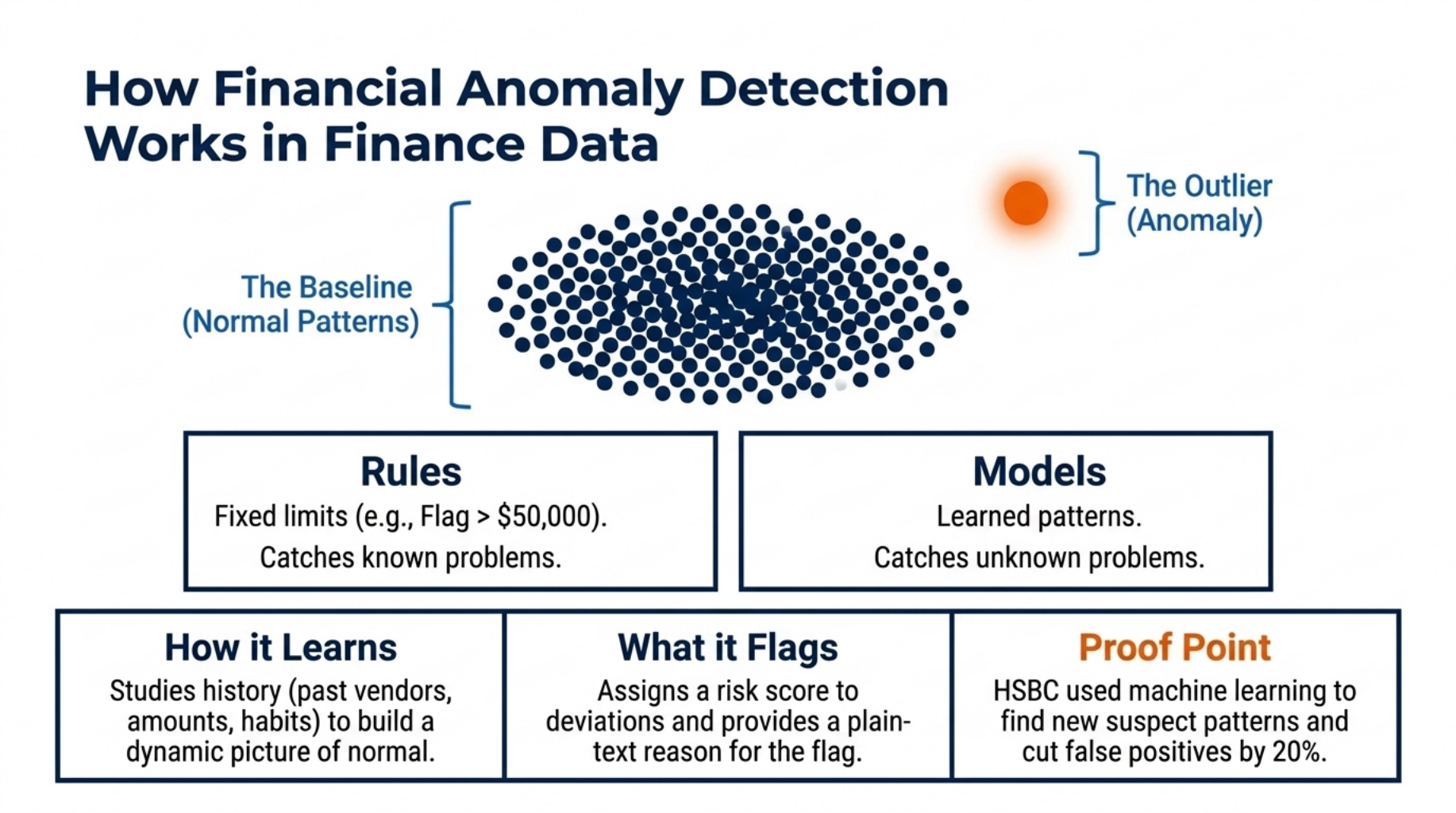
If you want to know how to detect financial fraud using machine learning, the answer starts with a baseline. A model learns what normal looks like, then flags what is not.
Two tools do this work. Rules use fixed limits, such as “flag any payment over 50,000”. Models learn patterns from your data. Rules catch known problems, models catch new ones, and most teams need both.
A published case study shows the gap. HSBC used machine learning software from Ayasdi in its financial crime monitoring. The bank found new suspect patterns and cut false positives by 20%.
How Models Learn Normal Patterns
A model starts with history. It studies past vendors, amount ranges, approval paths, posting times, and user habits. From these inputs, it builds a baseline, which is a picture of normal.
The baseline updates as the business changes. A new supplier or a busy season does not break it.
What the Model Flags
Each new item gets a risk score based on how far it sits from the baseline. Outlier detection of this kind flags duplicate invoices, unusual vendors, split purchases, and out of hours postings. Each flag carries a score and a plain reason, so a reviewer sees why it appeared.
Knowing what the model flags help you decide what to watch first.
High-Risk Transaction Types to Monitor
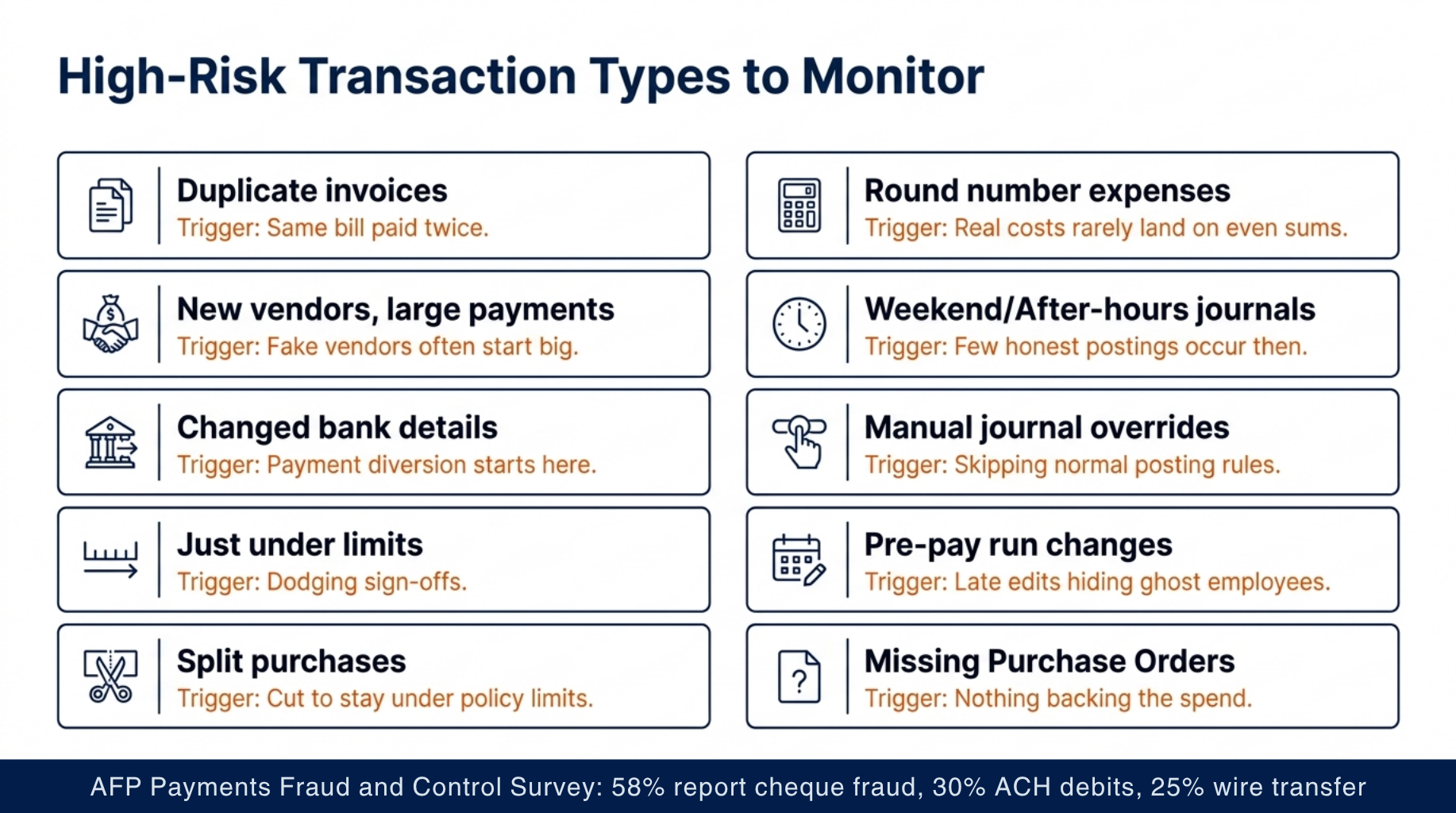
Watch the transactions that break the pattern, not the whole ledger. Use this list as the start of your transaction monitoring plan:
- Duplicate or near duplicate invoices. The same bill gets paid twice.
- New vendors with large first payments. Fake vendors often start big.
- Vendor bank detail changes. Payment diversion often starts here.
- Payments just under approval limits. Someone may be dodging a sign off.
- Split purchases. One buy is cut into small parts to stay under a limit.
- Round number expenses. Real costs rarely land on even sums.
- Weekend or after hours journals. Few honest postings happen then.
- Manual journal overrides. They skip the normal posting rules.
- Payroll changes before a pay run. Late edits can hide ghost employees.
- Payments with no matching purchase order. Nothing backs the spend.
The AFP Payments Fraud and Control Survey shows why payment controls matter. It found that 58% of organisations reported cheque fraud, ahead of ACH debits at 30% and wire transfers at 25%.
A list is useful, but a story shows how one item plays out.
Worked Example: Catching a Duplicate Payment Before It Clears
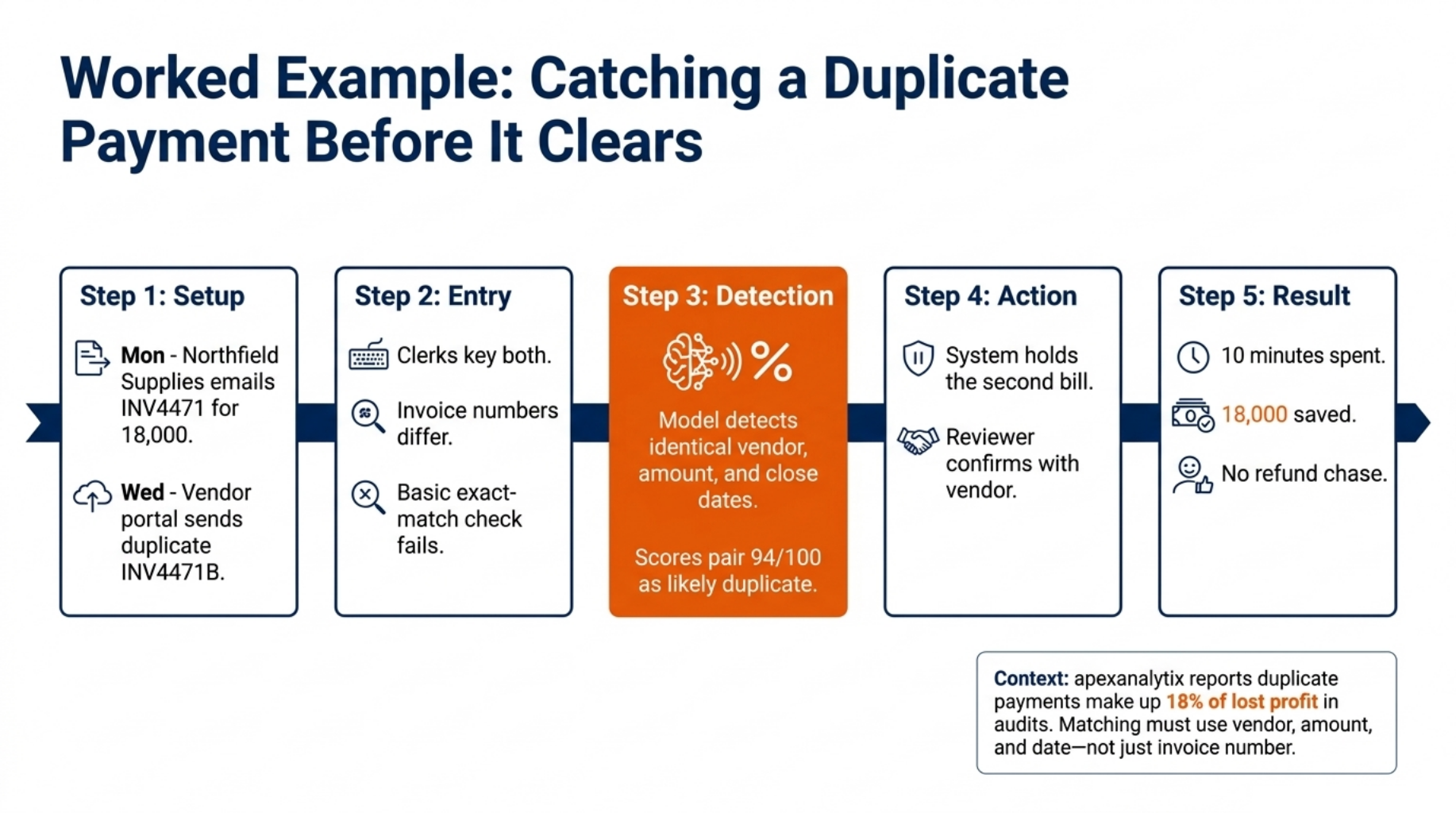
Catching duplicate payments with anomaly detection works best before the bank moves any money. Here is one example. The names and numbers are made up to show the steps.
- The setup. A vendor, Northfield Supplies, emails invoice INV4471 for 18,000 (in local currency) on Monday. Its portal sends the same bill on Wednesday as INV4471B.
- The entry. Two clerks key in both bills. The numbers differ, so a basic exact match check passes both.
- The detection. The model sees the same vendor, the same amount, and dates two days apart. It scores the pair 94 out of 100 as a likely duplicate.
- The action. The system holds the second bill before the payment run. A reviewer emails the vendor, who confirms it is one invoice sent twice.
- The result. The reviewer voids the second bill, and the payment run goes out clean.
The review took about ten minutes. It kept 18,000 in the bank and avoided a refund chase.
Strong duplicate payment detection is how to prevent duplicate vendor payments: match on vendor, amount, and date range, not on invoice number alone. Recovery audit firm Apexanalytix reports that duplicate payments make up 18% of the lost profit its audits uncover, so the case is far from rare.
One good catch is not a system, so the next step is tuning alerts and setting up review.
Tuning Alerts and Building a Review Workflow Finance Can Trust
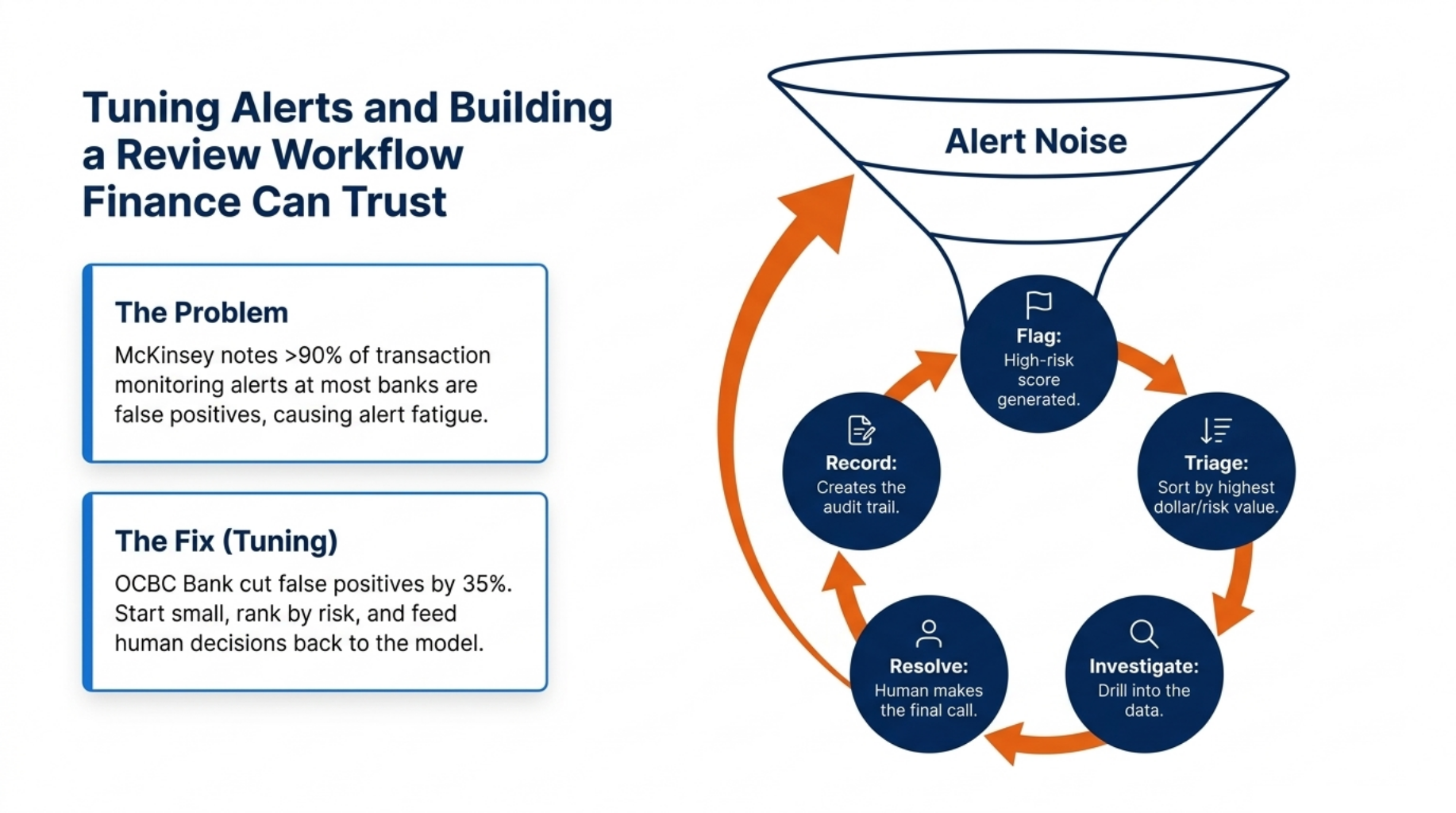
Too many alerts and your team stops reading them. One industry summary cites McKinsey as finding that more than 90% of transaction monitoring alerts at most banks are false positives. The fix is to start small, rank by risk, and let people make the final call.
Banking offers proof that tuning works. In a pilot, OCBC Bank in Singapore used machine learning to cut false positive alerts by 35%. It also sorted about 4,200 alerts into 48 risk clusters, so staff could start with the riskiest.
How to Reduce Alert Noise
Here is how to reduce false alerts in fraud monitoring. Begin with three to five checks that guard the most cash, such as duplicate invoices and vendor bank changes. Rank alerts by risk score and dollar value, so the largest risks come first.
Then mark every result as valid or false. That feedback teaches the model and lowers false positives over time. Add new checks when the first set works well.
A Review Workflow That Holds Up
Use five steps: flag, triage, investigate, resolve, and record. Name an owner for each step and set a target time, such as same day triage for high-risk alerts. Add an escalation path for anything above a set value.
A person makes the final call every time. A small team can start with one reviewer and a short daily check. The record of each decision becomes part of your approval workflow and your audit trail.
A good workflow also needs strong controls behind it.
Internal Controls, Segregation of Duties, and Audit Readiness
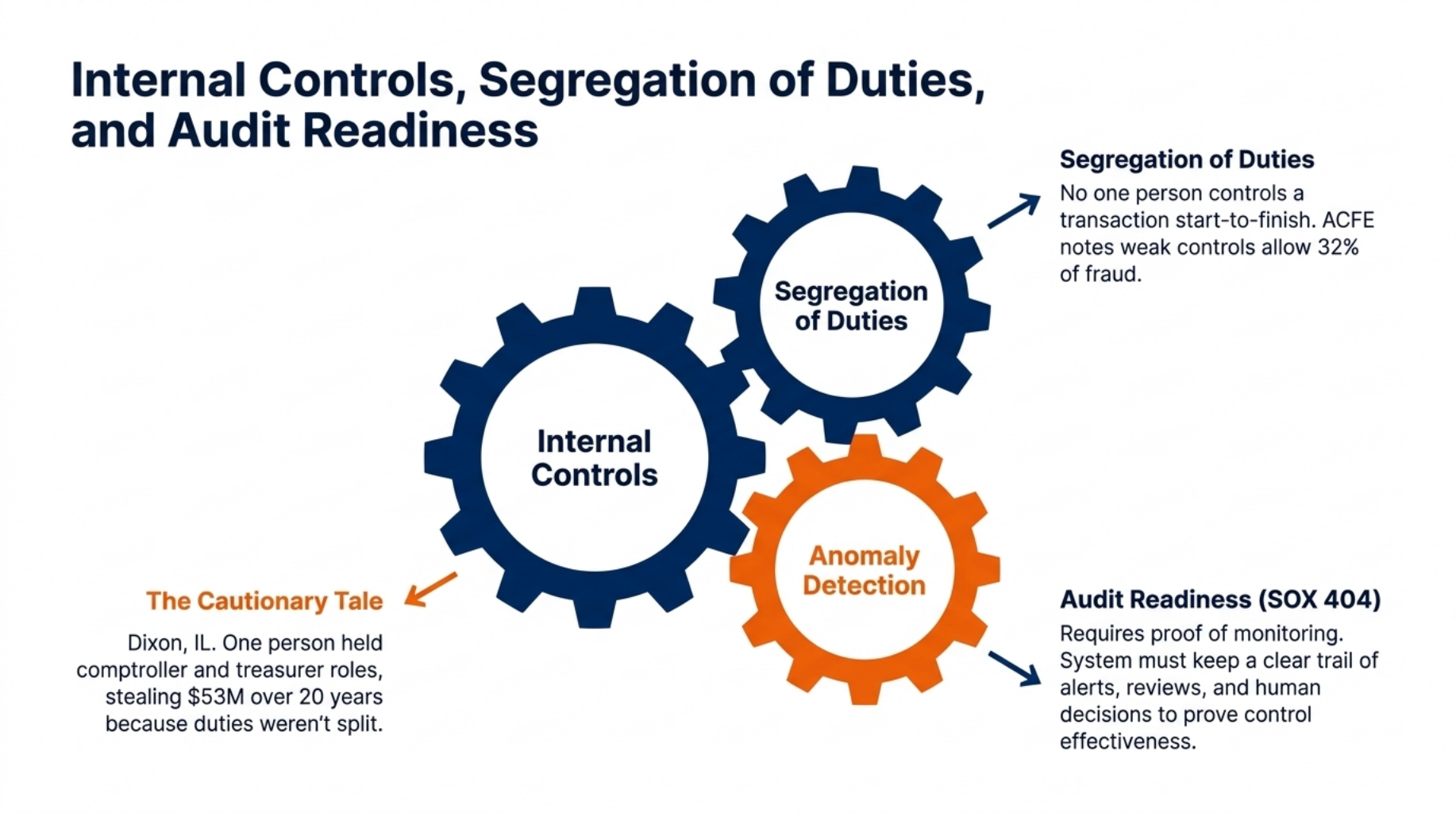
Detection supports internal financial controls. It does not replace them.
Segregation of duties means no one person controls a transaction from start to finish. For example, the person who adds a vendor should not approve that vendor’s payment. The ACFE found that weak controls allowed fraud in about 32% of its cases, and in 19% someone bypassed controls that existed.
Dixon, Illinois shows the price of getting this wrong. One person held both the comptroller and treasurer roles for the city and took about $53 million over more than 20 years. The city’s outside auditors had warned for over a decade that duties were not split enough.
Auditors look for proof. Section 404 of the Sarbanes Oxley Act requires management at public companies to report on the strength of internal control over financial reporting. Most use the COSO framework, which names monitoring as one of five components, and that is where anomaly detection fits.
Keep a clear trail of alerts, reviews, and decisions, and check who can do what in your system on a set schedule. That is audit readiness in practice.
Acumatica brings these pieces together in one system.
How Acumatica Brings AI Into Finance Controls
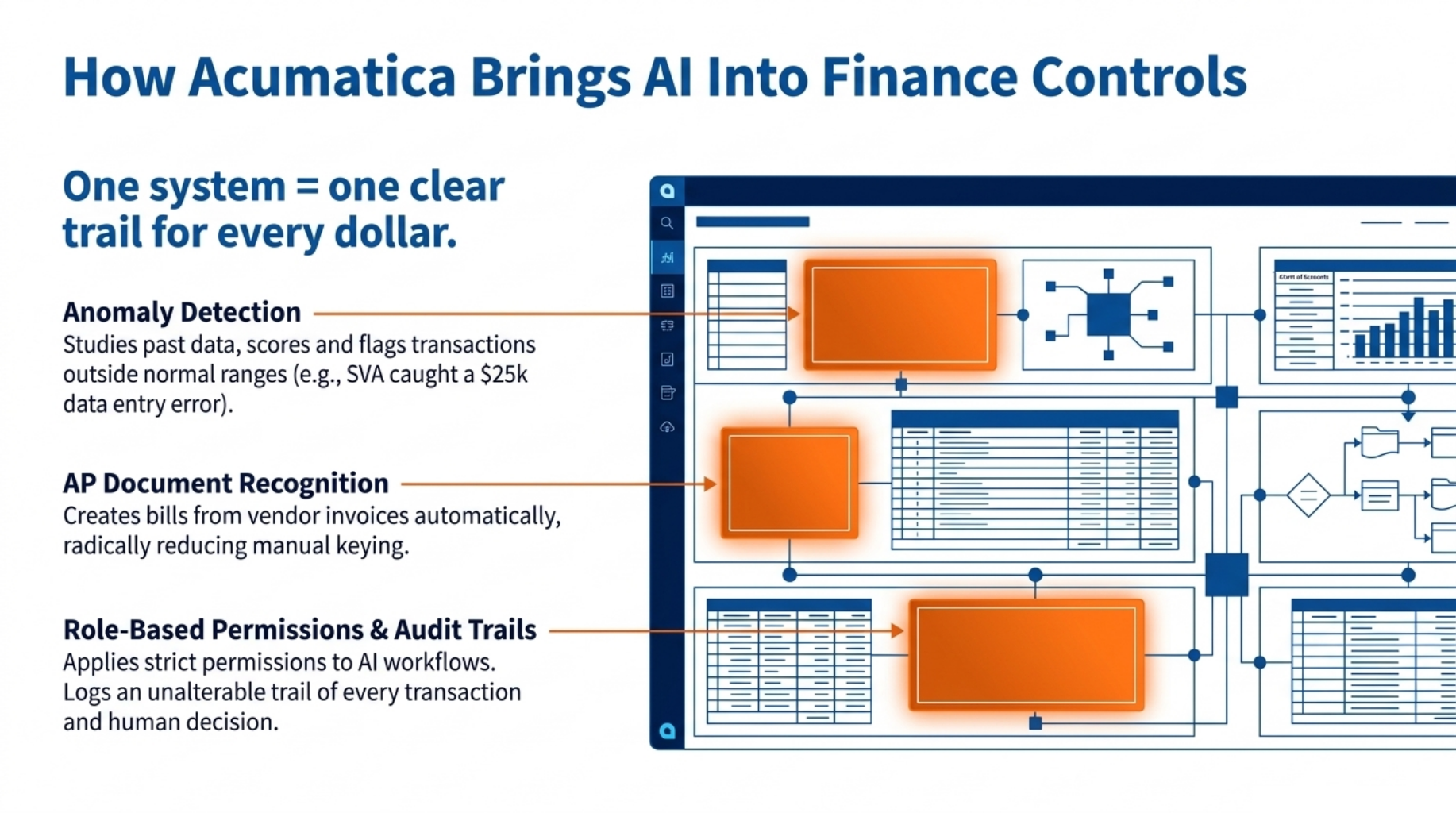
One system for the books makes one clear trail for every dollar. Acumatica holds the ledger, payables, and expense data together, which gives its AI tools cleaner data to learn from.
Among AI tools for internal financial controls, three Acumatica features matter most here:
- Anomaly Detection. It studies past data, then flags transactions outside the normal range. Partner SVA Consulting names near duplicate invoices and dormant vendors that suddenly become active. Reviewers can drill in, correct, approve, and add comments.
- AP document recognition. Acumatica says it can create bills from vendor invoices, so staff key in less data.
- Role-based permissions and audit trails. Acumatica applies existing role-based permissions to AI enabled workflows, and its payable’s datasheet lists an audit trail of all transactions.
SVA describes one expense claim flagged because its unit cost was $25,000 when similar claims ran a few hundred. The reviewer found a data entry error and fixed it before any payment.
Here is how to start.
Getting Started With Acumatica for Fraud and Error Prevention
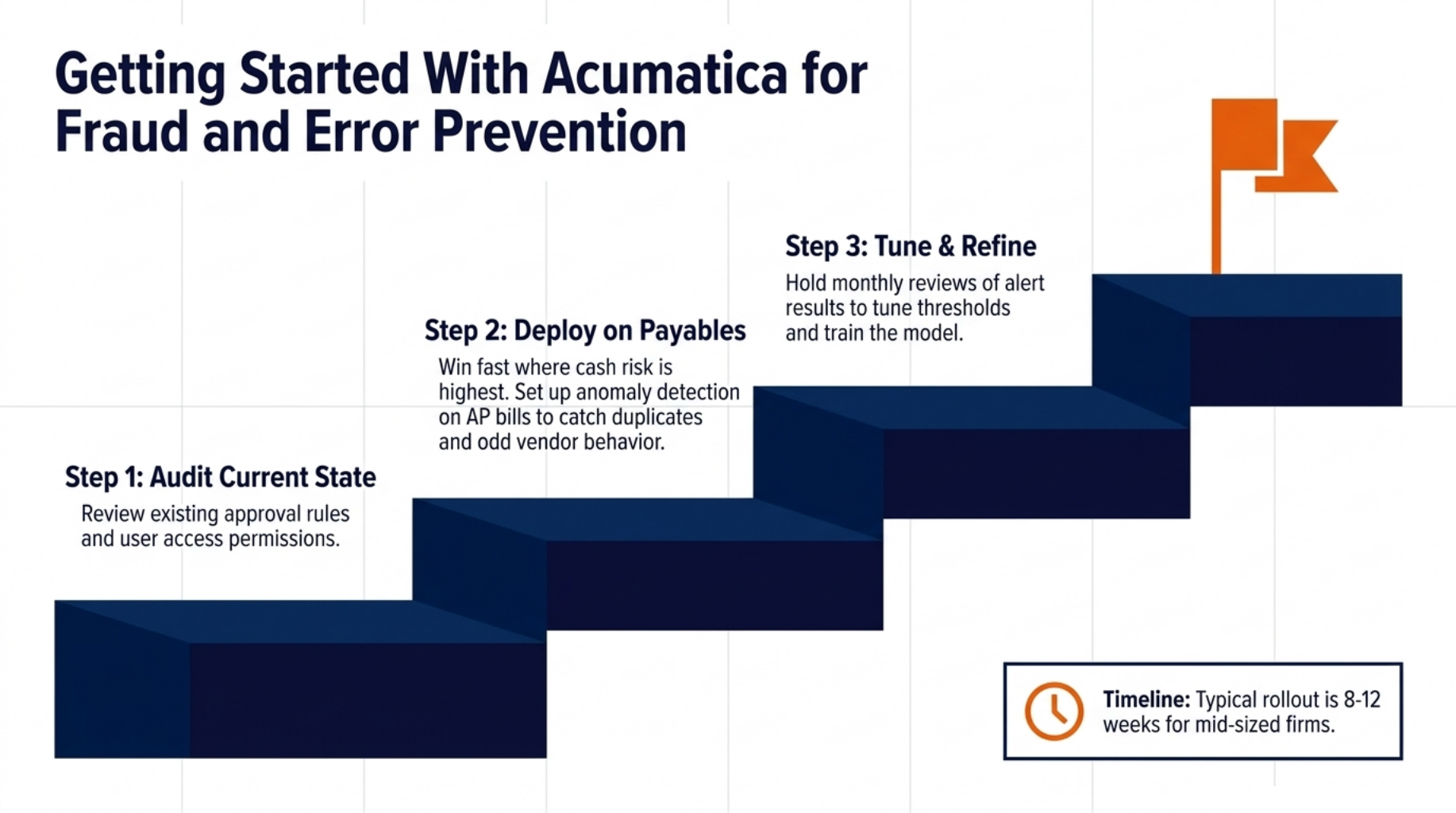
Start with payables. Win fast, then widen the net. Follow three steps:
- Review your current approval rules and user access.
- Set up anomaly detection on AP bills to watch for duplicates and odd vendor behaviour.
- Hold a monthly review of alert results and tune the checks.
These steps tighten your payment controls from day one. One AP automation vendor guide puts a typical rollout at 8 to 12 weeks for mid-sized firms, and your Acumatica partner can confirm what fits your data.
The main points are short.
Wrapping Up
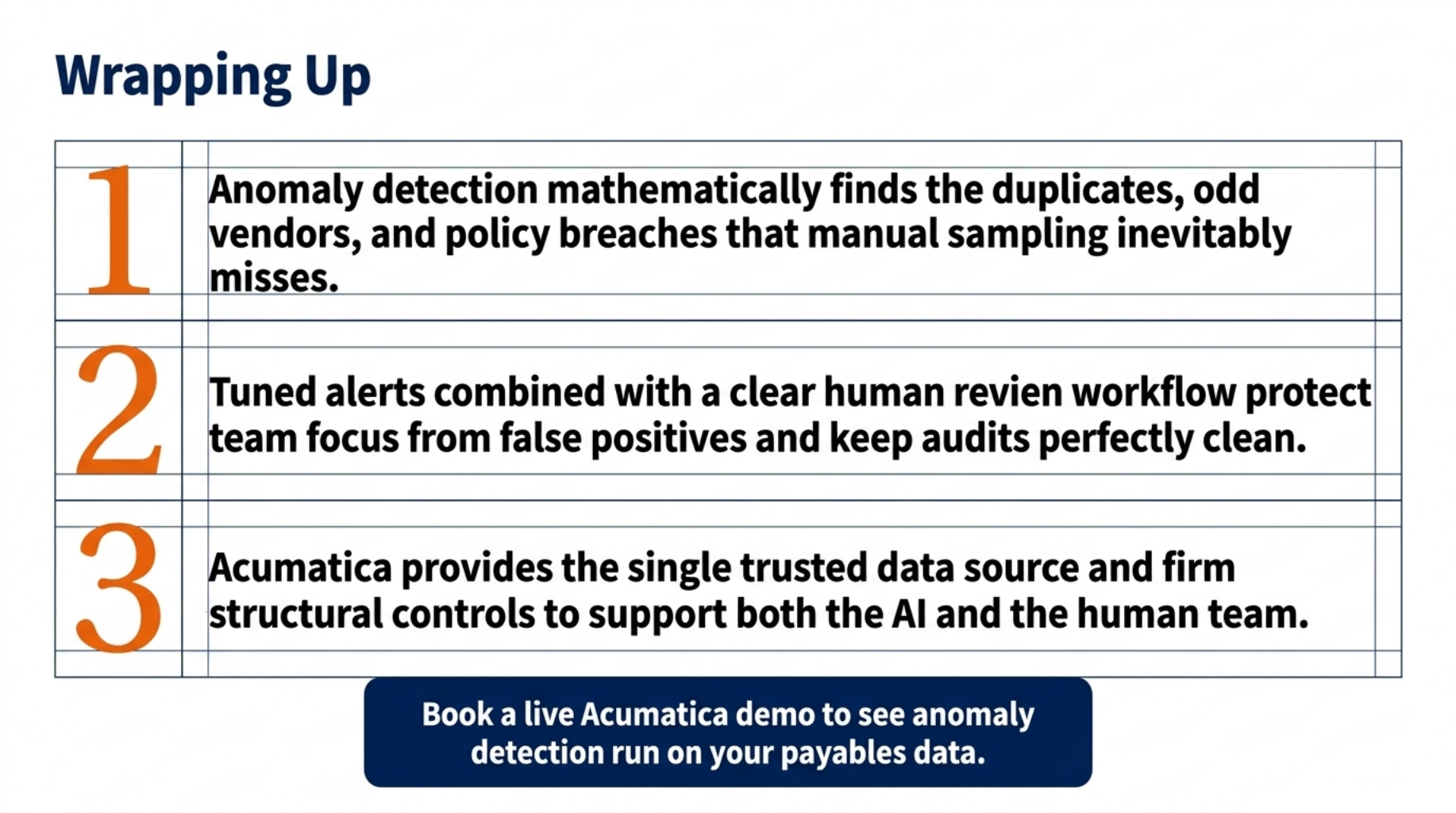
Keep these three points in mind:
- Financial anomaly detection finds duplicates, odd vendors, and policy breaches that manual review misses.
- Tuned alerts and a clear review workflow keep your team focused and your audits clean.
- Acumatica gives finance one trusted data source and strong controls to support both.
Book a live Acumatica demo to see anomaly detection run on your payable’s data.
Quick answers to common questions follow.
FAQ
What is financial anomaly detection?
It is the use of rules and machine learning to flag transactions that fall outside normal patterns so people can review them.
How can machine learning detect financial fraud?
Models learn the usual vendors, amounts, and timing in your data, then score new transactions by how far they differ.
How do you catch duplicate payments before they clear?
Match vendor, amount, and date range on every invoice, then hold any likely match until a reviewer confirms it.
How do you reduce false alerts in transaction monitoring?
Rank alerts by risk and value, and feed reviewer results back into the model to refine its thresholds.
Why does segregation of duties matter for fraud prevention?
It stops one person from controlling a transaction from start to finish, which removes the easiest path to fraud.