




Summary
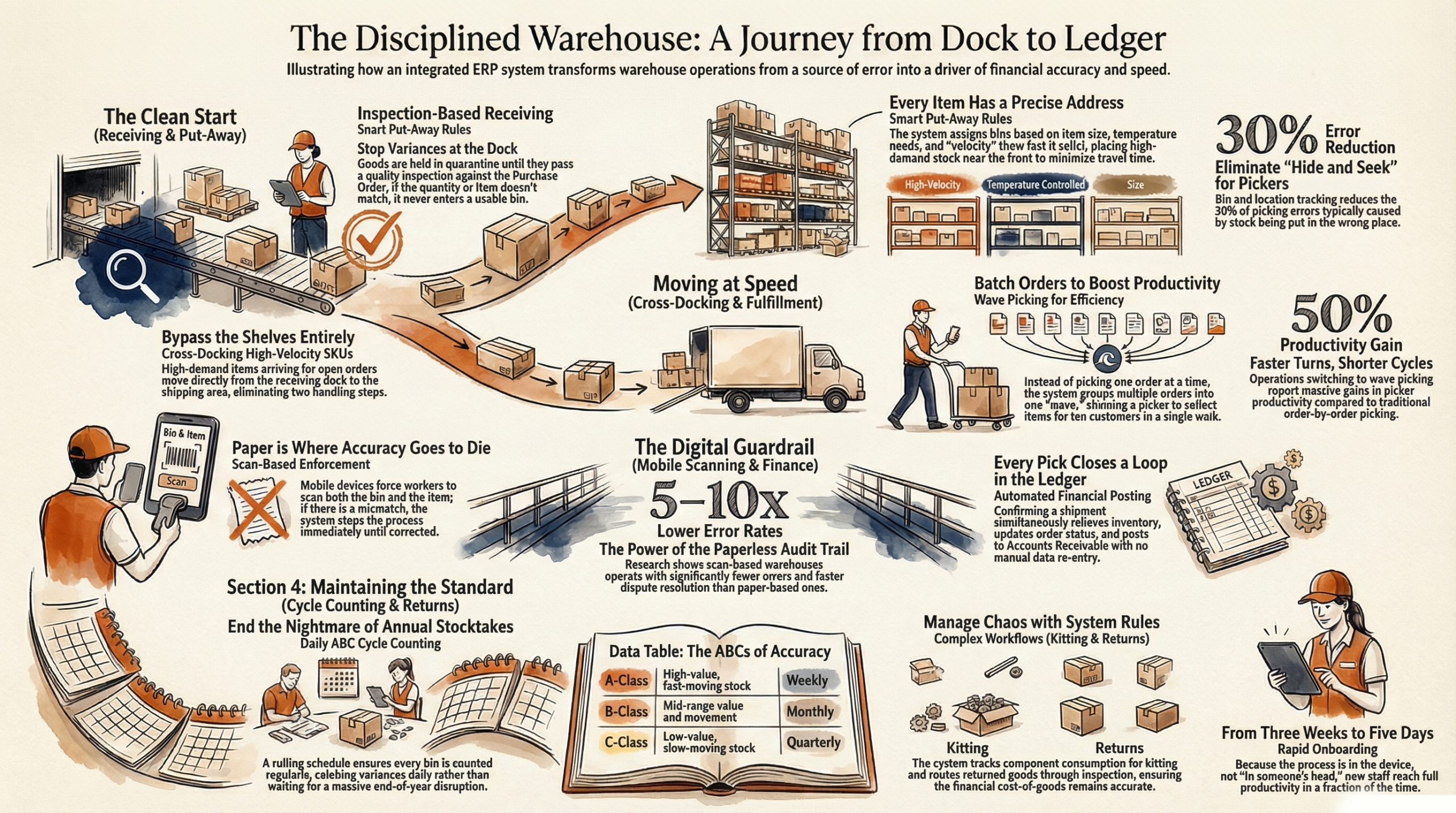
This guide explains how a warehouse management ERP (example: Acumatica) for South Africa eliminates inventory errors by enforcing disciplined processes from receiving to shipping. Key features are inspection-based receiving and smart put-away, barcode/mobile scanning, wave picking and cross-docking, daily cycle counting (ABC-focused), and system-managed kitting/returns. These controls produce accurate stock data, faster operations and automated financial postings so finance receives trustworthy numbers.
Key points
- Receiving & put-away: Hold mismatches in quarantine, only release after inspection; system assigns optimal bin by size, velocity, and temperature to prevent mis-putting and downstream errors.
- Pick/pack/ship and finance integration: Scanned shipment confirmation simultaneously relieves inventory, updates order status and posts AR — no manual re-entry.
- Cross-docking & wave picking: Cross-dock high-velocity SKUs to remove handling; batch orders into waves to boost picker productivity and cut cycle time.
- Cycle counting (daily, ABC): Replace full stocktakes with routine counts (A weekly, B monthly, C quarterly). Rapid variance detection, root-cause workflows and sustained ~99% accuracy.
- Mobile barcode scanning: Enforce every process step, stop wrong-item/quantity picks, create paperless audit trail, shorten new-staff onboarding and reduce errors 5–10× versus paper.
- Kitting, assembly, returns: System-managed workflows track component consumption, labour, and costs for accurate COGS; return routing and financial adjustments handled cleanly.
- Training & accountability: Standardised, system-enforced steps preserve institutional knowledge, create traceable records and reduce shortcut behaviours.
Ready to act? A live demo of an ERP warehouse management module (e.g., Acumatica) shows these tools applied to a South African distributor.
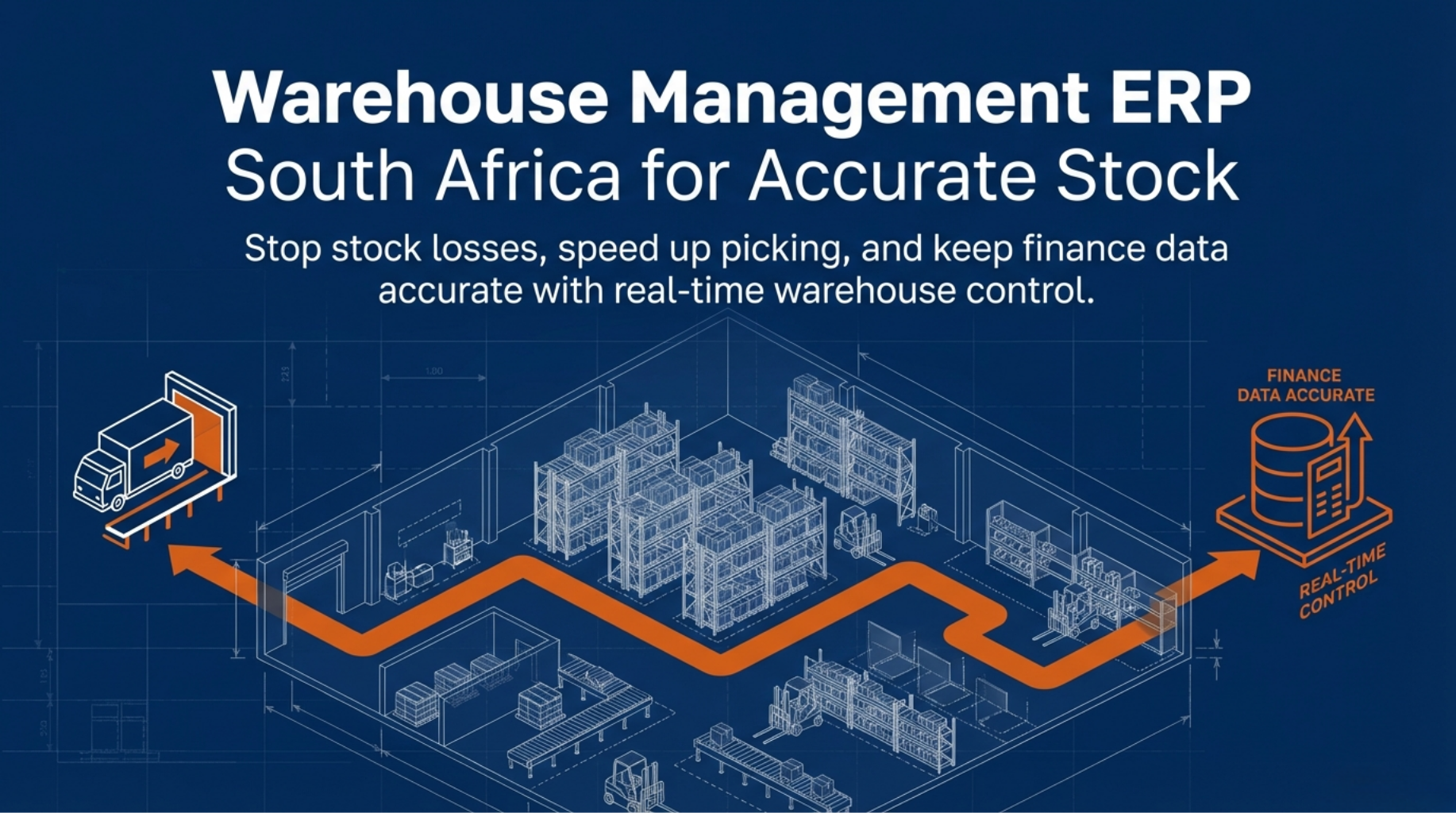
If your warehouse management ERP South Africa setup is not enforcing process at every step, your finance team is working with bad numbers. Inventory errors cost South African distributors time, money, and customer trust. The good news is that the right system eliminates those errors at the source — not at month-end when the damage is already done. This guide walks warehouse managers through the exact processes that deliver clean inventory data, faster picking, and financial transactions that post themselves.
Receiving and Put-Away That Starts Clean
“Accurate inventory starts the moment goods arrive at your dock.”
Alt tag: Warehouse worker scanning incoming stock at receiving dock with mobile device
Most inventory problems start at the receiving dock. A delivery arrives, someone counts the boxes, signs the paperwork, and moves the stock into the first open bin. That shortcut is where variances are born.
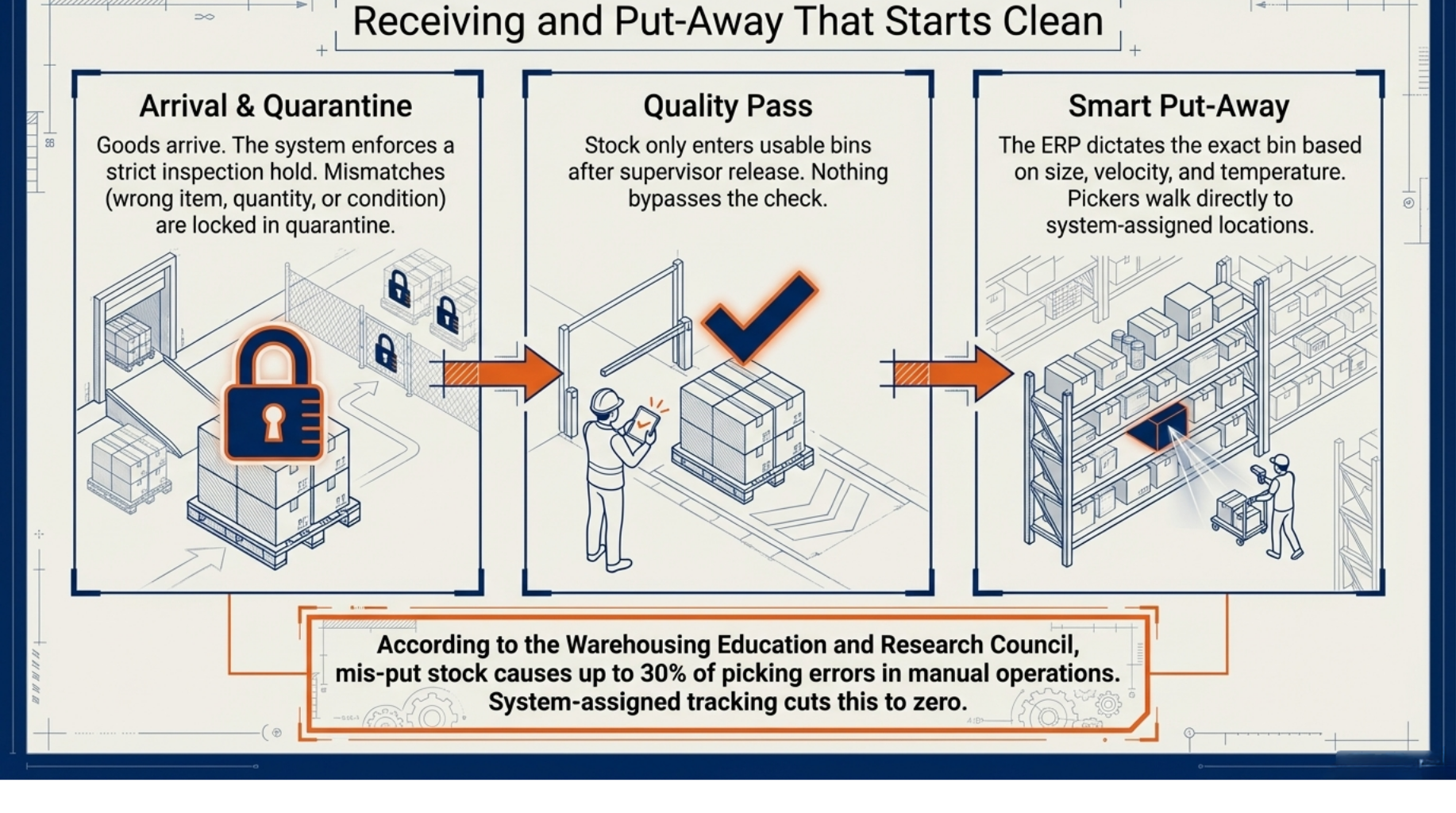
A warehouse management system puts a quality inspection hold on any item that does not match the purchase order — wrong quantity, wrong condition, wrong item. The stock sits in a quarantine location until a supervisor releases it or rejects it. Nothing enters your usable bins until it passes that check.
Once stock clears inspection, put-away rules take over. The system uses item dimensions, storage zone, and velocity to assign a bin. Fast-moving items land near the pick face. Bulky items go to ground-level locations. Temperature-sensitive stock routes to the correct zone automatically.
Every item now has a precise bin address. A picker looking for that item does not search — they walk to the location the system tells them. According to the Warehousing Education and Research Council, mis-put stock accounts for up to 30% of picking errors in manual operations. Bin and location tracking cuts that figure close to zero.
Good receiving process feeds good data downstream. Every section after this one depends on what happens at the dock.
Pick Pack Ship Workflows That Update Finance Automatically
“Every pick should close a loop — in the warehouse and the ledger.”
Alt tag: Warehouse picker using handheld scanner to fulfil order on pick list
Pick list generation is where fulfilment begins. The system pulls all open sales orders, groups them by pick zone or carrier, and issues a list to each picker. No manual sorting, no paper shuffle.
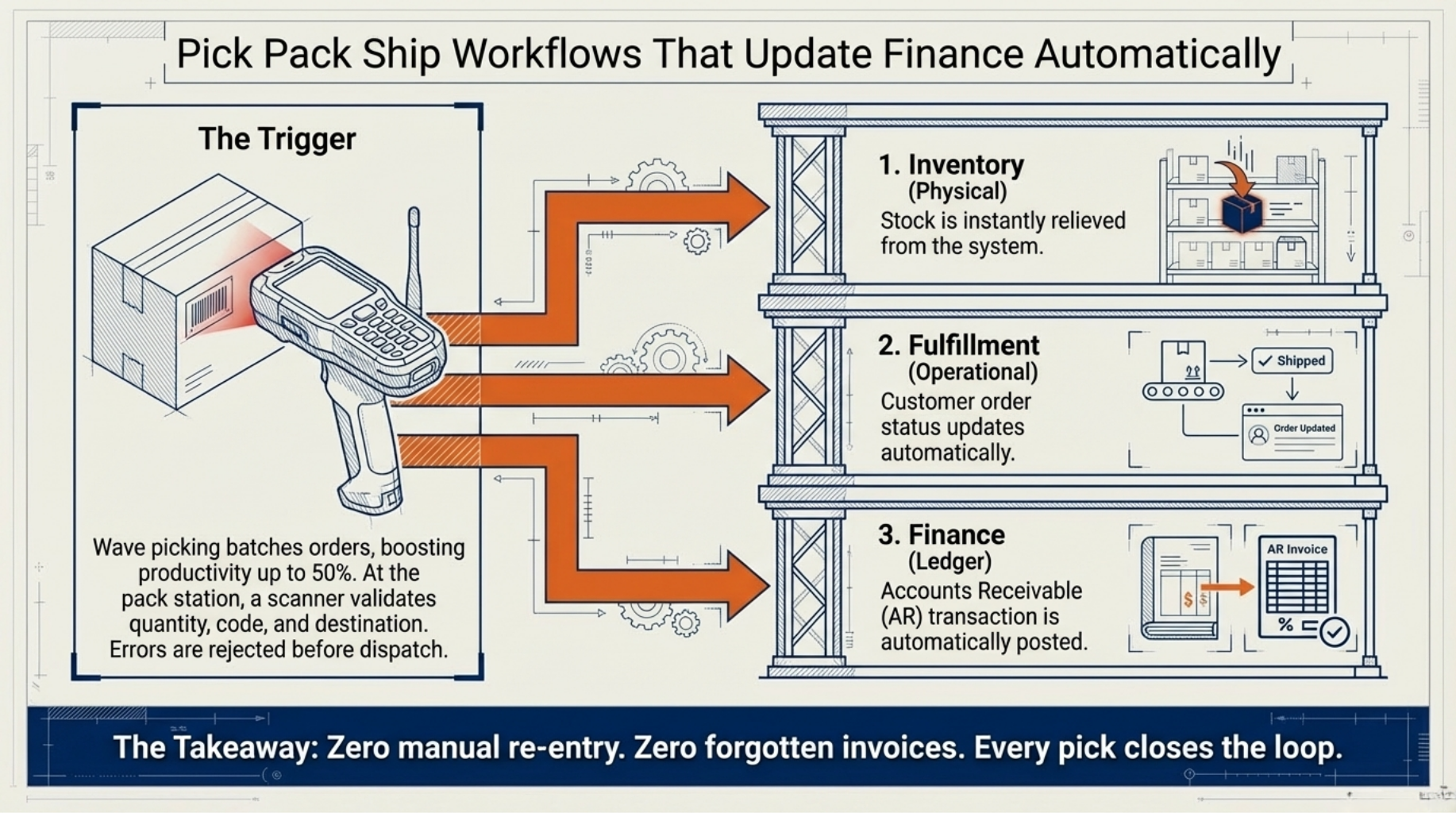
Wave picking takes this further. Instead of one picker handling one order at a time, the system batches multiple orders into a single pass through the warehouse. A picker collects items for ten orders in one walk, then sorts at the pack station. Operations that switch to wave picking report productivity gains of up to 50% compared to order-by-order picking.
At the pack station, the picker scans each item to confirm it matches the order. The system checks quantity, item code, and destination. If anything is wrong, the scan fails and the error is caught before the parcel leaves the building.
When the shipment is confirmed, the system does three things at once: it relieves inventory, updates the customer order status, and creates the accounts receivable transaction. No one re-enters the data. No one forgets to post the invoice.
Cross-Docking for Fast-Moving Items
Some items do not need to visit a storage bin at all. When a high-velocity SKU arrives from a supplier and there is already an open customer order waiting for it, cross-docking moves that stock directly from the receiving dock to the outbound staging area.
This removes two handling steps — put-away and pick — and cuts order cycle time. For items that turn weekly or faster, cross-docking is one of the highest-impact changes a warehouse manager can make.
Cycle Counting That Keeps Inventory Accurate Every Day
“Daily counts beat annual stock takes — every time.”
Alt tag: Warehouse team member counting shelf stock with tablet and barcode scanner
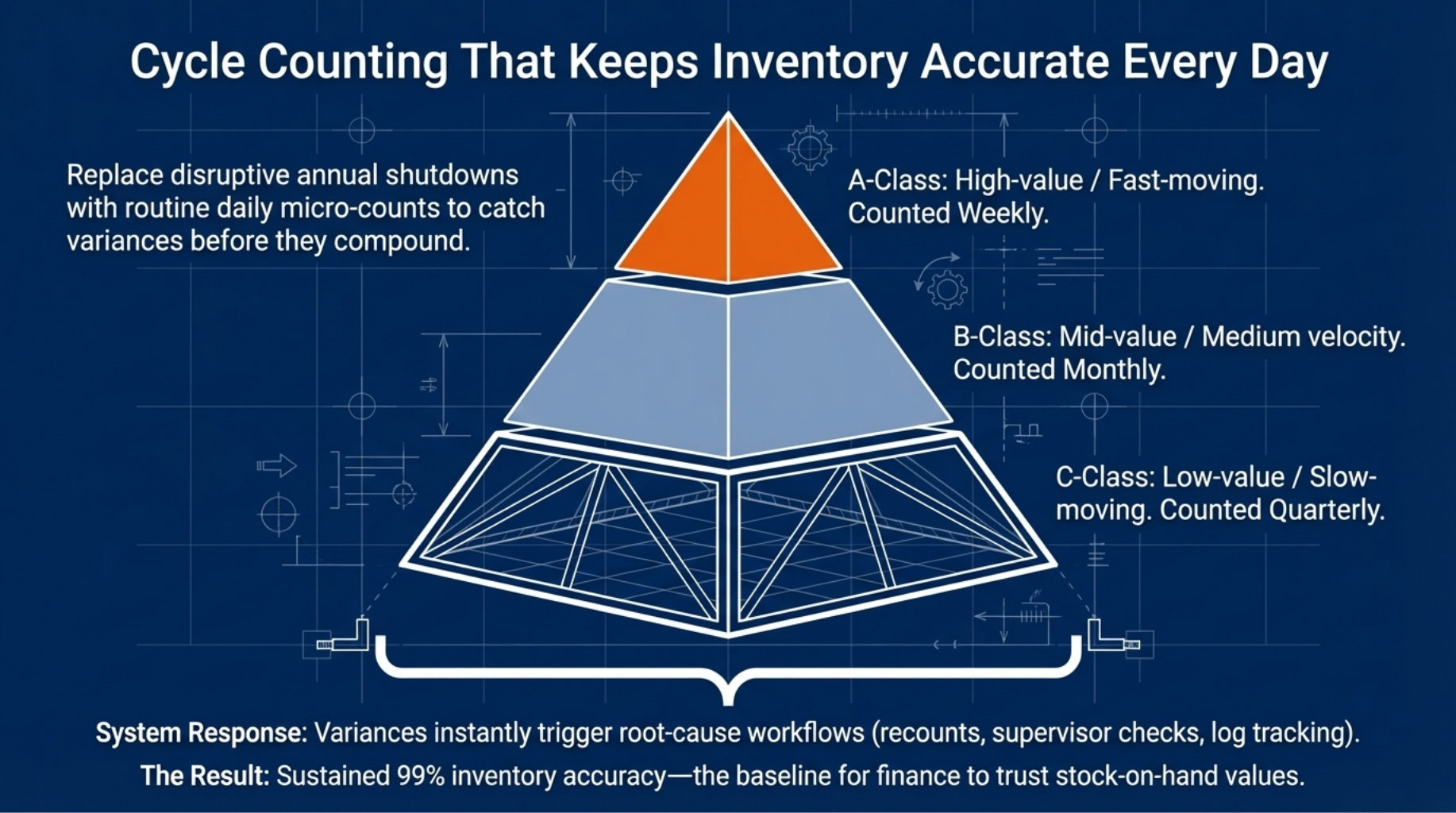
A full stock take shuts your warehouse down. It burns staff time, delays orders, and delivers a snapshot that is already out of date by the time you finish. Cycle counting replaces that disruption with a daily habit.
Each day, a small group of bins gets counted. Over a rolling period, every location gets checked. Variances surface quickly, before they compound into write-offs.
ABC analysis makes this smarter. A-class items — your highest-value, fastest-moving stock — get counted most often, sometimes weekly. B-class items get a monthly count. C-class items, low-value and slow-moving, get counted quarterly. The result is that your counting effort concentrates exactly where it matters most.
When a count finds a variance, the system triggers an investigation workflow. The counter does a recount. If the discrepancy holds, a supervisor investigates — wrong bin, wrong item, a receipt that was never confirmed. Root causes get logged. Patterns get fixed.
Operations that run a disciplined daily cycle counting programme consistently achieve 99% inventory accuracy. That number is not aspirational — it is the operational floor for warehouses that want finance to trust their stock-on-hand values.
Barcode Scanning and Mobile Devices in the Warehouse
“Paper pick lists are where accuracy goes to die.”
Alt tag: Mobile warehouse scanning device displaying bin location and item quantity
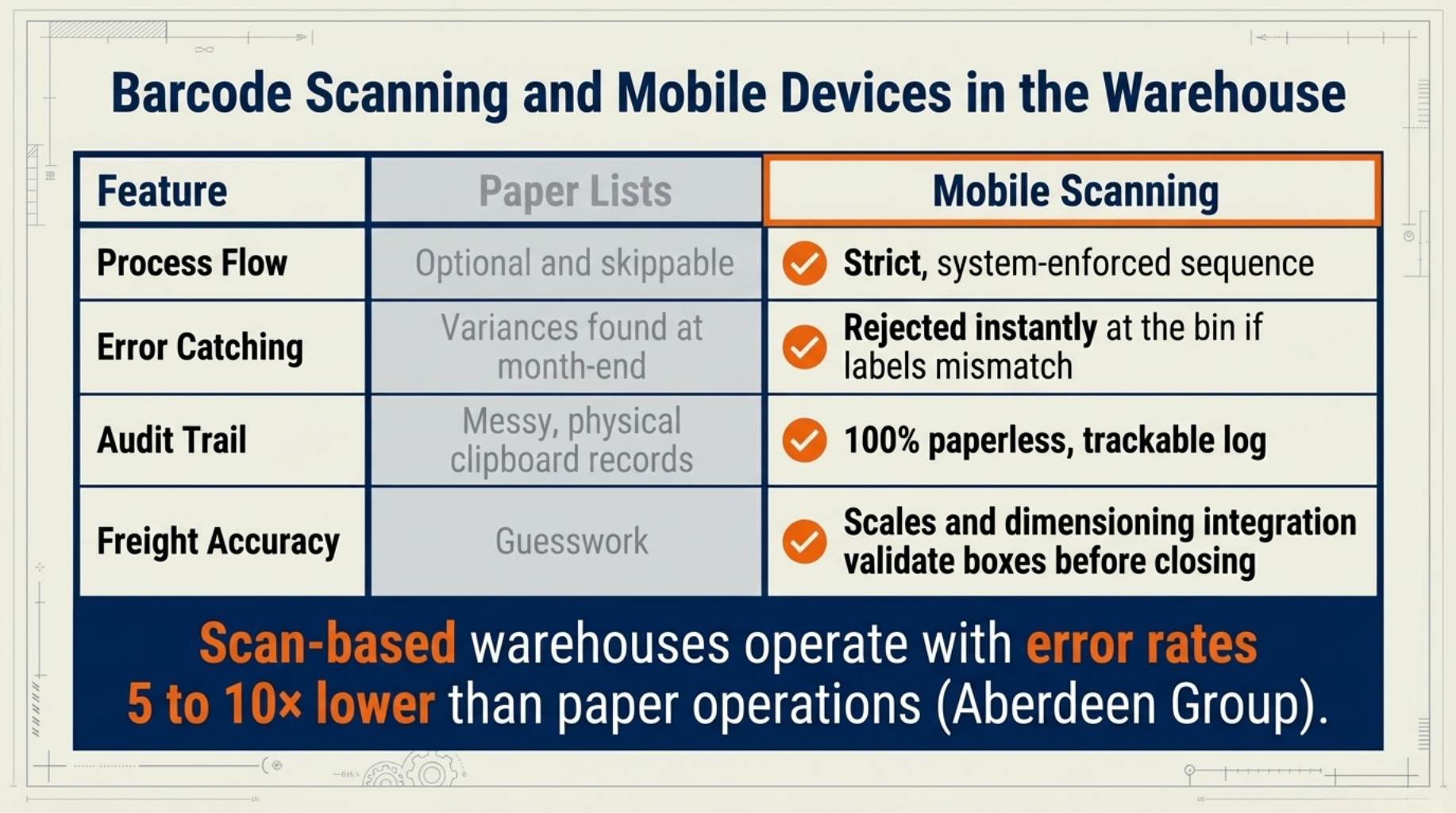
A mobile scanning device does more than replace a clipboard. It enforces every process step in sequence. A picker cannot confirm a pick without scanning the bin label and the item barcode. The system checks both against the order. If either is wrong, the device rejects the scan and prompts a correction.
That enforcement is the key difference between paper and scanning. A worker with a paper list can skip steps, write the wrong quantity, or pick the wrong item without any system pushback. A worker with a scanner cannot proceed until the correct action is confirmed.
Integration with scales and dimensioning systems at the pack station adds another layer. Weight and cube data capture at pack lets the system validate that the correct items are in the box before it closes. It also feeds accurate freight data to the courier booking.
Research by the Aberdeen Group found that scan-based warehouses operate with error rates five to ten times lower than paper-based operations. The paperless audit trail those scans create also makes stocktake reconciliation and customer dispute resolution significantly faster.
The transition from paper to mobile devices speeds up new staff training. The device tells a new picker exactly where to go and what to scan. The process is in the system, not in someone’s head.
Kitting, Assembly, and Returns Without the Chaos
“Complex warehouse operations need rules, not workarounds.”
Alt tag: Warehouse supervisor reviewing kitting assembly order on ERP screen
Kitting, assembly, and returns are where manual warehouses accumulate the messiest data. Each one involves multiple items moving in unusual directions. Without system support, inventory counts go wrong and financial entries get missed.
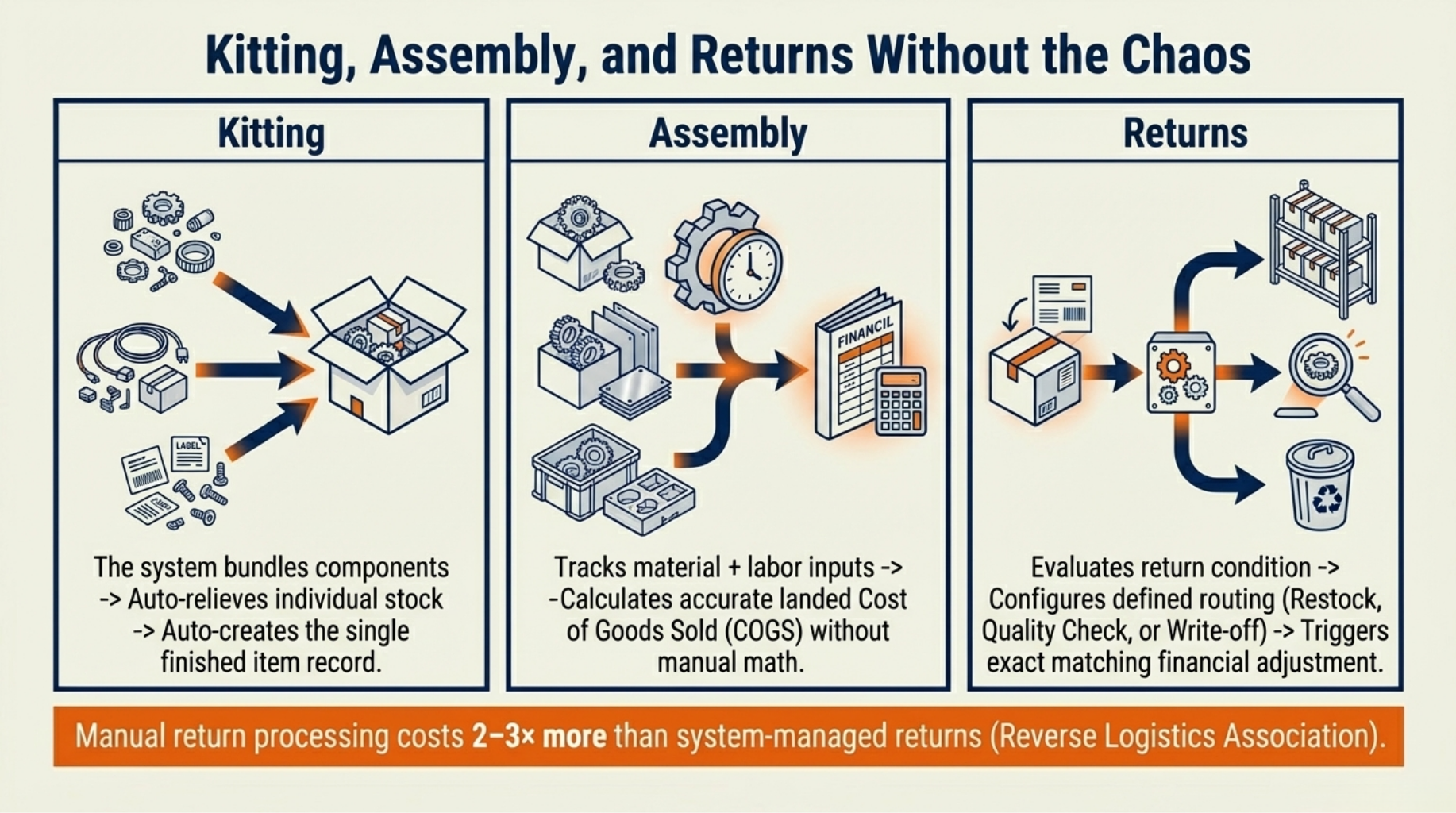
Kitting is straightforward in concept — take several components and bundle them into a single finished item. In practice, each component needs to be relieved from stock and the finished kit needs to be created as a new inventory record. The system handles both steps when the kit order is confirmed.
Assembly orders extend this to include labour and materials. The system tracks what went in and calculates the landed cost of the assembled item, giving finance an accurate cost-of-goods figure without manual calculation.
Returns are the most overlooked flow. A returned item needs a route — does it go back to a saleable bin, to quality inspection, or to a write-off location? Each path requires a different inventory adjustment and a different financial transaction. According to the Reverse Logistics Association, processing a return costs two to three times more in manual operations than in system-managed ones. A defined returns workflow in the system cuts that cost and keeps the audit trail clean.
Training Staff and Standardising Warehouse Processes
“Consistency turns a good warehouse into a great one.”
Alt tag: Warehouse manager conducting staff training session on mobile scanning device
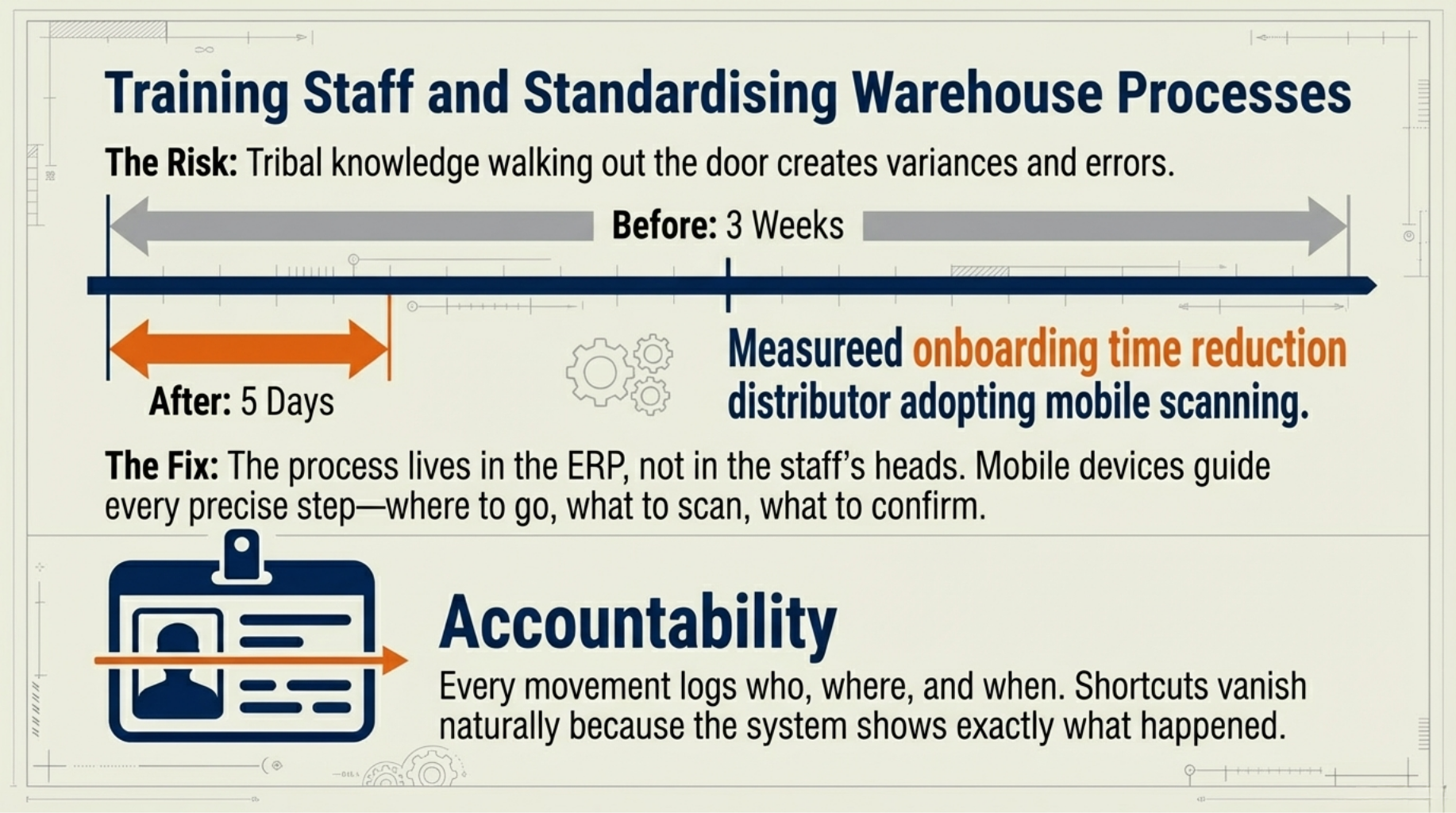
Staff turnover is the warehouse manager’s constant challenge. When your most experienced picker leaves, they take tribal knowledge with them — which bin is actually used for overflow, which supplier always shorts the order, which customer needs special packing. That knowledge walk-out creates variances.
System-enforced workflows remove the dependence on individual knowledge. The mobile device tells a new picker which bin to go to, which item to scan, and what quantity to confirm. They reach working productivity in days, not weeks. One Acumatica implementation at a South African distributor saw new picker onboarding drop from three weeks to five days after mobile scanning was introduced.
Process standardisation also closes the accountability gap. Every movement in the warehouse creates a transaction record — who picked it, from which bin, at what time. If a variance appears in a cycle count, the investigation starts with that log. Managers do not rely on memory or accusation. The system shows exactly what happened.
That accountability changes behaviour without confrontation. When staff know every scan is recorded, shortcuts decrease and accuracy improves on its own.
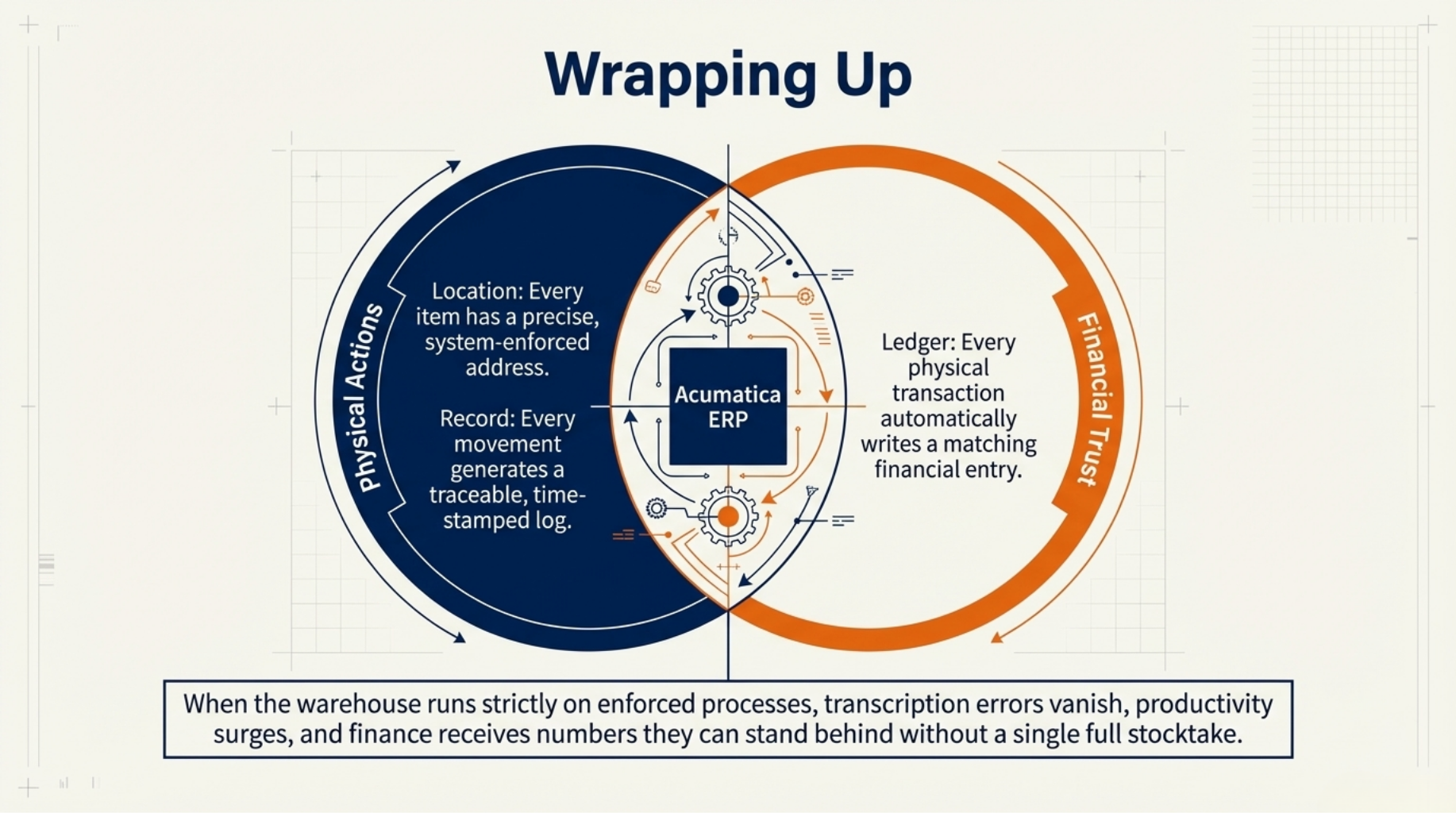
Wrapping Up
A warehouse management ERP South Africa built on Acumatica gives every item a location, every movement a record, and every transaction a matching financial entry. Daily cycle counting with ABC analysis brings you to 99% inventory accuracy without a single full stock take. Mobile scanning enforces process steps, eliminates transcription errors, and delivers productivity gains that are measurable from the first week of operation. When the warehouse runs clean, the numbers finance receives are the numbers you can stand behind.
Ready to see this in action? Book a live demo to see how Acumatica’s warehouse management tools work in a South African operation like yours.
FAQ
What is warehouse management ERP South Africa?
A warehouse management ERP is software that tracks every stock movement, bin location, and warehouse transaction and feeds that data directly into your financial system.
How does cycle counting improve inventory accuracy?
Cycle counting splits your stock into small daily counts so variances are caught and fixed before they compound into large discrepancies.
What is wave picking in a warehouse management system?
Wave picking batches multiple customer orders into one picking run, reducing travel distance and increasing the number of orders a picker can complete per shift.
How does barcode scanning reduce warehouse errors?
Scanning confirms every pick, put-away, and count against the system record, preventing the transcription mistakes that cause stock variances on paper-based processes.
Can a warehouse management system handle kitting and returns?
Yes — a warehouse management system tracks component consumption for kitting and routes returned goods through inspection to restocking or write-off, updating inventory and finance at each step.