




Summary
A multi-branch retail ERP for South Africa centralises inventory, sales, and financials across all stores in real time, removing silos and costly errors as retailers scale. It automates replenishment and inter‑branch transfers, supports branch-specific pricing and returns, and (with unlimited-user licensing models) avoids per-user cost barriers—delivering faster decisions, lower carrying costs and higher stock accuracy.
Key points
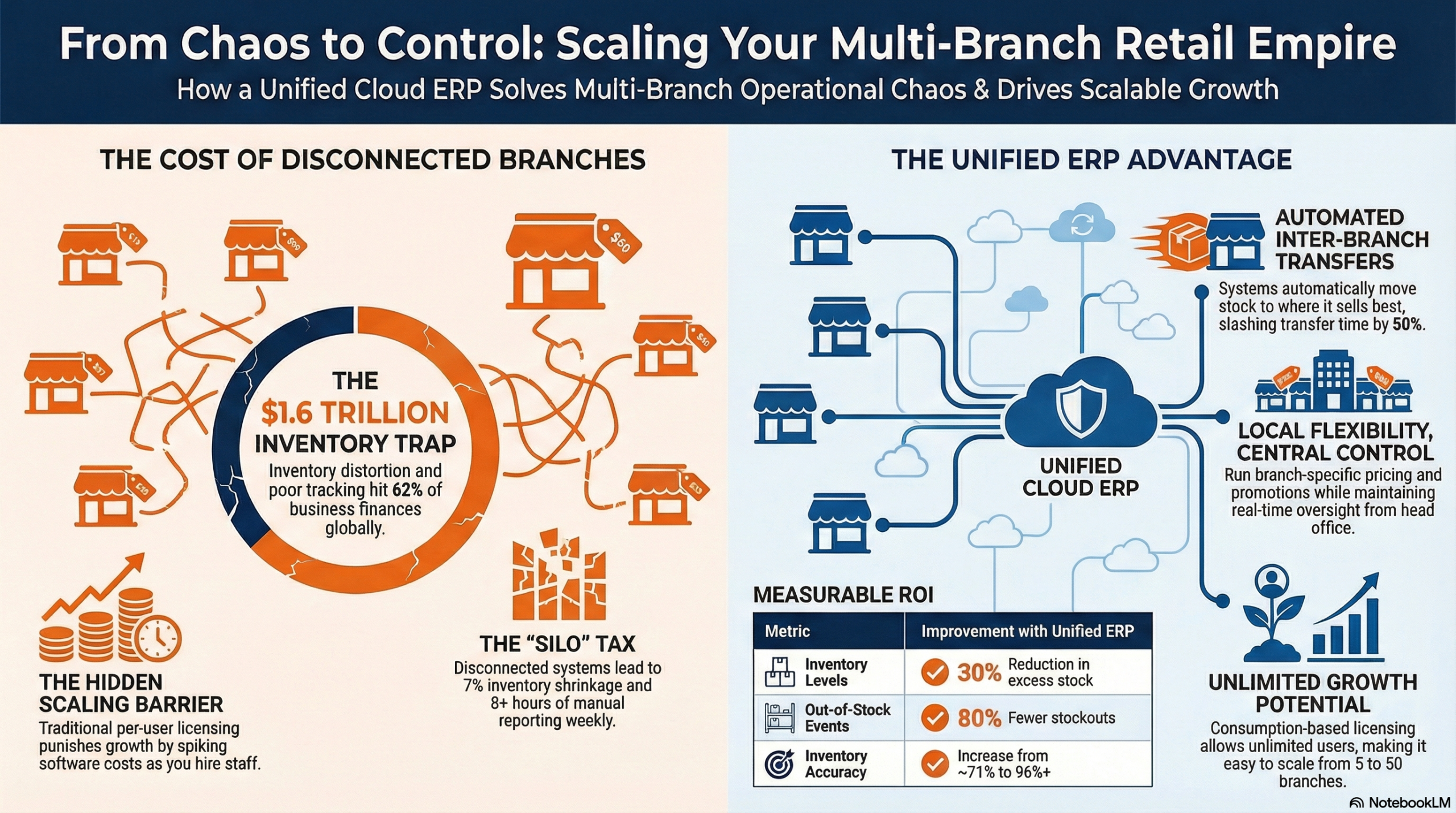
- Unified visibility: One source of truth for inventory, sales, and finances across every branch; head office and branch managers see the same real‑time data.
- Inventory & transfers: Automated reorder points, transfer suggestions and workflows reduce stockouts and excess inventory (typical benefits cited: ~30% inventory reduction, 50% faster transfers, 80% fewer stockouts).
- Branch flexibility: Support for local pricing, promotions and franchise vs company-owned configurations while maintaining central oversight.
- Scalability & licensing: Cloud-based ERP and consumption/unlimited-user licensing remove per-user cost barriers and let retailers add branches without huge software cost jumps.
- Change & results: Pilot-led rollouts and training ease adoption; measurable gains include higher inventory accuracy, reduced carrying costs and reclaimed staff time for customer-facing work.
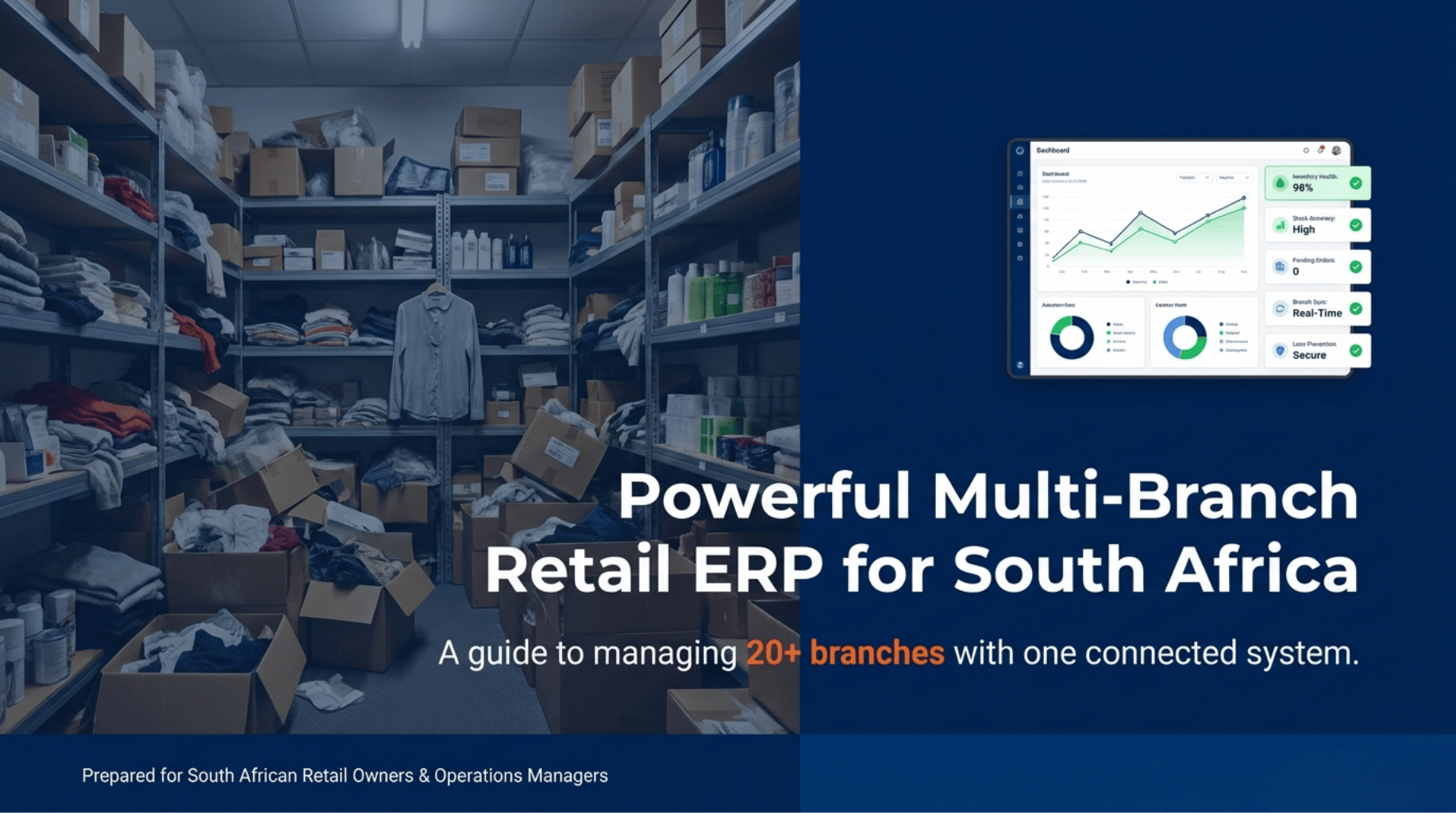
Your first retail store ran like clockwork. You knew every product on every shelf. Then you opened store two, three, and five. Suddenly, stock sits idle at one branch while another runs dry. Sound familiar?
A multi-branch retail ERP in South Africa solves this exact problem. It gives you one connected system that tracks every product across every location; in real time. No more guessing. No more phone calls between branches to check stock.
Here’s the thing most growing retailers don’t realise until it’s too late: inventory distortion costs businesses over $1.6 trillion worldwide each year. That’s not a typo. For South African retailers scaling from one store to twenty, the stakes are massive. The right ERP system can cut your inventory by 30% and slash inter-branch transfer time in half.
This guide walks you through how to manage twenty branches with one inventory system, and grow without the chaos.
Why Multi-Branch Retailers in South Africa Need a Unified ERP
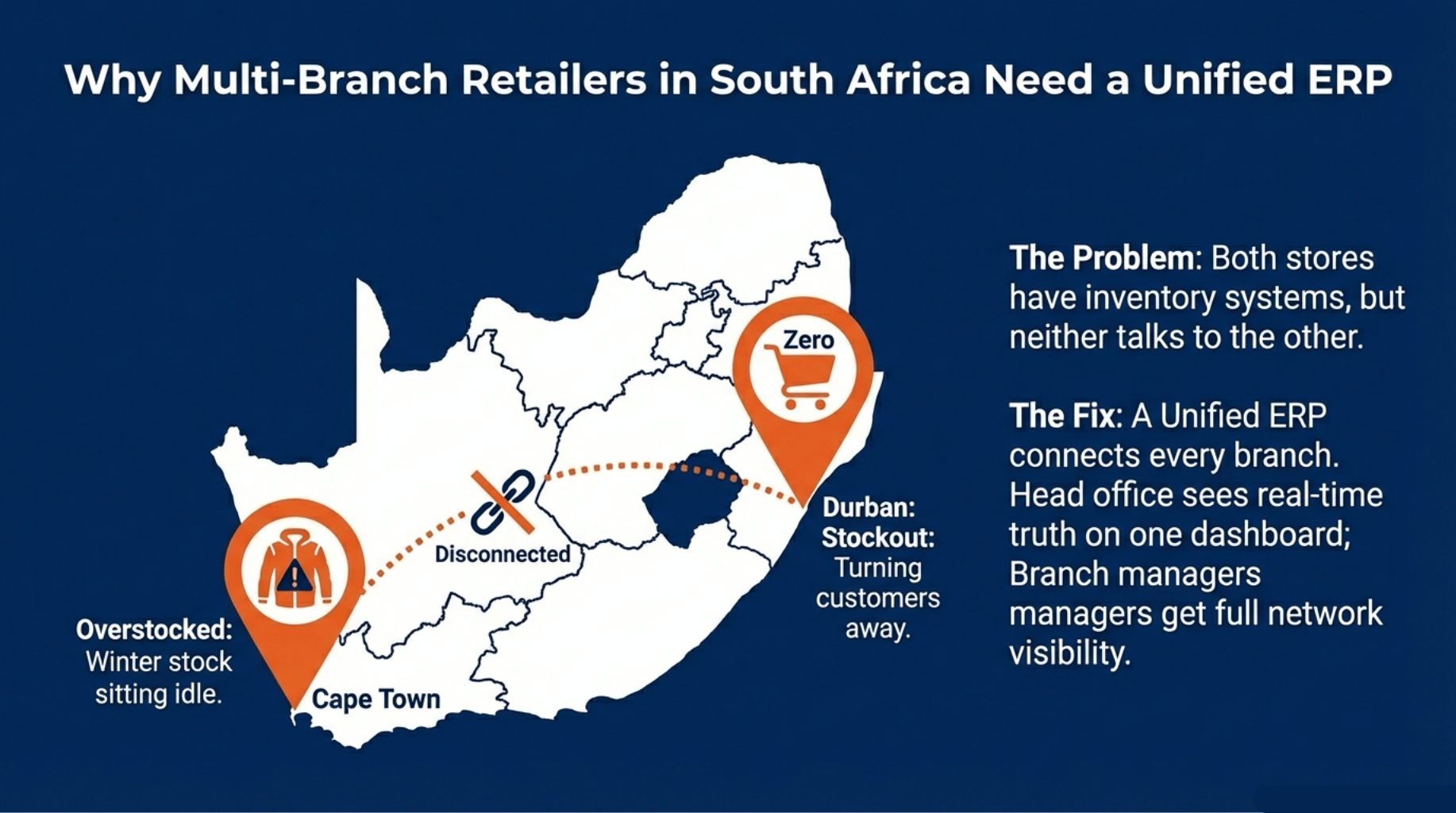
Picture this. Your Cape Town store is drowning in winter jackets nobody’s buying. Meanwhile, your Durban branch sold out two weeks ago and keeps turning customers away. Both stores have “inventory systems.” Neither one talks to the other.
That’s what happens when each branch runs its own setup. Reports don’t match. Stock counts conflict. Your finance team burns through entire days reconciling numbers that should take minutes.
A unified multi-branch retail ERP changes the game. It connects every branch to one system. Head office sees real-time inventory, sales, and financials for every location on a single dashboard. Branch managers still run their stores day-to-day; but now they do it with full visibility across the entire network.
No more guessing which branch has what. No more surprises at month-end. Just one source of truth that everyone trusts.
The Real Cost of Disconnected Branch Systems
When each branch runs its own spreadsheet or standalone software, problems pile up fast; and they’re expensive.
Studies show that 62% of business finances take a hit because of poor inventory tracking. On top of that, retailers lose roughly 7% of their inventory every year to theft, damage, and human error. That shrinkage rate climbs even higher when branches operate in silos with no central oversight.
For South African retailers, the pain runs deeper. Load shedding disrupts operations at the worst possible moments. Currency fluctuations squeeze margins. And when your systems aren’t connected, small errors at branch level snowball into big problems at head office.
Here’s what disconnected systems actually cost you:
- Overstocking ties up working capital you could invest elsewhere
- Stockouts send frustrated customers straight to your competitors
- Manual reconciliation eats up hours of management time every week
- Branch-level errors go undetected for weeks; sometimes months
One mid-market retailer we’ve worked with discovered they’d been carrying R2.3 million in dead stock across eight branches; simply because no one had visibility into what was sitting on shelves at other locations. That’s money locked up doing nothing.
What a Connected Multi-Branch Retail ERP Delivers
A connected ERP replaces guesswork with data. Every sale, every transfer, every return updates the system the moment it happens. Head office gets consolidated dashboards showing the full picture. Branch managers get local reports tailored to their store. Everyone works from the same numbers.
The capabilities that matter most for multi-branch retailers include:
- Real-time inventory across all locations; know exactly what’s where, right now
- Consolidated and branch-level financial reports; no more manual merging of spreadsheets
- Automated reorder points and stock alerts; the system flags low stock before it becomes a problem
- A single customer database shared across every branch; so returns and loyalty work everywhere
Research shows that retailers using automated inventory management reduce stockouts by up to 80%. That’s not a small improvement. That’s the difference between a customer walking out happy and walking out the door; for good.
For growing South African retail chains, this translates to faster decisions, lower holding costs, and a customer experience that stays consistent whether someone shops in Johannesburg, George, or anywhere in between.
The bottom line? A connected ERP doesn’t just organise your data. It gives every branch the tools to sell smarter; while head office keeps the entire network running as one.
How Multi-Branch Retail ERP Handles Branch-Specific Operations
Here’s something most retailers learn the hard way: not every branch should operate the same way.
A store in Sandton serves a completely different customer base than one in Stellenbosch. Buying patterns differ. Price sensitivity varies. Even the product mix that flies off the shelves changes from one location to the next.
Your ERP needs to respect these differences; without letting the network spiral into chaos.
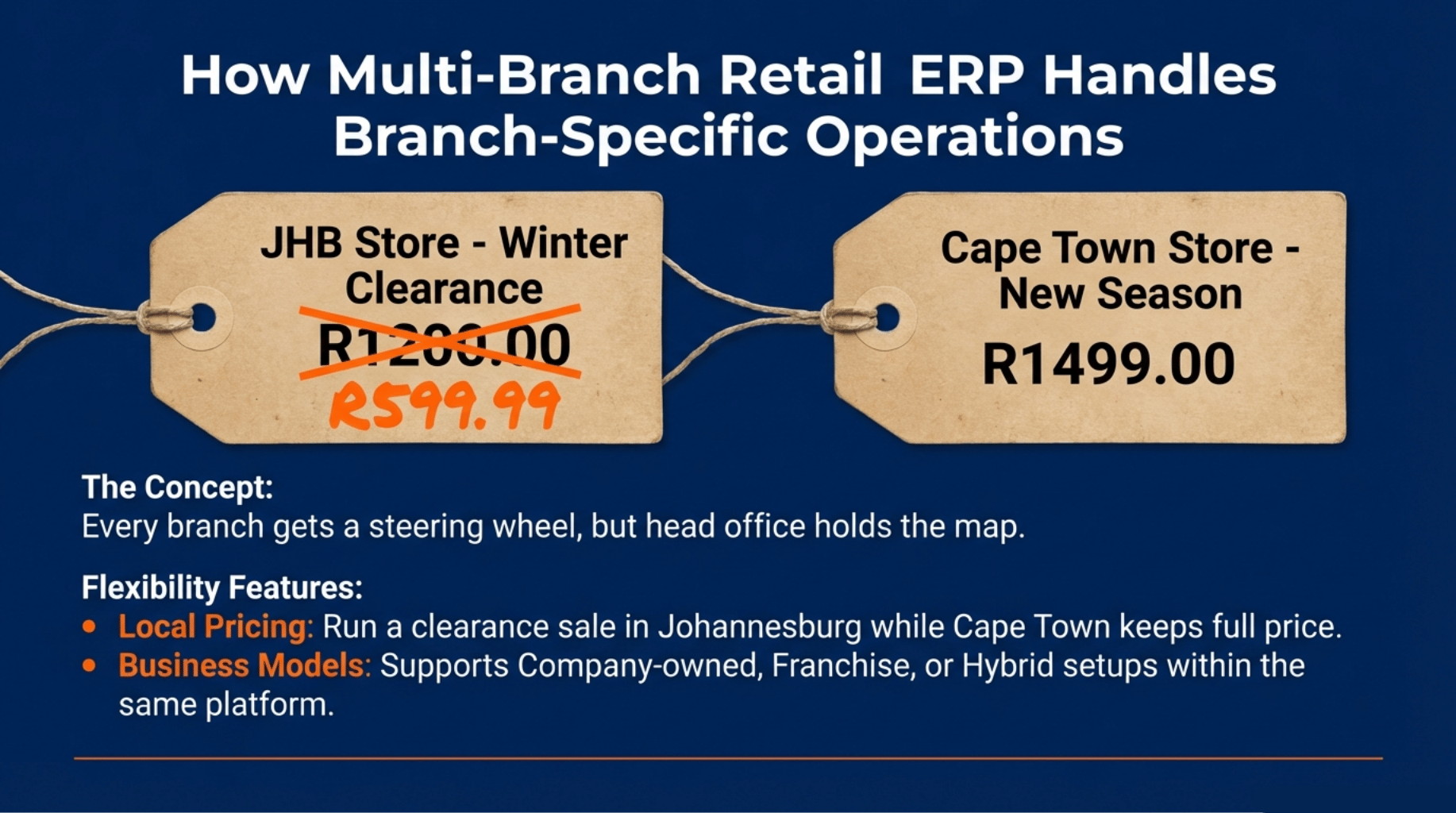
A multi-branch retail ERP in South Africa lets each branch run with its own local pricing, promotions, and stock levels. All within one centralised platform. You’re not forcing twenty stores into the same rigid mould. Instead, you give each location the flexibility it needs while head office keeps firm control at the group level.
Think of it like this: every branch gets its own steering wheel, but head office still holds the map.
That means your Johannesburg flagship can run a clearance sale on winter stock while your Cape Town branch keeps those same items at full price; because winter hasn’t hit yet. The system handles both scenarios without anyone picking up the phone or updating a spreadsheet.
Whether you’re managing company-owned locations, franchise setups, or a mix of both, the ERP adapts to each configuration. Branch managers get the autonomy they need. Head office gets the oversight it demands. Everyone wins.
Inter-Branch Transfers That Balance Stock Levels
Excess stock at one branch is a missed sale at another. It’s that simple.
A multi-branch ERP automates inter-branch transfer requests based on real stock levels and sales velocity. When Branch A drop below its reorder point, the system doesn’t just fire off a purchase order. It first checks whether Branch B or C has surplus stock sitting on shelves. If they do, it suggests a transfer instead.
Retailers who move from manual to automated transfer workflows see up to a 50% reduction in inter-branch transfer time. Stock flows to where it sells; not where it gathers dust.
Here’s how it works in practice:
- Automated transfer suggestions triggered by demand signals and stock thresholds
- Approval workflows that loop in both branch managers and head office where needed
- Full tracking from the moment stock leaves one branch until it’s received at another
- Reduced excess stock across your entire network; freeing up capital and shelf space
One retailer we supported had R1.8 million in slow-moving stock spread across twelve branches. Within three months of switching to automated transfers, they redistributed over 60% of that stock to locations where it actually sold. No new purchase orders needed.
Customer Returns, Stock Takes, and Branch-Level Pricing
What happens when a customer buys a jacket in Pretoria and wants to return it in Bloemfontein?
Without a connected system, that return becomes a headache. Stock records break. Financial reports don’t line up. The branch receiving the return doesn’t know where the item came from or what was paid.
With a multi-branch retail ERP, every transaction links back to the original sale; no matter which branch handles the return. The system updates inventory at the receiving branch, adjusts financials automatically, and keeps your records clean across the board.
Stock takes get simpler too. Each branch runs its own cycle count on its own schedule. Meanwhile, head office monitors variances across the entire group in real time. If one location shows a spike in shrinkage, you spot it immediately; not six weeks later during a manual audit.
And then there’s pricing. With branch-specific pricing built in, you can run region-based promotions without accidentally discounting stock at every store. Launch a back-to-school campaign in Gauteng while keeping standard pricing in the Western Cape. The system keeps it all separate and clean.
- Cross-branch returns with automatic inventory and financial updates
- Branch-level cycle counts with group-wide variance reports
- Region-specific pricing and promotional campaigns that don’t bleed into other stores
- Flexible configurations for franchise vs. company-owned locations
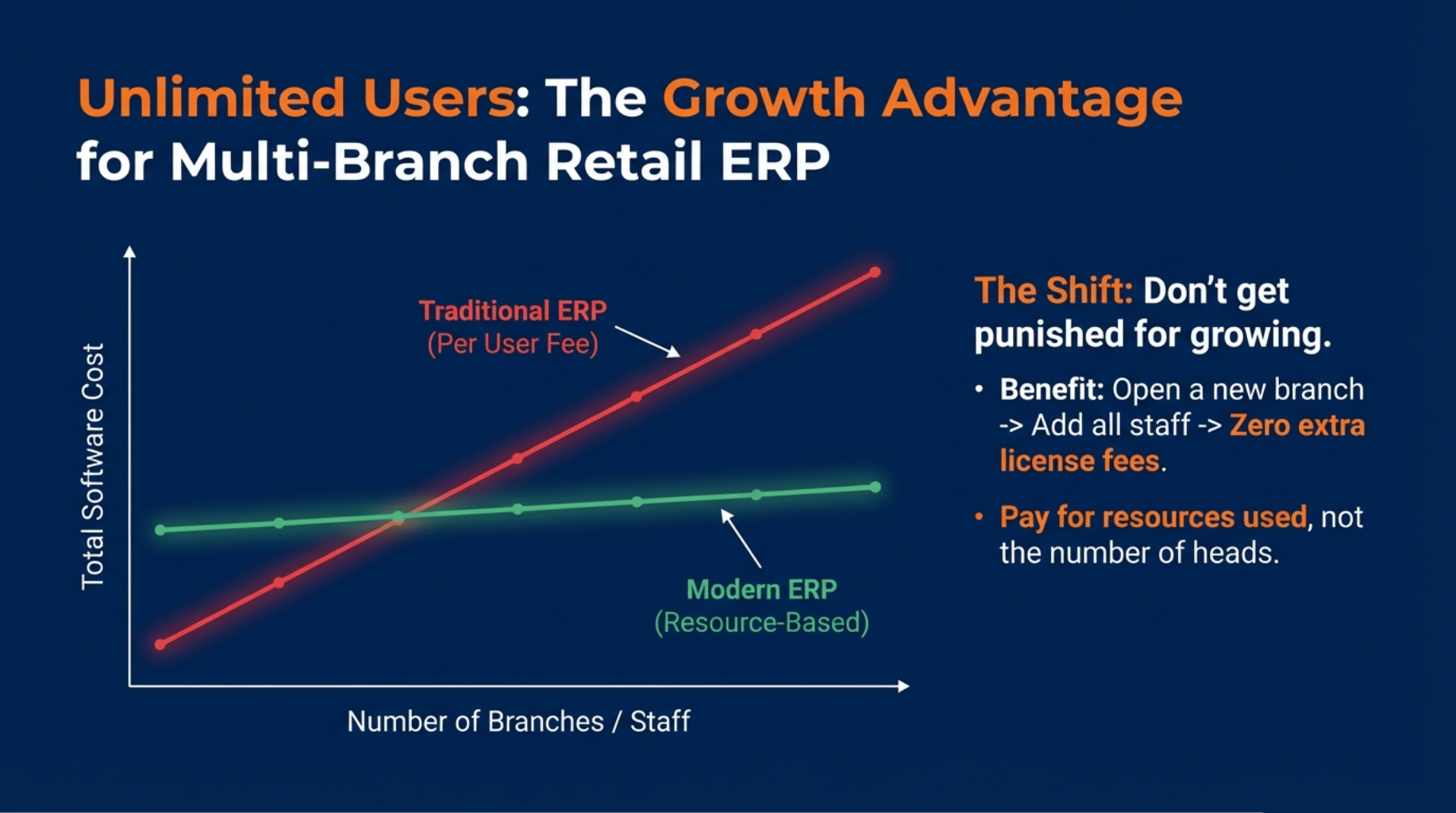
Unlimited Users: The Growth Advantage for Multi-Branch Retail ERP
Here’s where most ERP systems quietly punish you for growing.
You open a new branch. You hire five staff members. Suddenly, your software bill jumps because every single person needs a paid licence to log in. Add that up across ten, twenty, or fifty locations and the maths gets ugly fast.
Acumatica’s multi-branch retail ERP takes a fundamentally different approach. Instead of charging per user, it offers unlimited user licensing. You pay based on the system resources you consume; not the number of heads logged in.
What does that mean in practice? Every branch manager, every cashier, every warehouse team member gets full system access from day one. No extra licence fees. No awkward budget conversations before you can onboard a new store.
For South African retailers scaling from five branches to fifty, this removes one of the biggest hidden cost barriers in ERP. You’re free to grow your team, open new locations, and give every staff member the tools they need; without watching your software costs spiral out of control.
It’s a simple idea, but it changes everything: your ERP should grow with you, not charge you more for doing so.
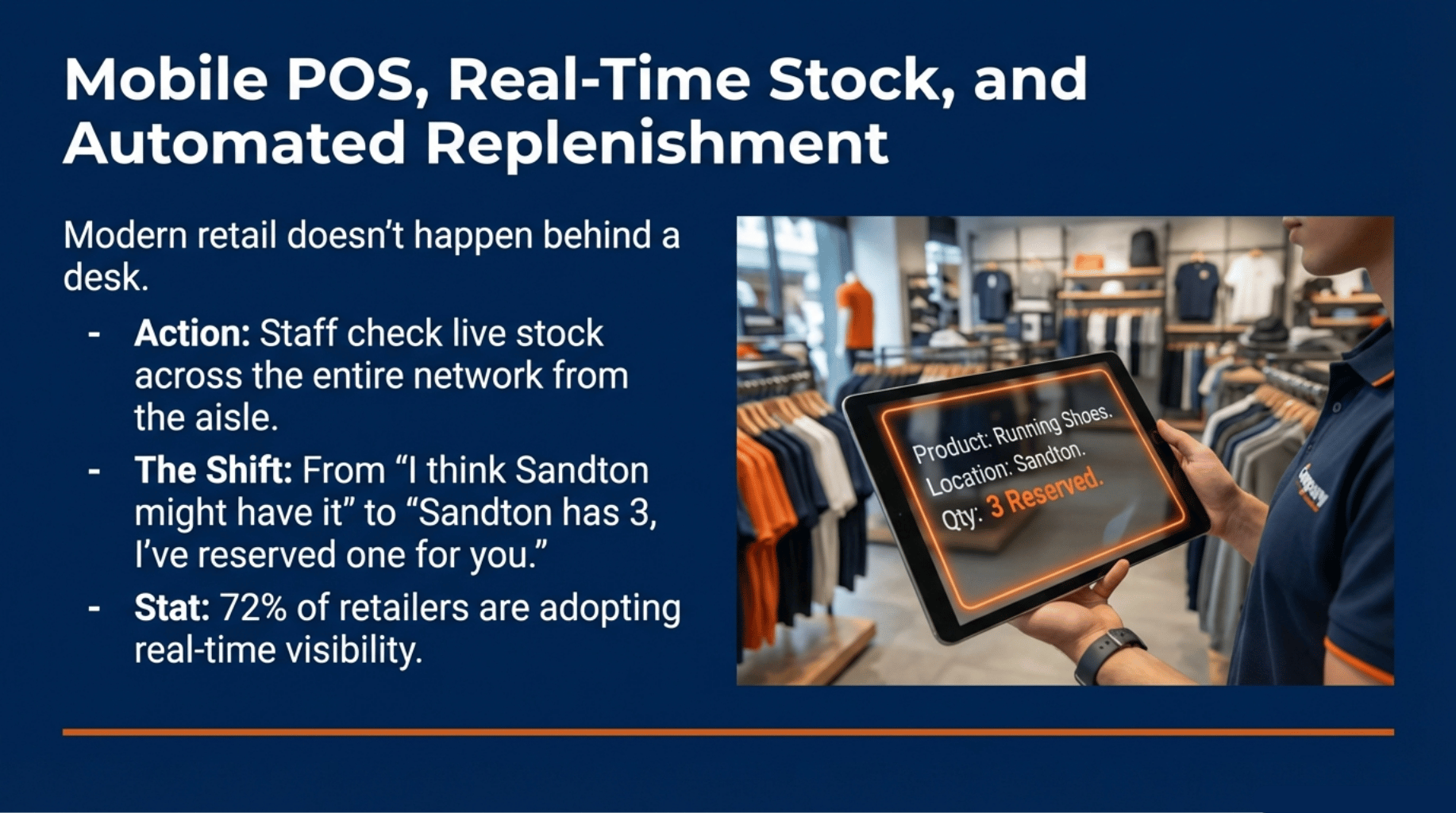
Mobile POS, Real-Time Stock, and Automated Replenishment
Modern retail doesn’t happen behind a desktop. Your floor staff are on the shop floor. Your warehouse team is between aisles. Your customers are standing right in front of you, asking whether that item comes in a different size; and whether your Rosebank branch has it.
They expect an answer in seconds. Not a phone call. Not “let me check and get back to you.”
A multi-branch retail ERP in South Africa puts mobile point-of-sale, live stock visibility, and automated replenishment into one connected platform. Your staff pull up real-time inventory on a tablet or phone, check availability across every branch, and reserve items for customers on the spot. No guesswork. No “I think Sandton might have it.”
Meanwhile, behind the scenes, the system watches your stock levels around the clock. When central warehouse inventory hits a reorder threshold, replenishment triggers automatically. Branches stay stocked without anyone sending an email or filling in a requisition form.
Here’s why this matters right now: 72% of retailers are planning to adopt real-time inventory visibility through automation and analytics. The ones who move first don’t just keep up; they pull ahead. While competitors are still phoning between branches and counting stock with clipboards, your team is selling.
And that gap only widens the more branches you open. At five locations, manual processes are painful. At twenty, they’re impossible. Real-time tools aren’t a luxury for multi-branch retailers. They’re the foundation.
Central Warehouse to Branch Replenishment
This is where the system really earns its keep.
Automated replenishment takes the guesswork out of keeping branches stocked. The ERP analyses sales trends, seasonal demand patterns, and current stock levels at each location. It knows what Branch A needs before Branch A’s manager even notices the shelf is getting thin.
Head office sets minimum and maximum stock thresholds for every branch. The moment stock dips below the minimum, the system creates a transfer order from the central warehouse. No emails bouncing back and forth. No missed reorders because someone was on leave.
Here’s what that looks like in practice:
- Sales-based demand forecasting that adjusts per branch; your coastal stores and inland stores don’t sell the same things at the same rate
- Automated transfer orders from central warehouse to branches, triggered the instant thresholds are breached
- Threshold alerts for both branch managers and head office, so everyone stays in the loop
- Seasonal adjustment capabilities that account for peaks like Black Friday, back-to-school, or festive season surges
One retailer we worked with used to spend the first Monday of every month manually reviewing stock levels across fourteen branches. That process took their ops team two full days. After switching to automated replenishment, those transfer orders now generate themselves; and the ops team spends that time on work that actually grows the business.
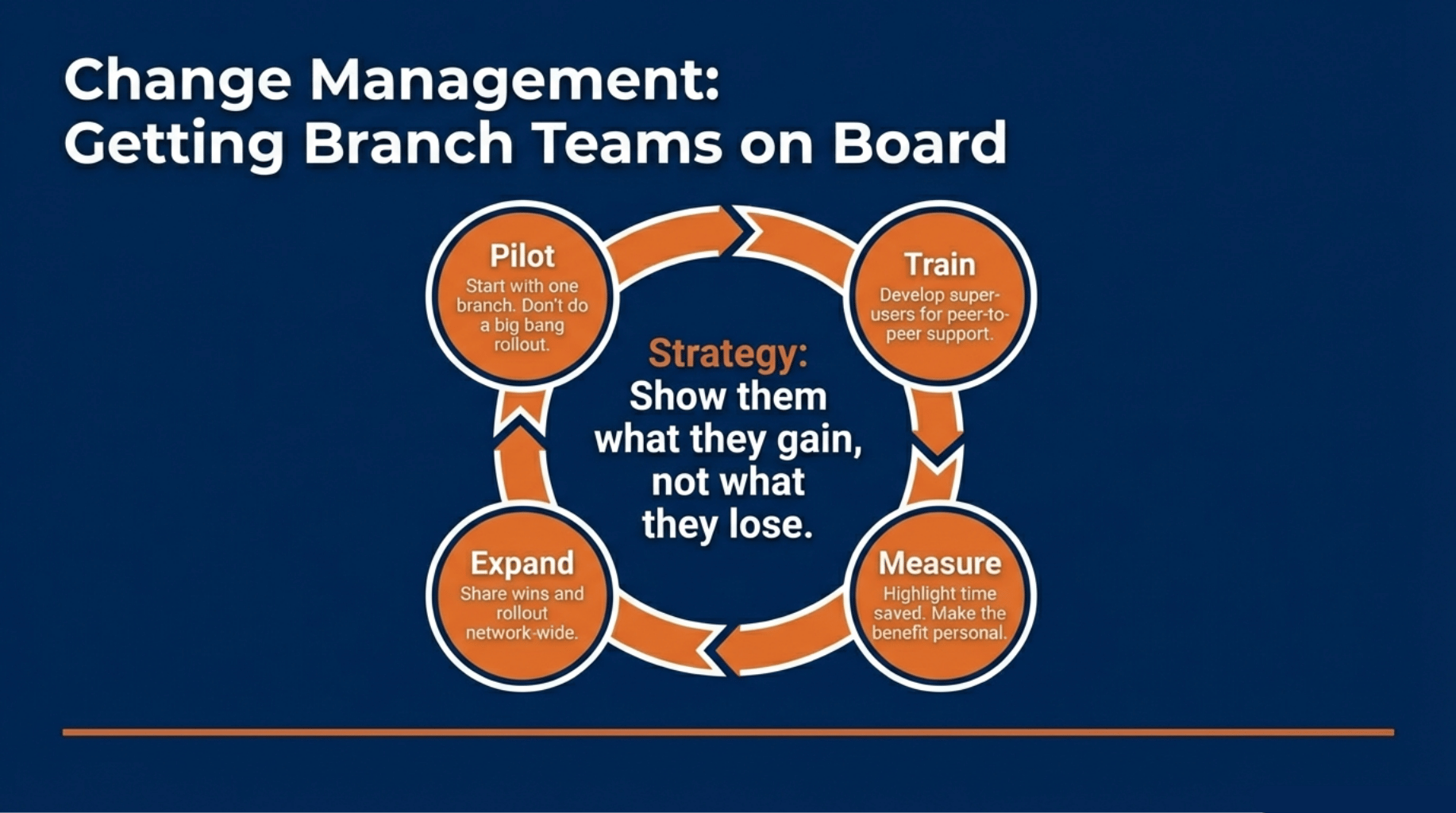
Change Management: Getting Branch Teams on Board
Let’s be honest about something. The best ERP in the world is useless if your people won’t use it.
And branch managers who’ve run their stores independently for years? They’re going to push back. They’ll worry about losing control. They’ll assume a centralised system means more oversight and more head office interference. Some will quietly keep their old spreadsheets running on the side; just in case.
This is normal. And it’s fixable.
Successful change management starts with one shift in messaging: show branch teams what they gain, not what they lose. With a multi-branch retail ERP, managers get faster access to stock data. Reporting takes minutes instead of hours. Manual tasks that used to eat up entire mornings disappear. They keep their branch-level authority; but now they’ve got network-wide support backing them up.
The smartest approach we’ve seen? Start with a pilot branch. Pick a location with a manager who’s open to change. Let them run the system for a month or two. Collect real results; time saved, stock accuracy improved, transfers completed faster. Then share those wins across the network.
When other branch managers see a peer; not head office, not a consultant; saying “this actually made my life easier,” resistance drops fast.
Here’s a practical rollout plan that works:
- Pilot one branch before committing to a full network rollout
- Train super-users at each location who becomes the go-to support for their peers
- Highlight time saved on manual tasks; make the benefit personal and immediate
- Share early wins across the network so momentum builds naturally
Retailers who follow this phased approach consistently report smoother adoption and faster return on investment. The ones who try to flip the switch across all branches at once? They’re the ones who end up with half the team still running shadow spreadsheets six months later.
Change doesn’t happen overnight. But it does happen; when you lead with proof instead of promises.
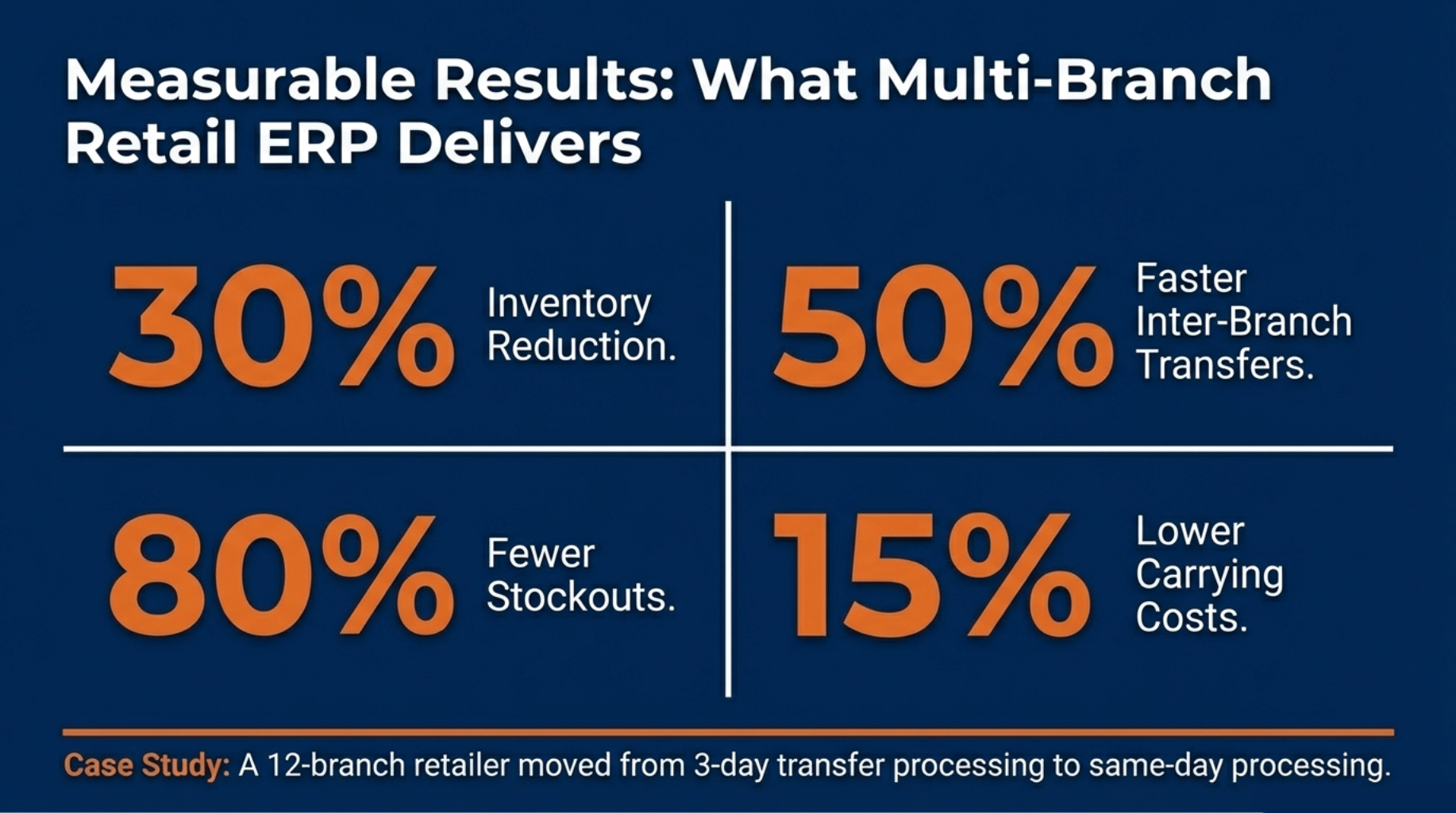
Measurable Results: What Multi-Branch Retail ERP Delivers
Talk is cheap. Let’s look at the numbers.
Retailers who move from disconnected systems to a unified multi-branch retail ERP in South Africa see gains they can actually measure; across operations, finances, and the customer experience.
Here’s what the data shows:
- 30% inventory reduction through network-wide stock optimisation; because you stop buying what you already have sitting at another branch
- 50% faster inter-branch transfers; stock moves to where it sells, not where it collects dust
- Up to 80% fewer stockouts with automated replenishment; your shelves stay full without manual intervention
- 15% reduction in carrying costs for companies that achieve 98% or higher inventory accuracy
These aren’t theoretical projections. They translate directly into more working capital, fewer lost sales, and customers who actually find what they came for.
A real example makes this concrete. A mid-market South African retailer with 12 branches had been managing stock through a patchwork of disconnected spreadsheets. Every branch was an island. Head office was flying blind.
After moving to a cloud-based multi-branch ERP, here’s what happened within six months:
- Excess inventory declined by 28%; freeing up cash that had been locked in dead stock
- Inter-branch transfer processing went from 3 days to same-day; because the system automated what used to require emails, phone calls, and manual approvals
- Stock accuracy jumped from 71% to 96%; which meant fewer surprises during stock takes and far fewer write-offs
- Branch managers reported saving 8+ hours per week on manual reporting; time they redirected to actually running their stores
That last point often gets overlooked. ERP isn’t just about inventory numbers. It’s about giving your people their time back. A branch manager who spends Monday morning pulling reports is a branch manager who isn’t on the floor helping customers.
The retailers seeing these results didn’t wait for the perfect moment to switch. They just got tired of the spreadsheet chaos and decided to fix it.
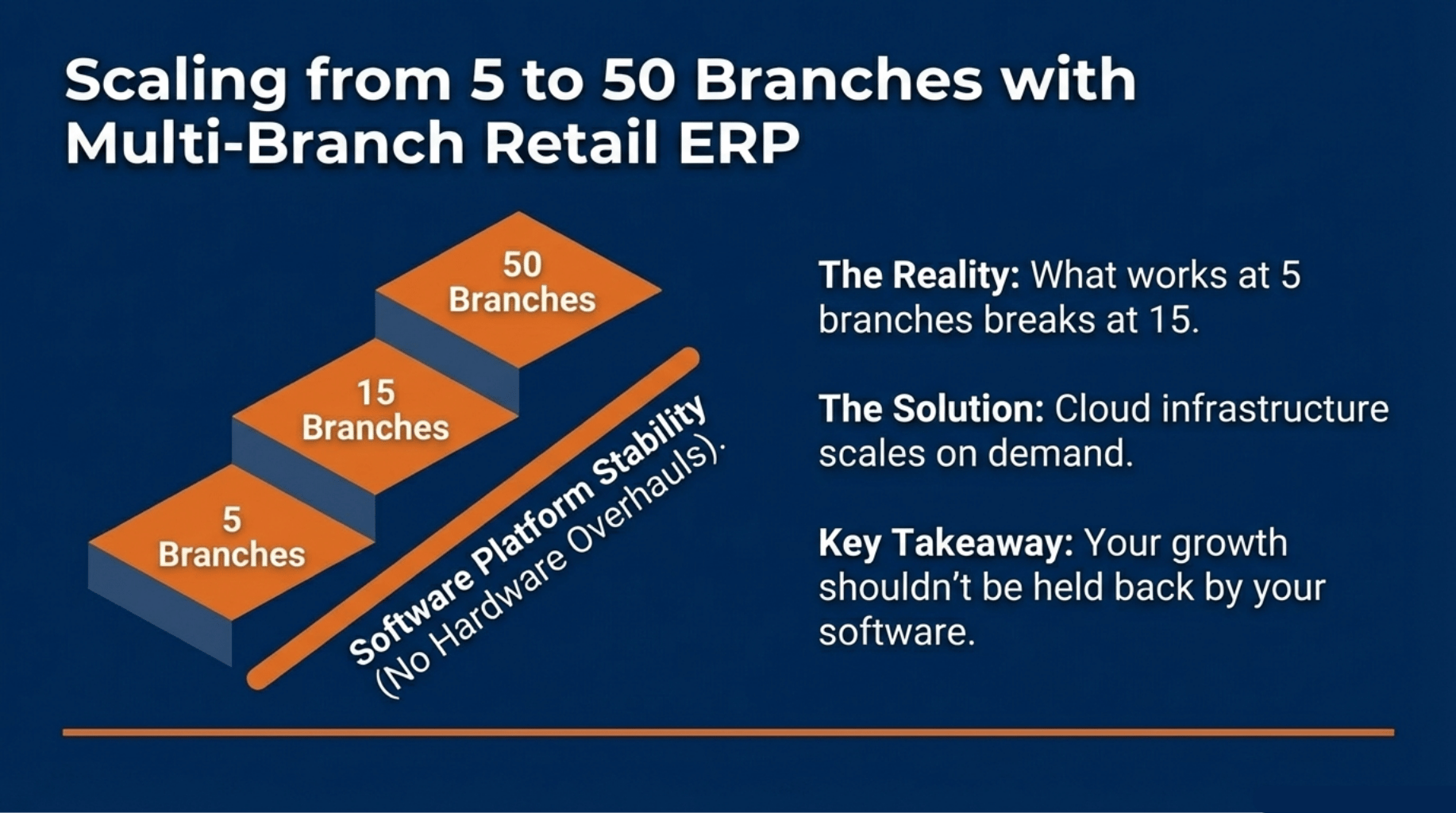
Scaling from 5 to 50 Branches with Multi-Branch Retail ERP
Here’s a truth that catches many growing retailers off guard: what works perfectly at five branches can completely fall apart at fifteen.
Your transaction volumes climb. You need more users across more locations. Reporting gets more complex. Your warehouse processes multiply. And if your system can’t keep up, everything slows down; right when you need it to speed up.
This is where cloud-based ERP changes the equation. Unlike legacy systems that require hardware upgrades and expensive overhauls every time you grow, a cloud ERP scales with you. You add branches, users, and data without ripping out infrastructure or negotiating new server contracts.
Acumatica’s consumption-based licensing model makes this even smoother. Your costs grow proportionally to what you actually use; not exponentially with headcount. Open a new branch on Monday, give every staff member system access by Tuesday. No per-user fees. No budget surprises.
South Africa’s cloud ERP market reflects this shift. SMEs across the country are driving demand for systems that are scalable and affordable; not enterprise-grade solutions that require enterprise-grade budgets.
What to look for in an ERP that truly scales:
- Cloud infrastructure that expands on demand without hardware investments
- No per-user fees so new branch openings don’t spike your software costs
- Multi-entity support that handles both franchise and company-owned models under one roof
- Consolidated reporting that works just as smoothly at 50 locations as it does at 5
The retailers who plan for scale from the start avoid the painful; and expensive; migration from a system that worked fine when they were small but couldn’t grow with them. Your fifth branch is exciting. Your fiftieth should be just as easy to bring online.
Wrapping Up
Managing twenty retail branches with one inventory system isn’t a far-off goal. It’s what a multi-branch retail ERP in South Africa delivers every single day.
Real-time stock visibility across every location. Automated inter-branch transfers that move stock where it sells. Unlimited user access that doesn’t penalise you for growing. Branch-specific pricing that gives local teams flexibility without losing central control.
The retailers who are pulling ahead in South Africa right now aren’t the ones with the biggest budgets. They’re the ones who’ve centralised their operations, automated the repetitive work, and armed every branch with real data to make better decisions; faster.
Your growth shouldn’t be held back by your software. It should be powered by it.
Ready to connect all your branches to one powerful system? Book a free demo with Astraia and see how Acumatica’s multi-branch retail ERP works for South African retailers.
FAQ Section
How does a multi-branch retail ERP handle inventory across multiple stores?
A multi-branch retail ERP tracks stock levels at every location in real time. Each branch maintains its inventory records while head office sees consolidated data across all stores. When stock runs low at one branch, the system can trigger transfers from other branches or the central warehouse automatically.
What is unlimited user licensing, and why does it matter for retailers?
Unlimited user licensing means you do not pay per person who logs into the ERP. Instead, pricing is based on system resource usage. This is critical for multi-branch retailers because every cashier, manager, and warehouse worker can access the system without extra licence fees making it affordable to scale.
Can I run different pricing and promotions at each branch?
Yes. A multi-branch ERP supports branch-specific pricing, regional promotions, and location-based discounts. You configure pricing rules per branch while head office maintains oversight and approval workflows for promotional campaigns across the network.
How long does it take to implement a multi-branch retail ERP?
Implementation timelines vary based on the number of branches, data complexity, and customisation needs. A phased rollout starting with a pilot branch typically takes 3 to 6 months for the initial go-live, with additional branches onboarded in 2 to 4-week intervals.
What results can South African retailers expect from a multi-branch ERP?
Retailers typically see a 30% reduction in excess inventory, 50% faster inter-branch transfers, and significantly fewer stockouts. Improved stock accuracy (above 95%) also reduces carrying costs by up to 15%, freeing up working capital for growth.