




Summary
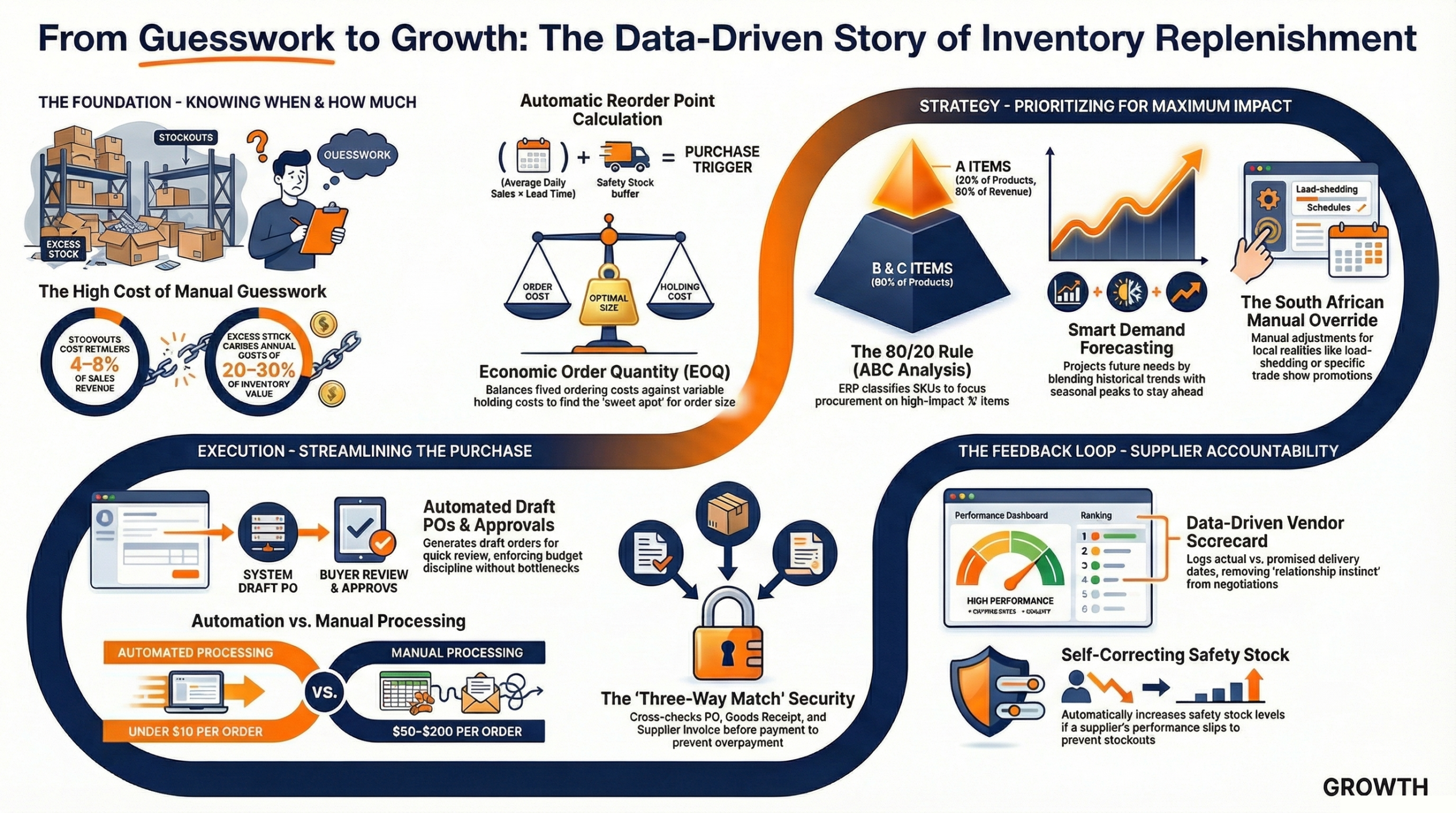
The text explains how an inventory replenishment ERP tailored for South Africa replaces guesswork in procurement with data-driven replenishment: automated reorder point planning, EOQ recommendations, ABC analysis, demand forecasting, purchase automation, blanket/drop-ship orders, and supplier scorecards.
These features reduce stockouts, lower carrying costs, improve purchasing efficiency and supplier management, and adapt to location-, season- and production-specific needs.
Key points
- Reorder point planning: ERP auto-calculates reorder points from average daily sales, supplier lead time and safety stock and updates them as sales velocity changes, eliminating spreadsheet guesswork.
- EOQ and ABC analysis: ERP recommends optimal order quantities (balancing ordering vs holding costs) and classifies SKUs (A/B/C) so procurement focuses where value and risk are highest.
- Demand forecasting and manual overrides: Forecasts use historical trends and seasonality but allow manual inputs for local events (e.g., promotions, load‑shedding) to avoid over- or under-ordering.
- Purchasing automation and controls: Draft POs, approval workflows, and three-way matching speed procurement, enforce budgets and reduce per-order processing cost.
- Advanced purchasing tactics: Blanket POs and drop-ship orders cut admin for frequent/contracted or direct-to-customer purchases while keeping visibility.
- Vendor performance tracking: ERP measures on‑time delivery, lead-time variance and quality, feeding back into safety stock and supplier negotiations to reduce stockout risk.
- Practical benefits for South African businesses: multi-warehouse/location settings, MRP for manufacturers, seasonal planning for retailers, all reduce stockouts, free up cash and make procurement data-driven.
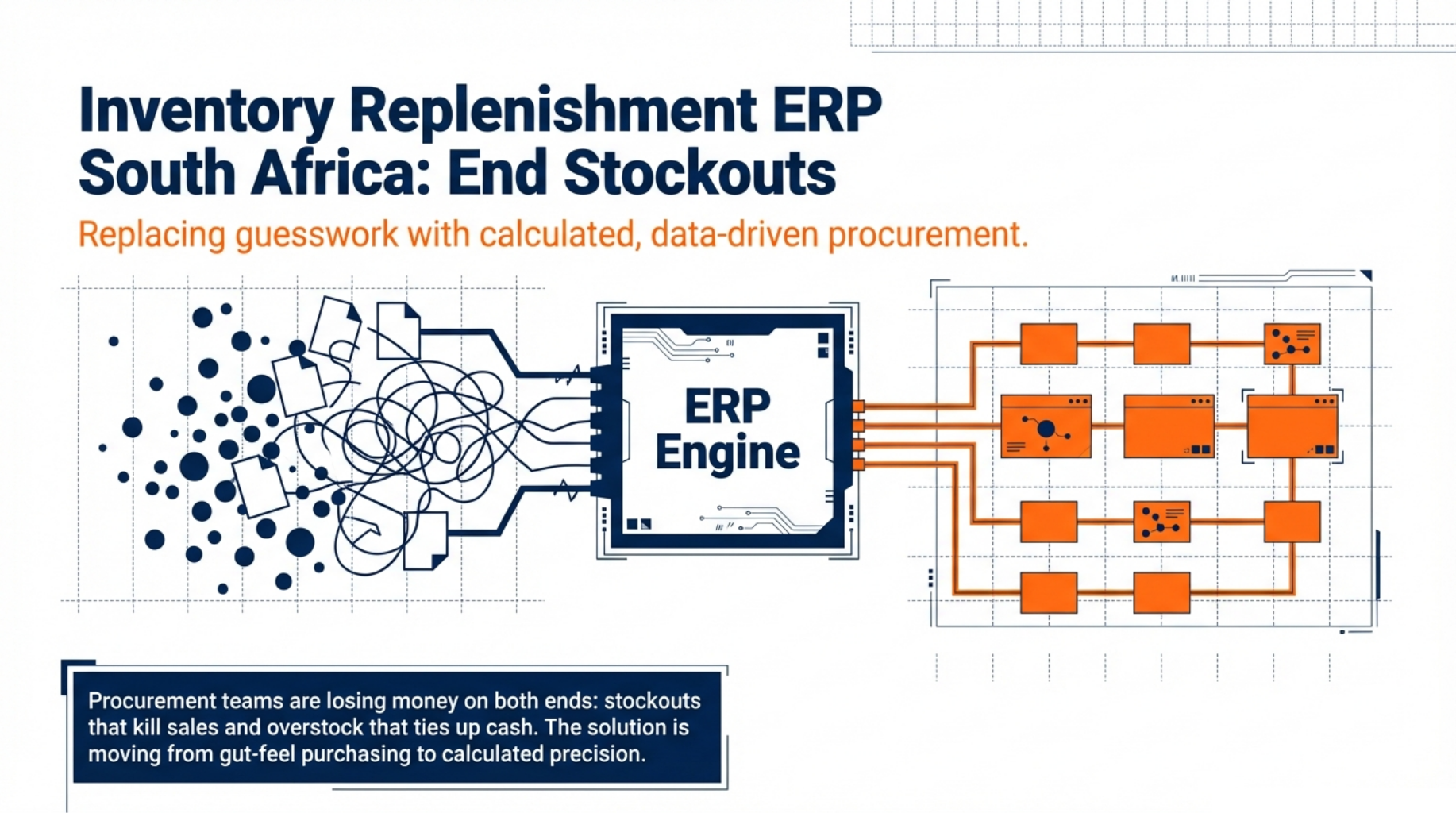
Procurement teams across South Africa are losing money on both ends, stockouts that kill sales and overstock that ties up cash. Inventory replenishment ERP South Africa solves this by replacing gut-feel purchasing with calculated, data-driven decisions. When your system knows your sales velocity, your supplier lead times, and your safety stock requirements, it tells you when to buy and how much.
This post breaks down exactly how that works, from reorder point planning and demand forecasting to vendor scorecards and automated purchase orders. If you are still managing replenishment on spreadsheets or memory, this is where the cost is hiding.
Why Reorder Point Planning Beats Manual Purchasing
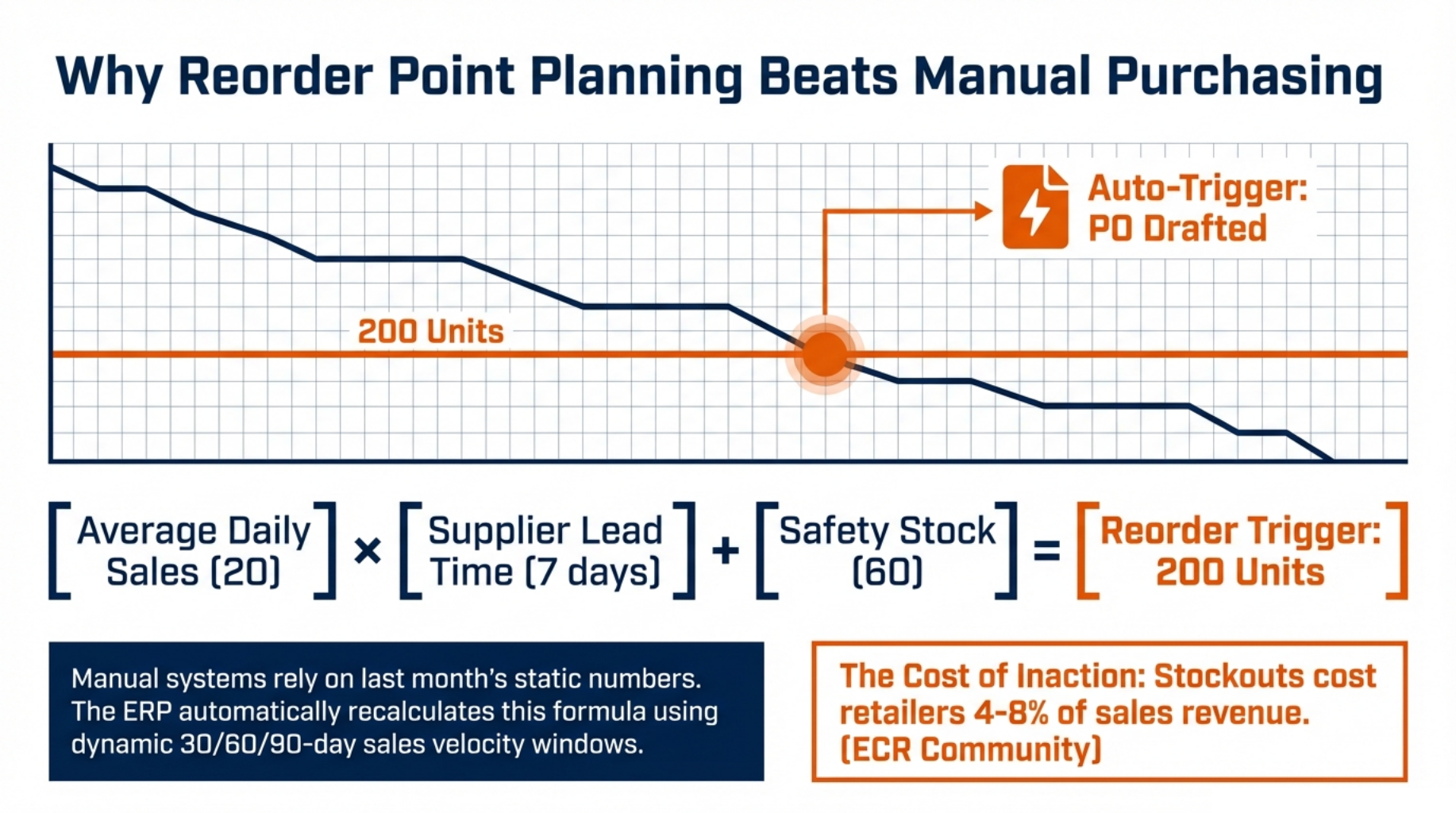
A reorder point is the stock level that triggers a new purchase. When your inventory drops to that number, a purchase order goes out. Simple in principle, but manual tracking cannot keep up with changing demand.
ERP calculates the reorder point using three inputs: average daily sales, supplier lead time, and safety stock. If you sell 20 units per day, your supplier takes 7 days to deliver, and you want 3 days of buffer stock, your reorder point is (20 × 7) + (20 × 3) = 200 units. The moment stock hits 200, the system flags a replenishment need. No spreadsheet, no reminder, no guessing.
The critical advantage is that ERP recalculates automatically as your sales velocity changes. A manual system uses last month’s numbers. ERP uses the last 30, 60, or 90 days, whatever window you set. Research from the ECR Community estimates that stockouts cost retailers between 4% and 8% of sales revenue. For a distributor turning over R50 million, that gap is significant.
Safety stock sits on top of the reorder point as a buffer. If your supplier delivers late or demand spikes unexpectedly, safety stock keeps you trading while the new order arrives.
Economic Order Quantity, Order the Right Amount
Knowing when to order is only half the answer. Ordering the wrong quantity either inflates carrying costs or forces you to reorder too often, both waste money.
Economic order quantity (EOQ) is the calculation that finds the sweet spot. It weighs the fixed cost of placing each order against the variable cost of holding stock. Ordering in large batches reduces order frequency but increases storage, insurance, and obsolescence costs. Ordering small batches reduces holding costs but multiplies admin and freight.
ERP runs EOQ in the background. Procurement teams see a recommended order quantity, not a formula. A manufacturer in Gauteng, for example, might see a recommended batch of 500 components rather than their habitual 200 because the system has determined that the freight saving outweighs the marginal holding cost. Carrying costs typically run between 20% and 30% of inventory value annually, according to the Chartered Institute of Procurement and Supply. EOQ directly attacks that number.
ABC Analysis, Focus Purchasing Effort Where It Matters
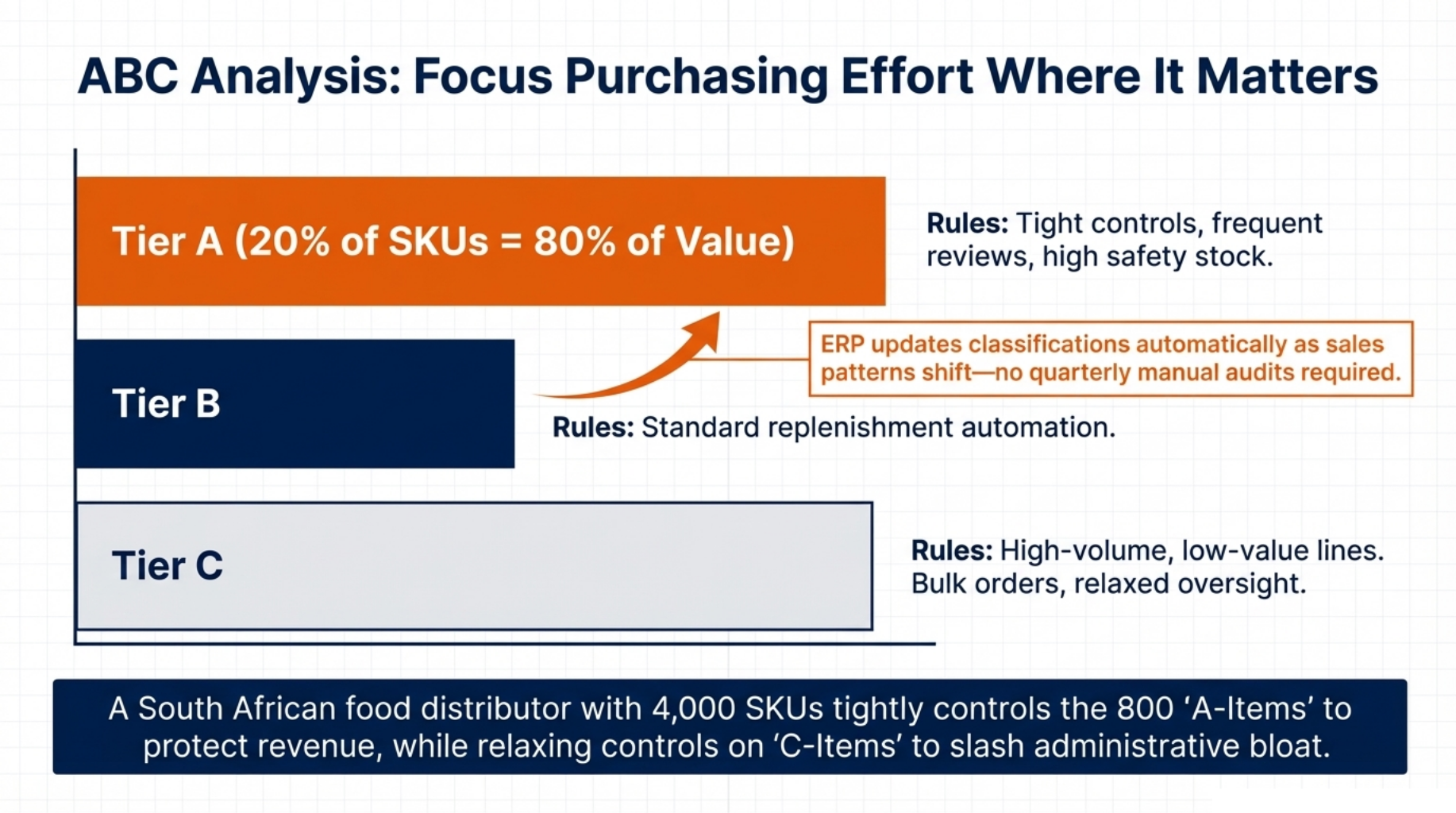
The Pareto principle applies directly to inventory: in most businesses, roughly 20% of SKUs account for 80% of inventory value. ABC analysis formalises this reality so procurement effort goes where it makes the most difference.
ERP classifies every SKU automatically. A item, your top revenue drivers, get tight controls: frequent reorder point reviews, high safety stock, and close supplier monitoring. B items sit in the middle, with standard replenishment rules. C items are low-value, high-volume lines that can be managed on bulk orders with minimal oversight.
The practical effect is significant. A South African food distributor carrying 4,000 SKUs does not need to manage all of them the same way. Tightly controlling the 800 A items protects the bulk of revenue. Relaxing controls on C items reduces admin without meaningful risk. ERP updates classifications automatically as sales patterns shift, an item that becomes a bestseller moves from B to A without anyone manually reassigning it. That means your replenishment rules stay accurate without a quarterly audit.
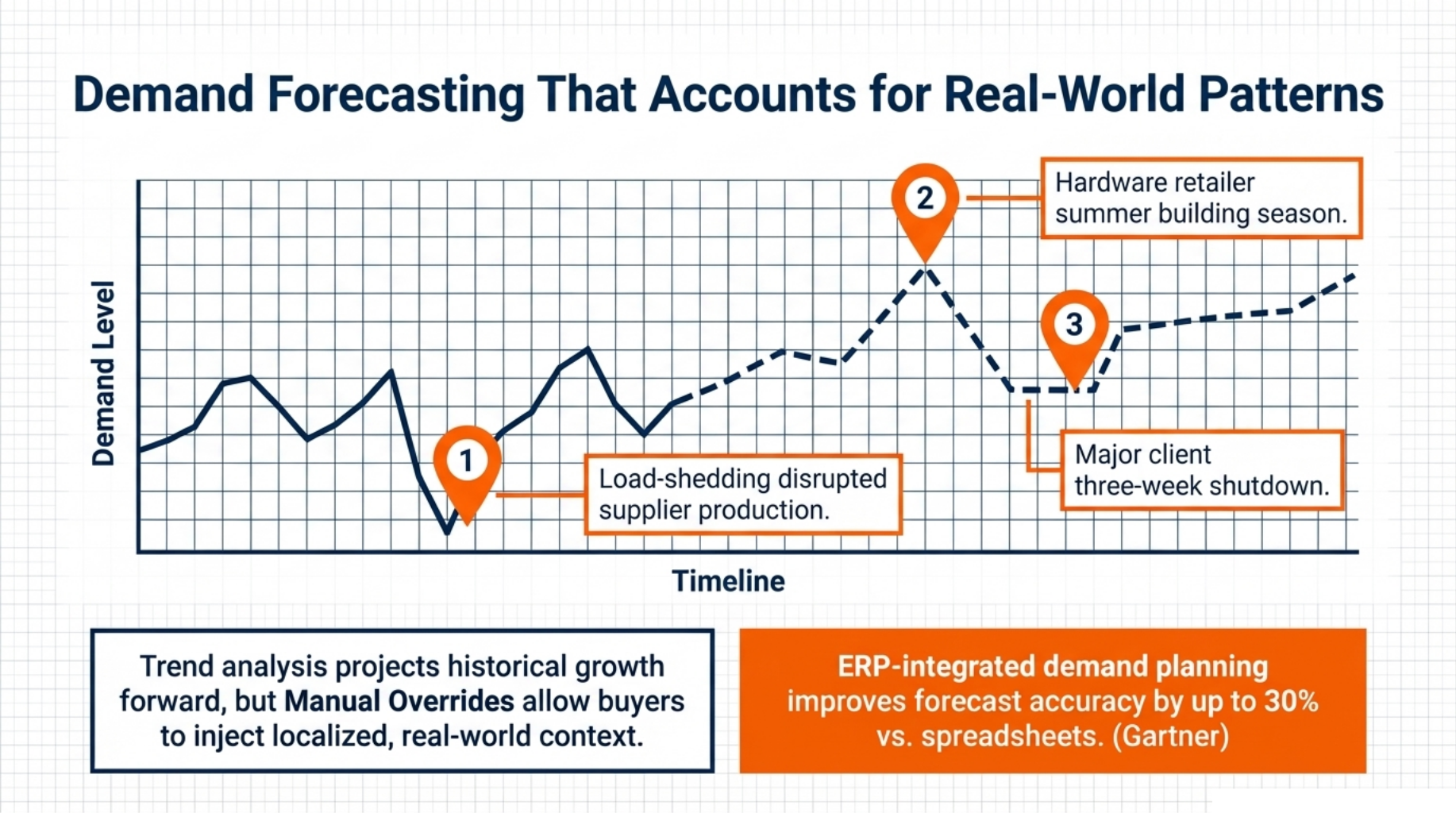
Demand Forecasting That Accounts for Real-World Patterns
Reorder points based on yesterday’s data fail when demand changes. Demand forecasting solves this by projecting future requirements from historical trends, seasonal patterns, and manual inputs.
Trend analysis examines your historical sales data and extends the line forward. If monthly sales have grown by 5% over the past year, the forecast builds that growth into reorder quantities. Seasonal profiles work differently, they identify repeating peaks and troughs, such as a hardware retailer seeing a spike before summer building season, and pre-adjust stock levels ahead of the curve.
Manual adjustments are where the South African context matters most. Your ERP system cannot know that a major client is shutting down for three weeks, that a trade show is driving a promotional spike, or that load-shedding has disrupted your supplier’s production schedule. Manual overrides let procurement flag these events directly, so the system does not either over-order into a quiet period or under-order before a peak. Research by Gartner found that companies using ERP-integrated demand planning improve forecast accuracy by up to 30% compared to spreadsheet-based approaches. The result is fewer emergency orders, better supplier relationships, and less cash tied up in precautionary stock.
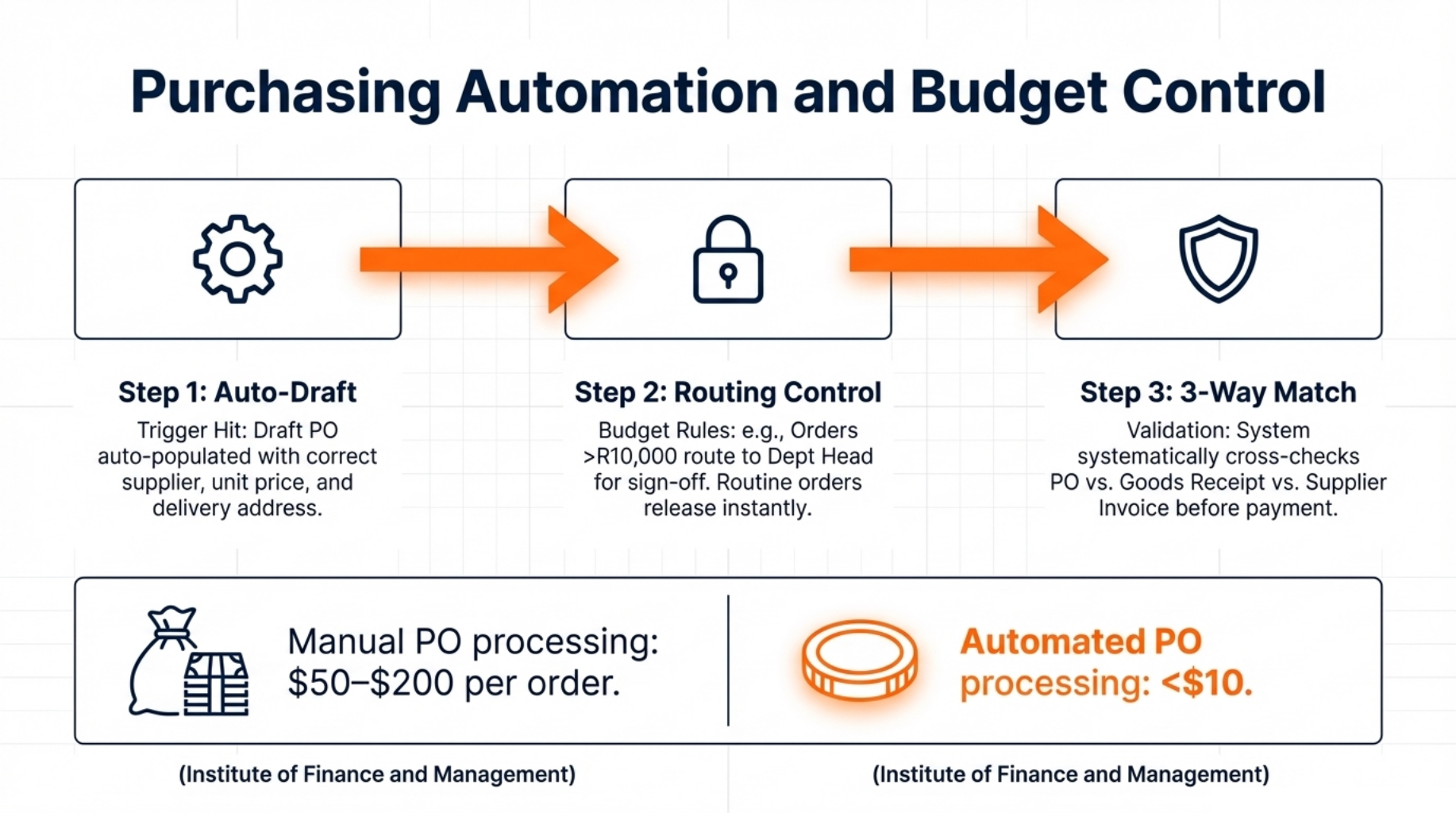
Purchasing Automation and Budget Control
Once a reorder point is triggered, the system does not wait for a buyer to notice. ERP generates a draft purchase order automatically, populated with the correct supplier, quantity, unit price, and delivery address. The buyer reviews and confirms, they do not create from scratch.
Approval routing adds budget control without slowing things down. Purchase orders below a defined threshold, say, R10,000, can be released directly. Orders above that threshold route to a department head for sign-off before the supplier sees anything. This protects spending discipline without turning routine replenishment into a bottleneck.
Three-way matching closes the loop on the back end. When a delivery arrives, the system cross-checks the goods receipt against the original purchase order. When the supplier invoice arrives, it checks against both. If quantities or prices do not align, the invoice is flagged before it reaches payment. A logistics company that processes 300 supplier invoices per month can catch discrepancies systematically, rather than relying on a finance team member to spot them manually. Studies from the Institute of Finance and Management suggest manual PO processing costs between $50 and $200 per order, automation reduces that to under $10.
Blanket Orders and Drop-Ship Purchasing
Two purchasing tools reduce admin for high-frequency and direct-delivery scenarios.
Blanket purchase orders work well for contracted suppliers. You agree on a total quantity and price upfront, ERP then draws down against the blanket as individual deliveries are needed. This locks in pricing and eliminates repetitive PO creation for the same supplier. A manufacturer buying steel coil from the same supplier every month benefits directly.
Drop-ship purchasing routes the supplier delivery straight to the customer, bypassing your warehouse entirely. ERP generates the PO to the supplier with the customer’s delivery address attached. There is no goods receipt at your facility, no pick-and-pack, and no outbound freight cost. Both tools reduce procurement workload while keeping full transaction visibility inside the system.
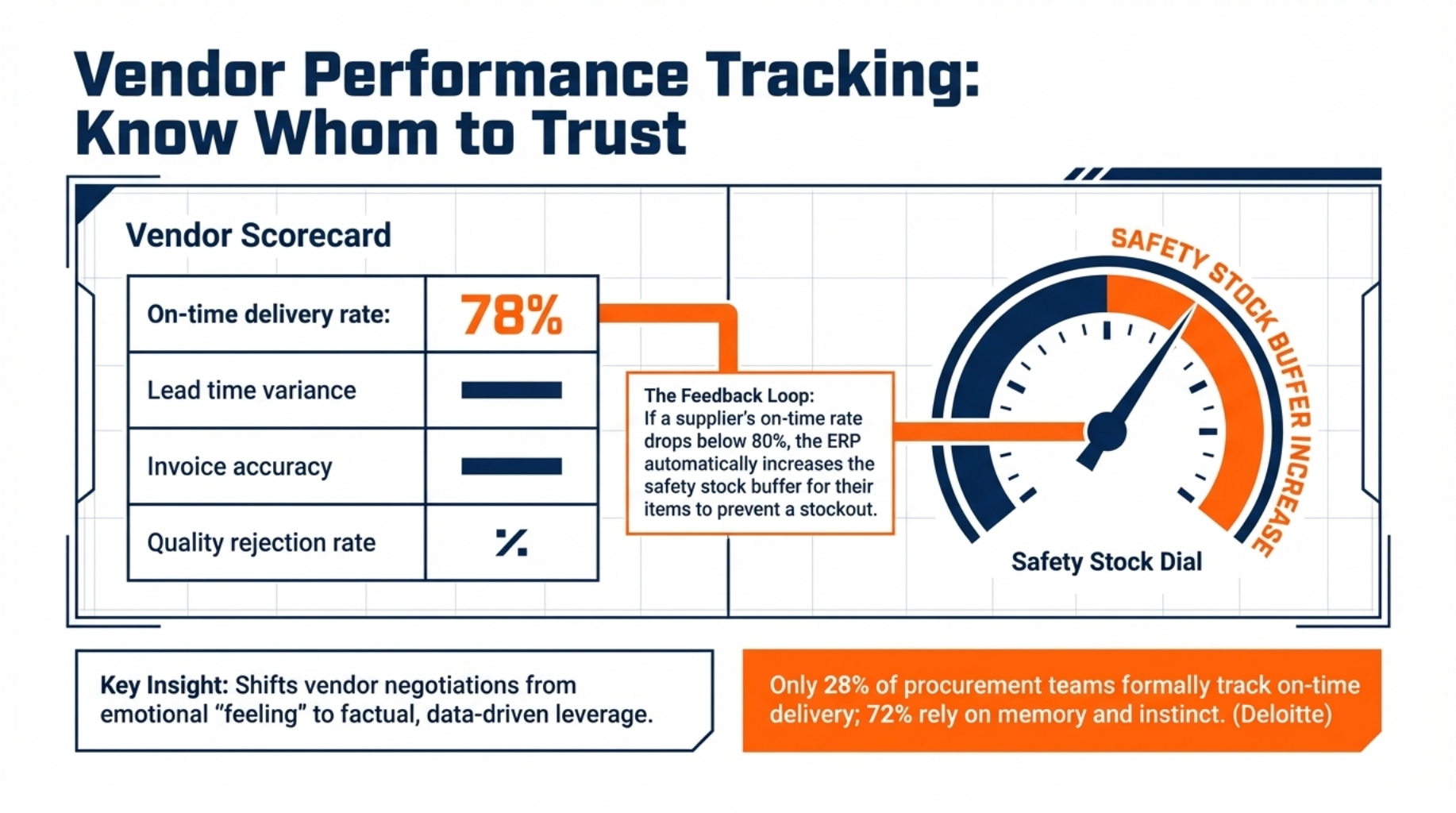
Vendor Performance Tracking, Know Whom to Trust
A reorder point calculation is only as accurate as the lead time data behind it. If your system assumes a 7-day lead time, but your supplier consistently delivers on day 10, your safety stock is perpetually short.
ERP logs the actual delivery date against the promised date for every order. Over time, this builds a supplier performance record covering on-time delivery rate, lead time variance, invoice accuracy, and quality rejection rate. The data is factual and automatic, no one needs to remember to update a tracker.
Poor performance feeds directly into replenishment settings. If a supplier’s on-time rate drops below 80%, ERP increases the safety stock held for their items. The system compensates for unreliability before it causes a stockout. A procurement manager at a Cape Town retailer, for example, might not know that a supplier’s performance has been slipping, the ERP scorecard makes it visible in a meeting.
Research by Deloitte found that only 28% of procurement teams formally track supplier on-time delivery. The remaining 72% rely on memory and relationship instinct. A supplier scorecard built from live ERP data changes that conversation, from feeling to fact, and gives procurement a negotiating lever at contract renewal.
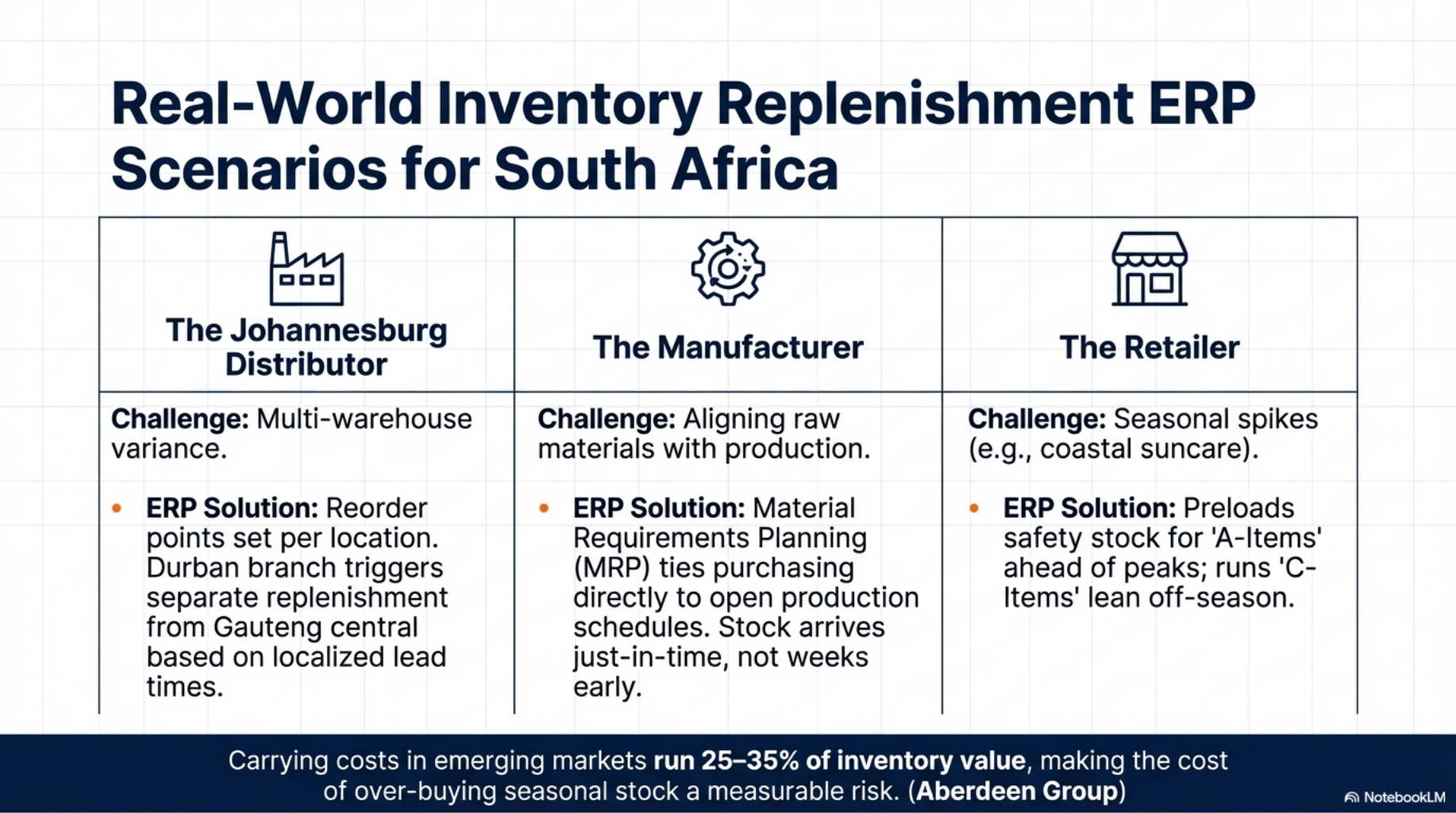
Real-World Inventory Replenishment ERP Scenarios for South Africa
The same ERP engine applies differently depending on the business type.
A Johannesburg distributor managing 12 suppliers across three warehouses use reorder points set per location, not per business. Stock at the Durban branch triggers a separate replenishment from the Gauteng central warehouse or direct from the supplier, depending on which is faster. Lead time variance per supplier means each branch carries a different safety stock level for the same SKU.
A manufacturer replenishing raw materials ties purchasing to the production schedule. Material requirements planning (MRP) looks at open production orders, calculates what components are needed and when, and generates purchase requisitions accordingly. The result is stock arriving in line with production start dates, not sitting in the warehouse for three weeks waiting for a production run.
A retailer managing seasonal SKU spikes, coastal suncare products, for example, uses seasonal demand profiles and ABC classification together. A item in a peak category are preloaded with elevated safety stock before the season starts. C items in the same category are let run lean until the season proves itself. The Aberdeen Group estimates that inventory carrying costs in emerging markets run between 25% and 35% of inventory value, making the cost of over-buying seasonal stock a real and measurable risk.
Wrapping Up
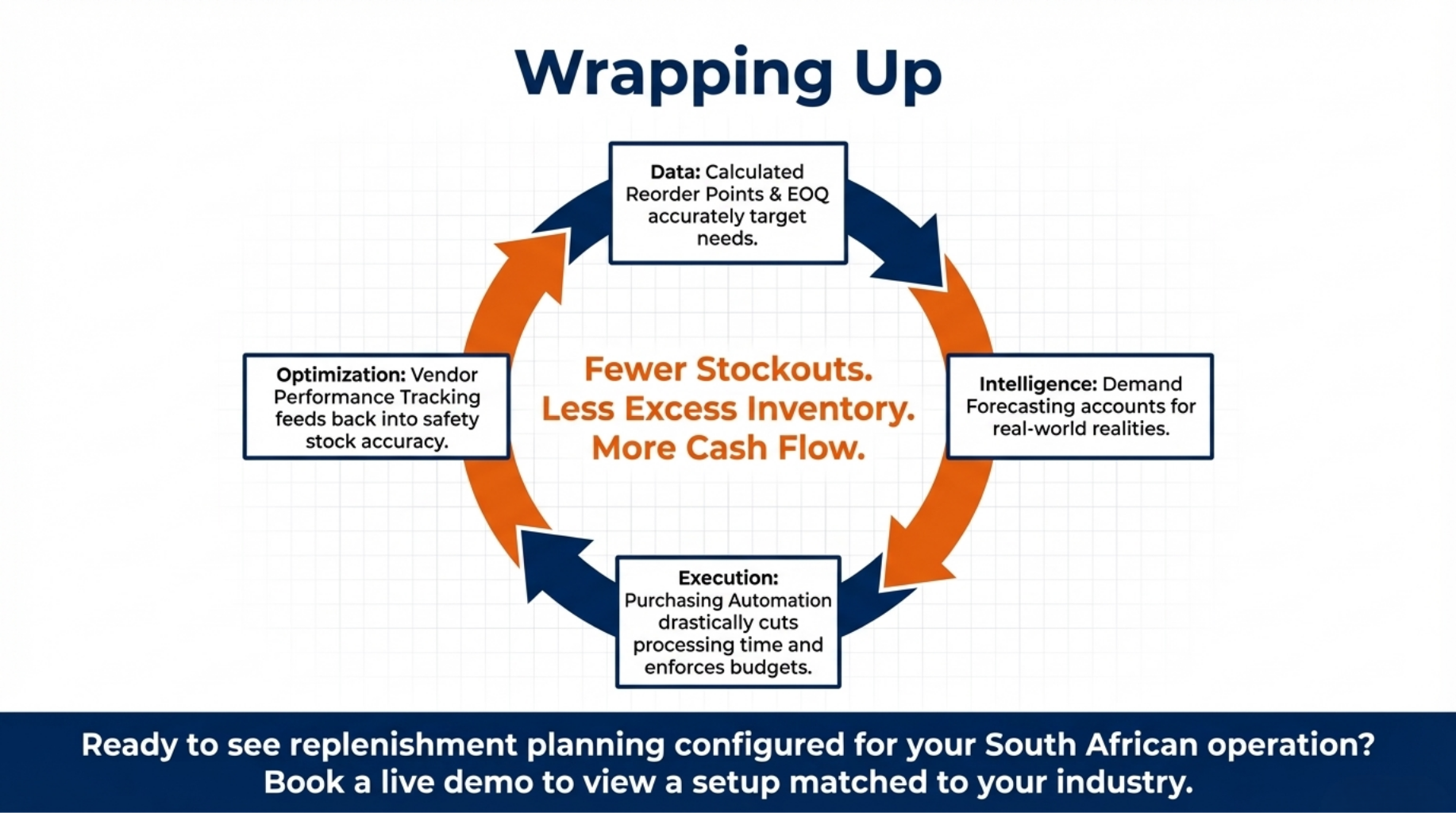
Inventory replenishment ERP in South Africa removes the guesswork that costs procurement teams on both sides of the ledger. Calculated reorder points, EOQ-driven order quantities, and real demand forecasting mean you buy the right stock at the right time. Purchasing automation reduces the time buyers spend creating orders, while approval workflows keep budget discipline intact. Vendor performance data feeds back into safety stock settings, so the system becomes more accurate as your supplier relationships mature.
The result is fewer stockouts, less excess inventory, and a procurement function that runs on data rather than instinct.
Ready to see Acumatica’s replenishment planning configured for your South African operation? Book a demo, and we will walk you through a live setup matched to your industry.
FAQ
Q1: What is reorder point planning in an ERP system?
A: Reorder point planning is an ERP feature that automatically calculates the stock level at which a new purchase order should be raised, based on daily sales velocity, supplier lead time, and a safety stock buffer.
Q2: How does an automated inventory replenishment system work in South Africa?
A: The system monitors stock levels in real time, triggers a draft purchase order when inventory hits the reorder point, routes it through an approval workflow, and dispatches it to the supplier, without manual intervention.
Q3: What is ABC analysis in inventory management?
A: ABC analysis classifies stock into three tiers by value and sales contribution, so procurement teams apply tighter controls to high-value A items and lighter oversight to low-value C items.
Q4: How does three-way matching prevent overpayment to suppliers?
A: Three-way matching cross-checks the purchase order quantity and price against the goods receipt and the supplier invoice before releasing payment, blocking discrepancies from reaching accounts payable.
Q5: Can ERP handle seasonal demand for inventory replenishment?
A: Yes, ERP demand forecasting uses historical sales patterns to build seasonal profiles that automatically adjust reorder quantities and safety stock levels ahead of peak and off-peak periods.