




Summary
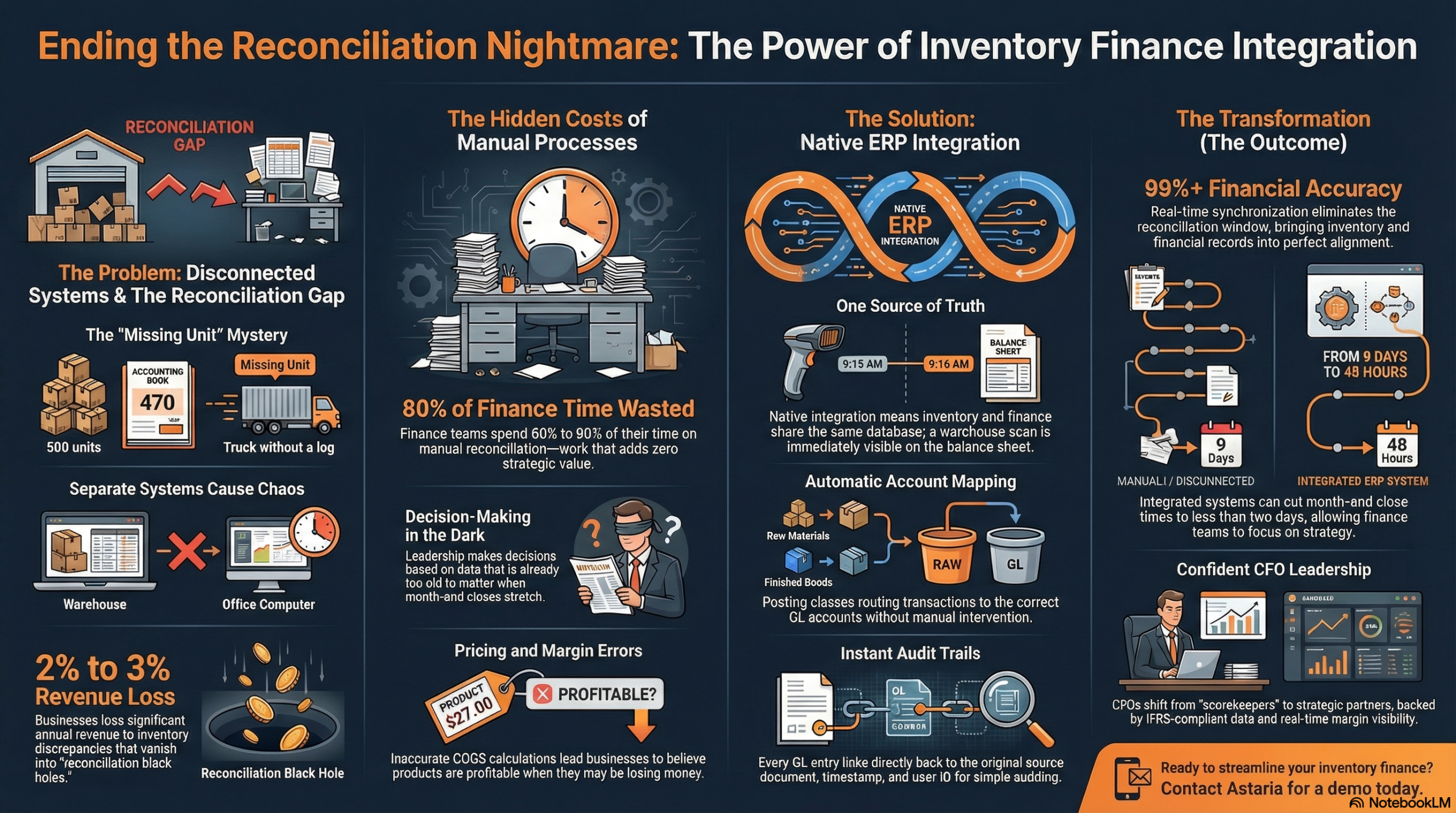
Integrated inventory-finance (native ERP) systems sync stock movements and general ledger entries in real time, eliminating timing gaps and manual reconciliation. This reduces errors, speeds month-end closes from days to hours, improves margin accuracy, strengthens audit trails and compliance, and frees finance teams to do strategic analysis instead of data chasing.
Key points
- Real-time posting: every inventory transaction (receipts, issues, adjustments, shipments) simultaneously updates inventory balances and GL accounts, removing timing mismatches and manual journal entries.
- Automated COGS & account mapping: costing methods and posting classes auto-calc and route debits/credits consistently, preventing human error and ensuring correct margin reporting.
- Faster, cleaner month-end and audits: continuous updates and built-in audit trails cut close time dramatically and simplify auditor verification and compliance.
- Better decision-making & lower hidden costs: accurate, timely inventory valuation and ageing reports reveal real problems (shrinkage, obsolescence) so CFOs can act on margins and working capital instead of reconciling spreadsheets.
- Operational controls & scalability: configurable posting rules, location-specific overrides and approval workflows maintain control as the business and warehouses grow.
Stop inventory mismatches with inventory finance integration that links stock and finance in real time for accurate books and faster month-end close.
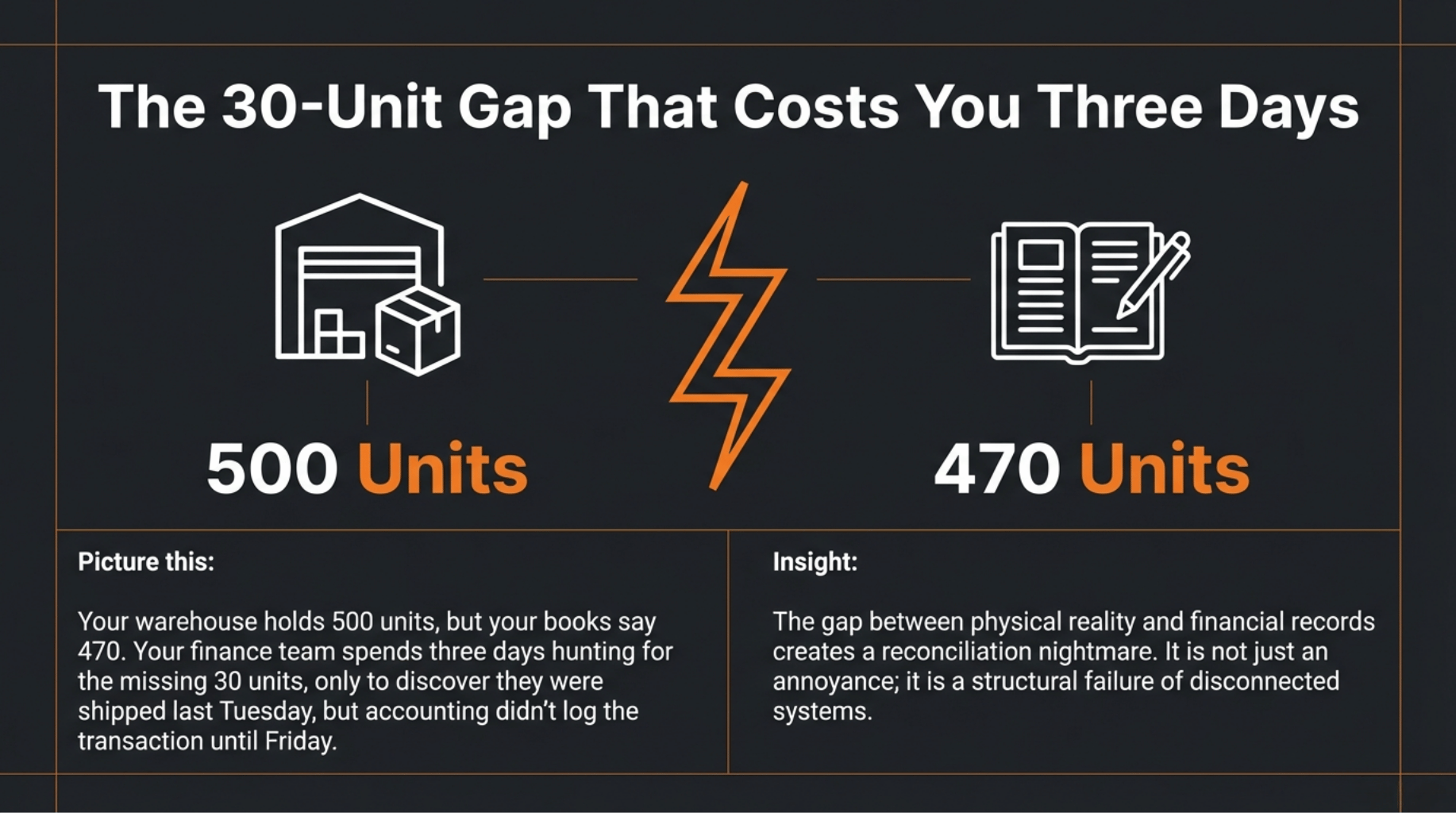
Picture this: your warehouse shows 500 units in stock, but your books say 470. Your finance team spends the next three days hunting for the missing 30 units; only to discover they were shipped last Tuesday, but accounting didn’t log the transaction until Friday. Sound familiar?
Inventory finance integration solves this nightmare by connecting stock movements directly to your general ledger. No more timing gaps. No more mystery variances. Just clean, accurate numbers that match; every single time. When inventory and finance share the same system, every stock movement instantly updates both your warehouse counts and your financial records. It’s the difference between chasing errors all month and closing your books in hours, not days.
For CFOs juggling growth targets and audit deadlines, integrated systems deliver numbers you can actually trust. Real-time cost of goods sold calculations. Instant margin visibility. And month-end closes that won’t have your team working weekends.
Why Your Inventory and Finance Numbers Never Match
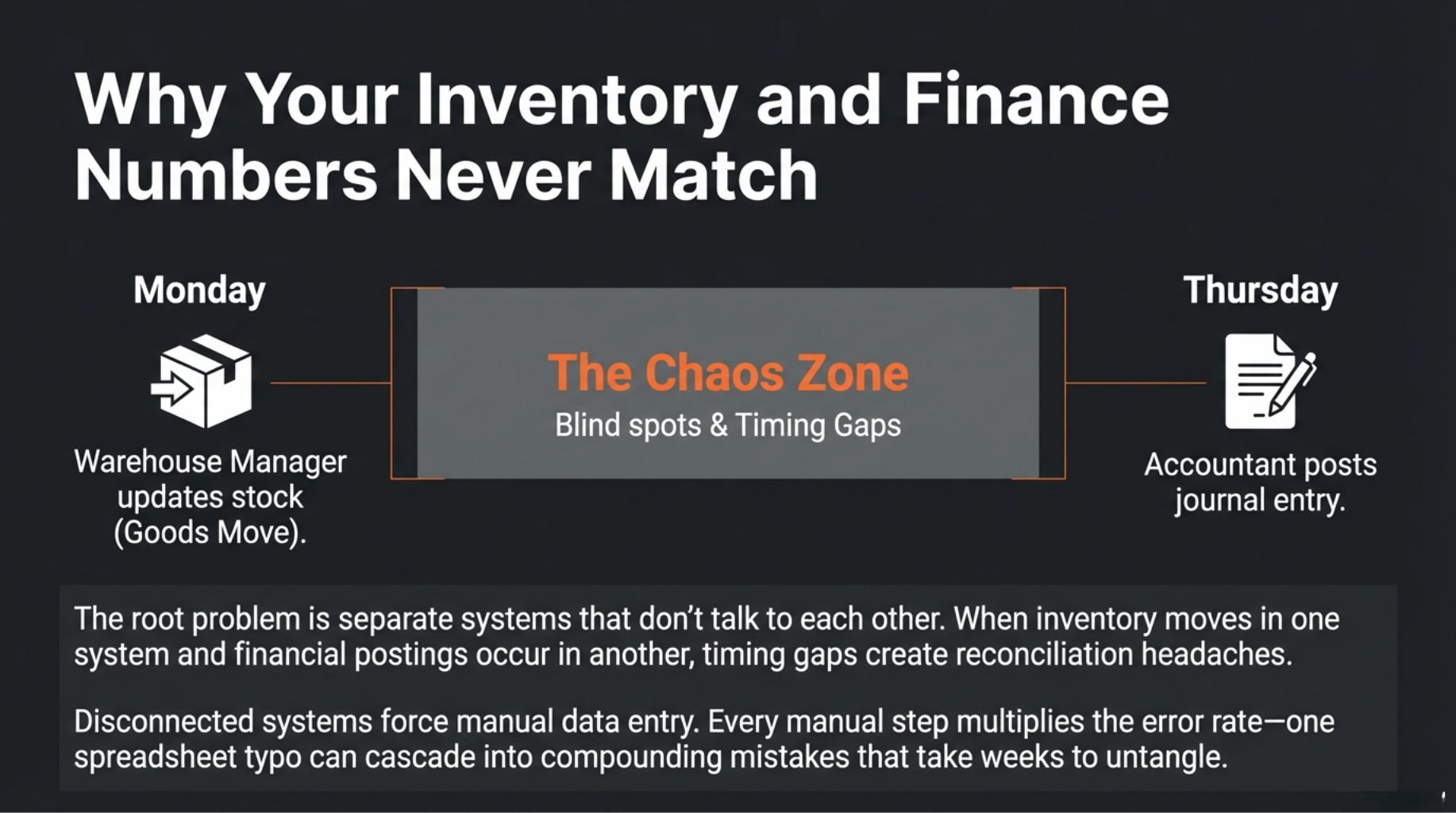
Every month-end, your finance team scrambles to reconcile inventory records with general ledger balances. Hours turn into days hunting for missing pennies and unexplained variances. The root problem isn’t human error; it’s separate systems that don’t talk to each other.
When inventory movements happen in one system and financial postings occur in another, timing gaps create reconciliation headaches that hide operational issues and destroy financial accuracy. Your warehouse manager updates stock in the inventory system on Monday. Your accountant posts the journal entry on Thursday. Those three days? Pure chaos for anyone trying to close the books.
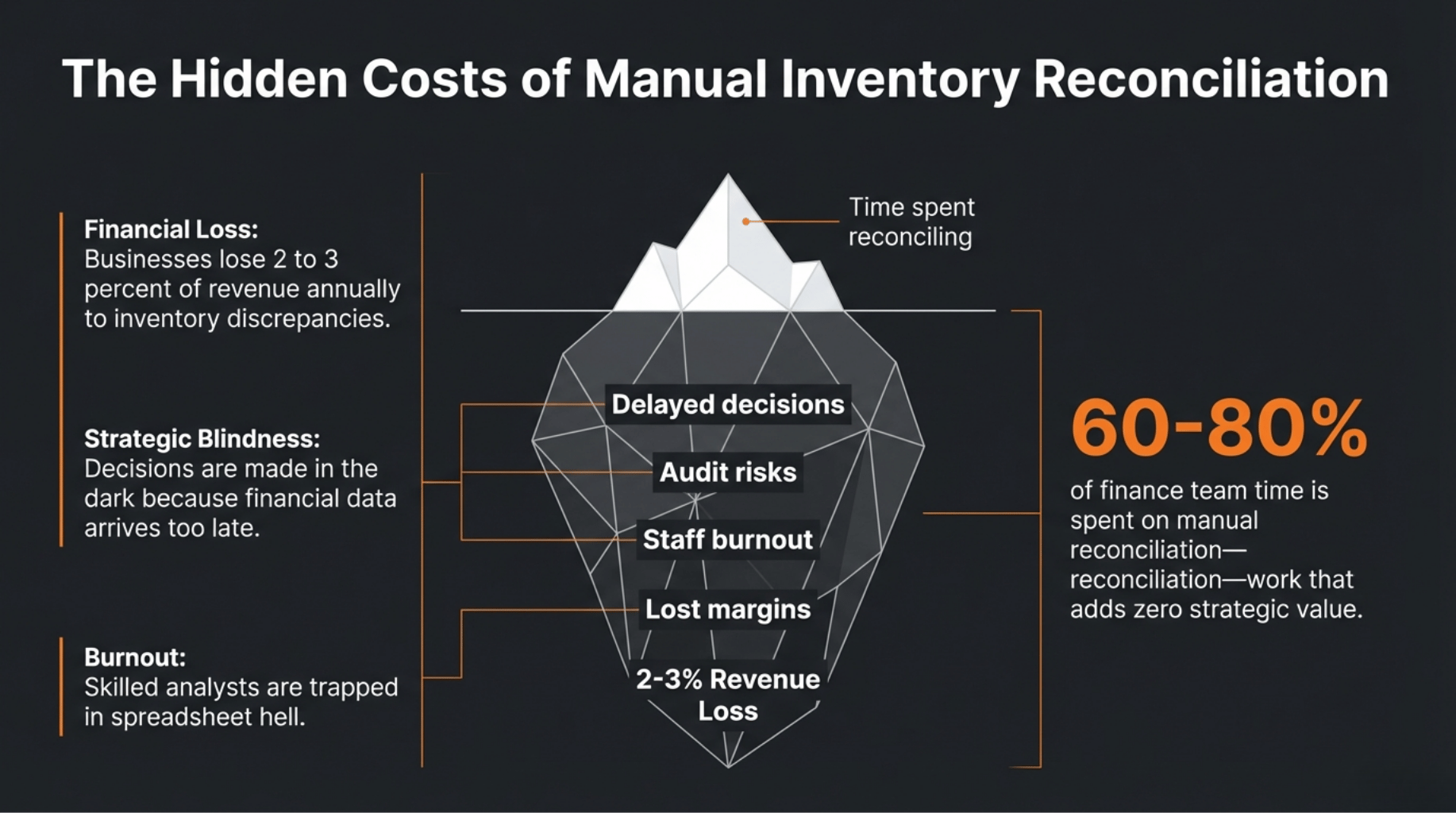
Here’s the brutal truth: disconnected systems force manual data entry, and every manual step multiplies your error rate. One typo in a spreadsheet cascades into compounding mistakes that take weeks to untangle. Research shows businesses lose 2 to 3 percent of revenue annually to inventory discrepancies; money that simply vanishes into reconciliation black holes.
The problem gets worse as you grow. Add multiple warehouses, cost centres, or product lines, and suddenly, you’re juggling dozens of spreadsheets. Each location tracks stock differently. Each manager has their own “system.” And your finance team? They’re stuck piecing together a financial puzzle with half the pieces missing.
Manual journal entries mask the real issues. When numbers don’t match, someone creates an adjustment to force the books to balance. But that adjustment hides operational problems; shrinkage, theft, process failures; that cost far more than the original variance. You’re not fixing problems; you’re sweeping them under the rug.
Timing differences wreck accuracy. Physical stock moves instantly when goods ship or arrive. But financial recognition? That depends on when someone enters data, approves transactions, or processes paperwork. The gap between physical reality and financial records creates a reconciliation nightmare that makes accurate reporting impossible.
The Hidden Costs of Manual Inventory Reconciliation
Manual reconciliation steals more than just time from your finance team. Each hour spent tracking down variances represents lost opportunity for strategic analysis. When your controllers chase phantom inventory differences instead of identifying margin opportunities, your business operates blind.
The real damage shows up in delayed financial closes, audit findings, and strategic decisions based on inaccurate data that slows growth. Studies reveal finance teams spend 60 to 80 percent of their time on manual reconciliation; work that adds zero strategic value. That’s four out of every five hours wasted on number-crunching that integrated systems handle automatically.
Month-end closes stretch from hours into days. While competitors deliver management reports by the second business day, your team is still hunting for variances on day seven. Leadership makes decisions in the dark because financial data arrives too late to matter. You’re driving your business by looking in the rearview mirror.
Audit season becomes everyone’s nightmare. External auditors flag inventory discrepancies, question your controls, and demand endless documentation. Management letters cite “material weaknesses” in reconciliation procedures. Your CFO spends board meetings explaining why the numbers changed; again.
Inaccurate margin reporting destroys pricing strategy. When cost of goods sold calculations are wrong, your gross margin reports lie. You think product A is profitable at current prices, so you push sales. Three months later, you discover it’s actually losing money; but you’ve already committed to contracts you can’t break.
Staff burnout accelerates turnover. Your best finance people didn’t train for years to become reconciliation robots. They joined to do meaningful financial analysis, build strategy, and drive growth. Instead, they’re trapped in spreadsheet hell, working late every month-end, watching their skills decay. Eventually, they leave; and you’re training replacements on the same broken process.
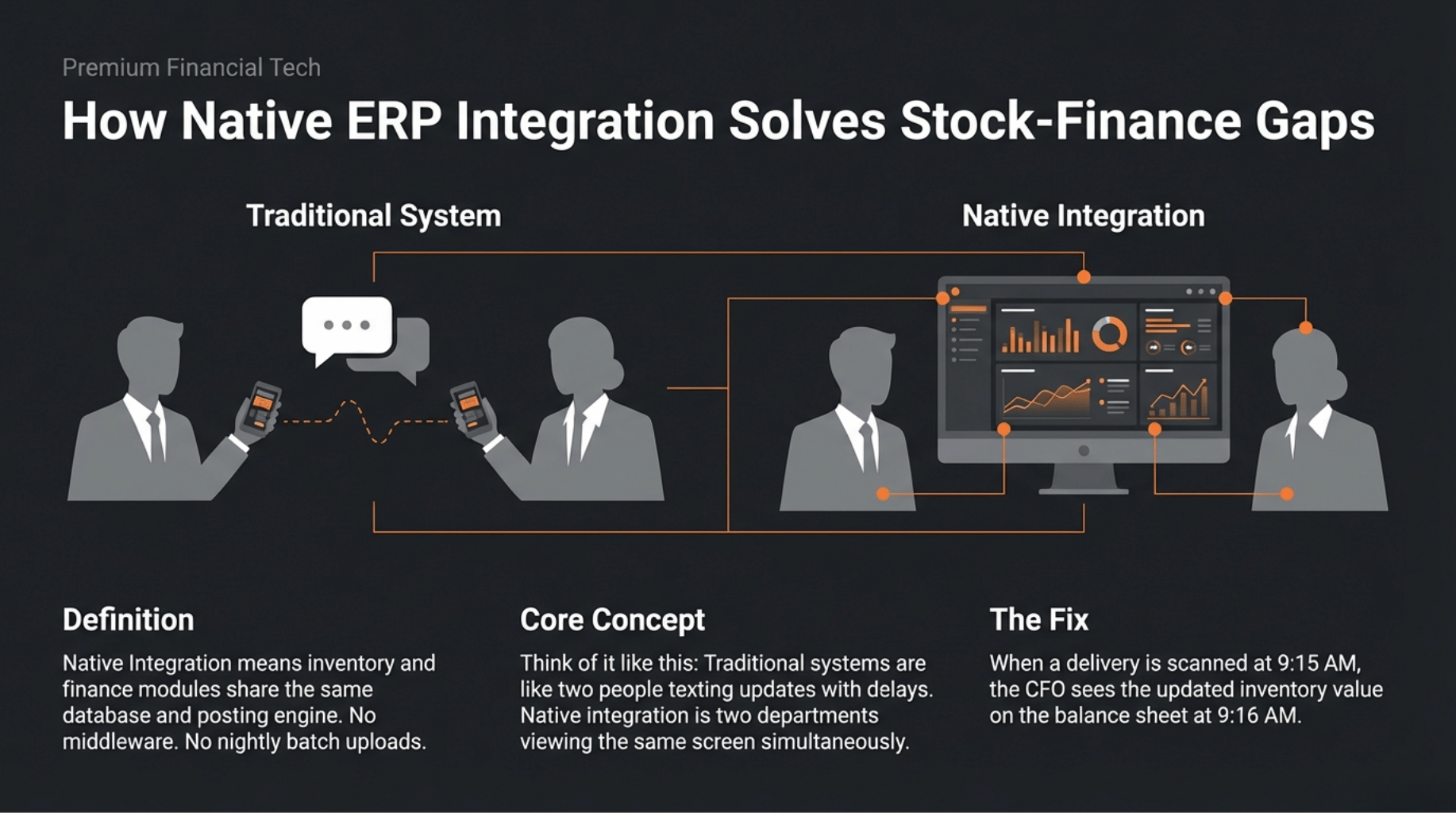
How Native ERP Integration Solves Stock-Finance Gaps
Native integration means inventory and finance modules share the same database and posting engine. Every stock movement automatically creates corresponding general ledger entries in real time. When an ERP processes a goods receipt, the system simultaneously updates inventory quantities, values, and posts to the correct GL accounts; all in one transaction.
Think of it like this: traditional systems are like two people texting each other updates. There’s delay, miscommunication, and messages get lost. Native integration? That’s two departments looking at the same screen at the same time. When warehouse staff receive 100 units, finance sees the same transaction instantly. No lag. No translation errors. No reconciliation needed.
This removes timing gaps and keeps inventory and financial records perfectly aligned. Your warehouse manager scans in a delivery at 9:15 AM, and by 9:16 AM, your CFO sees the updated inventory value on the balance sheet. It’s not magic; it’s just smart system design that treats inventory and finance as two views of the same data.
The beauty of inventory finance integration through native ERP systems is simplicity. You’re not forcing two separate programs to play nice through awkward middleware or nightly batch uploads. Everything lives in one place, follows the same rules, and updates together. When you adjust inventory, the financial impact calculates automatically. When you post a sale, cost of goods sold appears instantly. No manual intervention required.
Real-Time Posting Eliminates Timing Gaps
Traditional systems create lag between physical inventory movements and financial recognition. A warehouse receives goods on Tuesday, but accounting doesn’t post the transaction until Friday; creating three days of mismatched records that drive everyone mad.
Integrated systems post simultaneously, so inventory receipts, issues, and adjustments instantly update both inventory balances and general ledger accounts. This real-time synchronisation can push accuracy above 99 percent by eliminating the reconciliation window entirely.
Here’s what happens in practice: Your warehouse team scans in a pallet of raw materials. That single scan triggers multiple updates across the system:
- Inventory quantities increase immediately
- The inventory asset account on your balance sheet rises
- Purchase price variance gets calculated and posted
- The receiving report links to the original purchase order
- Your purchasing team sees the order fulfilled
All of this happens in seconds, not days. No waiting for batch processing overnight. No weekend update runs that mysteriously fail. Just instant, accurate posting that keeps your books current every moment of every day.
The audit trail connects everything automatically. Click on any general ledger entry, and the system shows you the exact inventory transaction that created it; complete with timestamps, usernames, and source documents. External auditors love this because they can verify transactions in minutes instead of requesting boxes of paperwork.
Configurable posting rules mean different transaction types follow the right accounting treatment. Inventory receipts hit asset accounts. Issues to production hit work-in-progress. Sales shipments trigger cost of goods sold. Returns reverse the original entries. The system knows the rules and applies them consistently every single time, eliminating the human error that creeps in with manual posting.
Automatic Account Mapping Ensures Accuracy
Posting classes in integrated ERP systems define which GL accounts receive debits and credits for each inventory transaction type. Configure a posting class for raw materials once, and every receipt automatically hits the correct inventory asset account, every issue posts to the right cost of goods sold account, and every adjustment flows to the designated variance account.
This automation slashes manual journal entries and the errors that come with them. No more end-of-month scrambles where someone has to figure out which account code applies to which transaction. The system already knows.
Here’s a real example: You sell electronic components and finished assemblies. Components use posting class “RAW” that sends receipts to account 1400-RAW and issues to 5100-MAT. Finished goods use posting class “FIN” that posts to 1450-FIN and 5200-COGS. Set this up once during implementation, and the system handles thousands of transactions flawlessly without anyone thinking about account codes.
Warehouse-specific overrides handle complex scenarios. Your Cape Town warehouse might use different GL accounts than your Johannesburg facility for cost centre reporting. Configure account overrides by location, and the system posts correctly based on where the transaction happens. Finance gets the detail they need for regional profitability analysis without warehouse staff doing anything differently.
Integration with cost centres and departments adds another dimension. Manufacturing issues that go to production job 12345 automatically pull costs into that job’s cost centre. This granular tracking flows through to financial reporting, showing exactly where money goes without manual allocation spreadsheets.
The system even handles exceptions gracefully. Need to override the standard posting for a one-off transaction? The system allows it, but requires approval and documentation. This flexibility supports unusual situations while maintaining control and audit trail integrity.
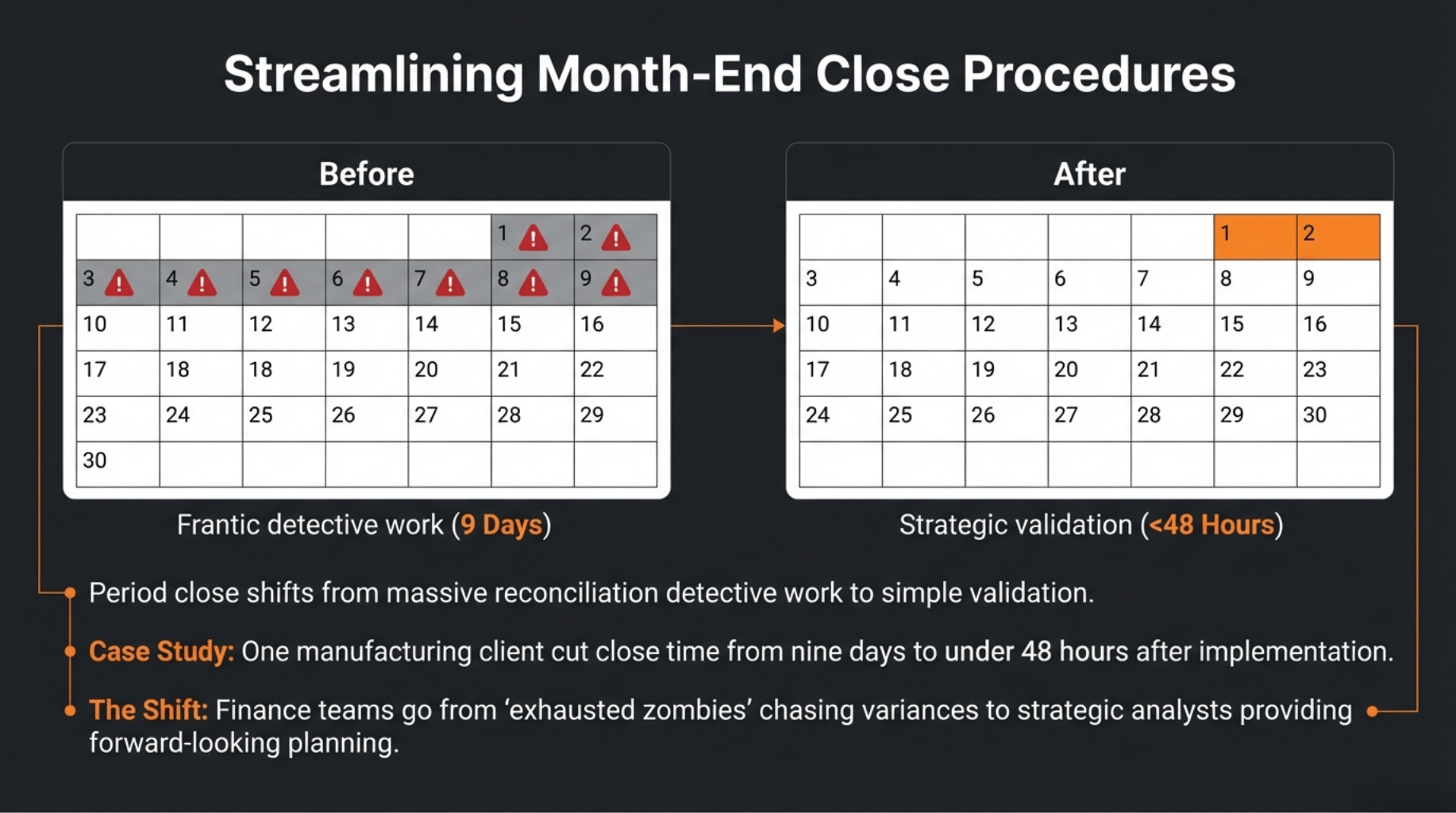
Streamlining Month-End Close Procedures
Integrated inventory-finance systems turn month-end close from a multi-day slog into a streamlined few-hour process. When inventory transactions post to GL automatically throughout the month, period close becomes validation and review rather than massive reconciliation detective work.
Controllers can close books faster, deliver timely management reports, and shift focus from number-crunching to financial analysis that actually drives business decisions. While competitors are still hunting for variances on day five, you’re presenting completed financials on day two.
The transformation is dramatic. One manufacturing client cut their close time from nine days to under 48 hours after implementing integrated inventory finance systems. Their finance team went from exhausted zombies every month-end to strategic analysts who actually enjoy their jobs. Staff turnover dropped, and the CFO finally had time for forward-looking planning instead of backward-looking reconciliation.
Real-time visibility throughout the month eliminates surprises. Finance sees inventory values update continuously, so gross margins reflect current reality instead of last month’s estimates. When sales spike unexpectedly, you spot the margin impact immediately and can adjust pricing or promotions before the month closes. This agility turns finance from scorekeepers into strategic partners.
Automated Cost of Goods Sold Calculation
Cost of goods sold calculates automatically as inventory moves. When you ship a sales order, the system instantly determines COGS based on your valuation method and posts to the correct expense accounts. No waiting. No estimates. No month-end surprises.
This removes manual adjusting entries and keeps gross margin reporting accurate throughout the period, enabling timely pricing decisions and margin analysis. Your sales team quotes new opportunities with confidence because margin data reflects today’s costs, not last quarter’s guesses.
The calculation happens behind the scenes in milliseconds:
- Customer order ships 50 units
- System checks inventory costing method (FIFO, average, or standard)
- Calculates cost based on chosen method
- Posts revenue to income statement
- Posts COGS to expense simultaneously
- Updates inventory asset account
- Recalculates gross margin instantly
Your dashboard shows updated margins before the delivery truck leaves the loading dock. This real-time visibility transforms decision-making. Spot a product with eroding margins? Investigate immediately, instead of discovering the problem weeks later when it’s too late to fix.
Consistent application of valuation methods eliminates the errors that happen when different people apply different logic. Whether your warehouse ships ten orders or ten thousand, each transaction follows identical costing rules applied by the system, not interpreted by humans having different coffee levels.
Inventory Valuation Reports and Controls
Month-end valuation reports give instant visibility into inventory values by location, category, and costing method. Integrated systems generate inventory ageing analysis, slow-moving stock reports, and turnover metrics automatically; no spreadsheets required.
Controllers review variances between physical counts and system records, investigate meaningful differences, and make adjustments with full audit trails that satisfy both internal scrutiny and external auditors. The whole process takes hours instead of days because you’re reviewing exceptions, not reconciling everything from scratch.
Modern systems highlight what matters. Variance reports flag discrepancies above your threshold; say 2 percent or R5,000; so controllers focus on material issues instead of chasing R12 rounding differences. Traffic light indicators show green for normal variances, yellow for items needing attention, and red for significant problems requiring immediate investigation.
Automated ageing analysis identifies slow-moving inventory before it becomes obsolete. See which items haven’t moved in 90, 180, or 360 days, then make decisions about clearance pricing, write-downs, or discontinuation. This proactive management prevents warehouse space getting clogged with dead stock that ties up working capital.
Adjustment approval workflows maintain control. Significant inventory adjustments require manager approval before posting, creating accountability and preventing unauthorised changes. The system logs who requested the adjustment, who approved it, when it happened, and why; building the audit trail automatically.
Complete documentation satisfies auditors without extra work. Every adjustment links to count sheets, investigation notes, and approval records. External auditors verify your inventory valuation in half the time because documentation lives in the system, not scattered across email threads and filing cabinets.
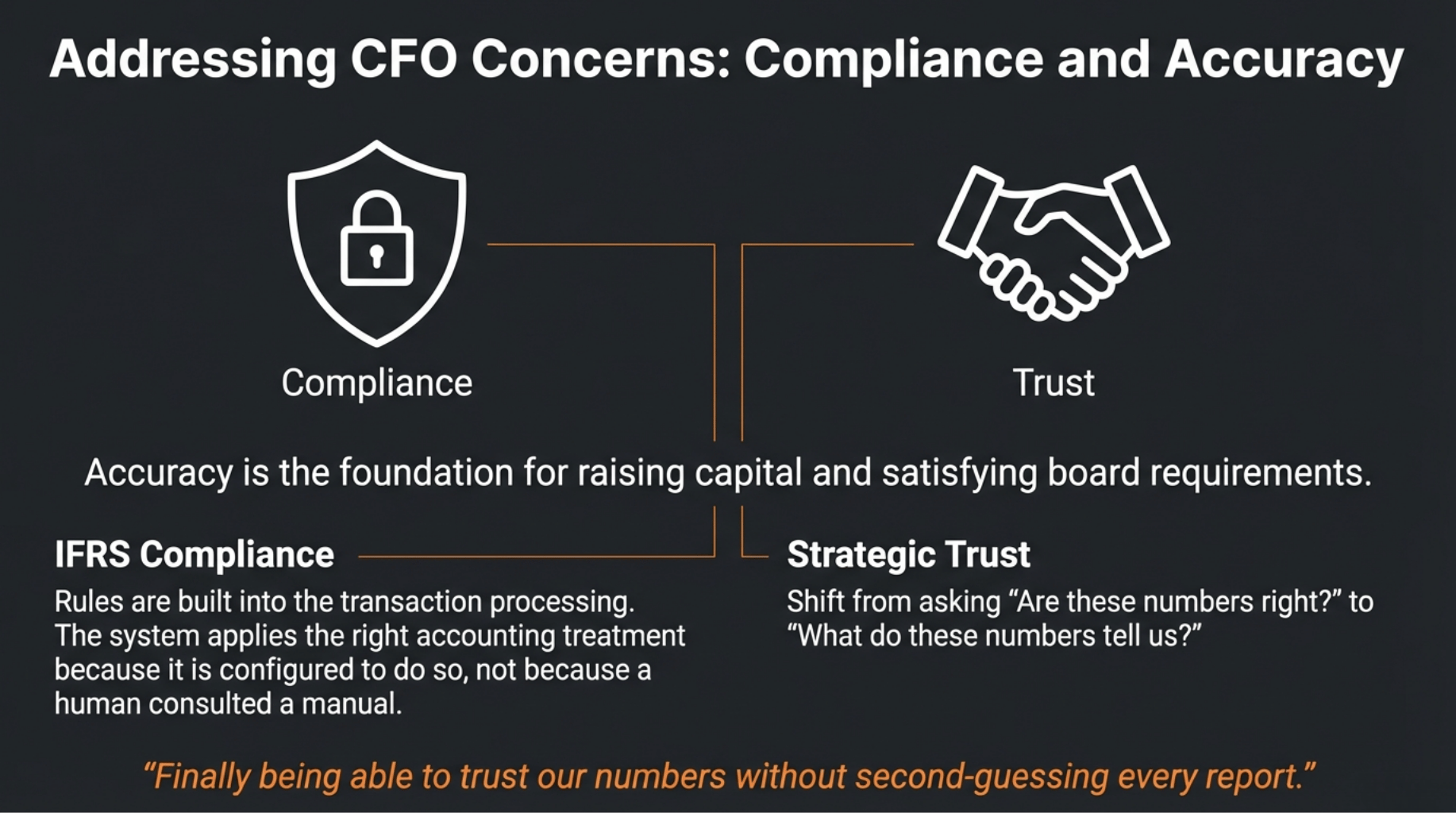
Addressing CFO Concerns: Compliance and Accuracy
CFOs care about financial statement accuracy, audit readiness, and regulatory compliance. These aren’t abstract concerns; they’re the foundations that determine whether your business can raise capital, satisfy board requirements, and make strategic decisions with confidence.
Integrated inventory-finance systems address these priorities by applying consistent valuation methods, maintaining complete audit trails, and producing margin reporting you can actually trust. When inventory values match financial records automatically through inventory finance integration, CFOs gain confidence in reported results and can shift focus from backward-looking reconciliation to forward-looking strategy.
The transformation is tangible. One CFO described the shift as “finally being able to trust our numbers without second-guessing every report.” Before integration, he spent weeks preparing for board meetings, validating inventory figures, and explaining variances. After? Reports generate in hours with confidence they’re accurate.
Compliance becomes simpler when systems enforce rules automatically. IFRS requirements, audit standards, and internal controls get built into transaction processing rather than relying on people remembering policies. The system applies the right accounting treatment every time because that’s how it’s configured; not because someone consulted a manual.
Margin reporting accuracy drives strategic decisions. When you know actual product profitability down to the penny, you can confidently shift marketing spend towards winners, phase out losers, and price new products competitively whilst protecting margins. Guesswork disappears when data becomes reliable.
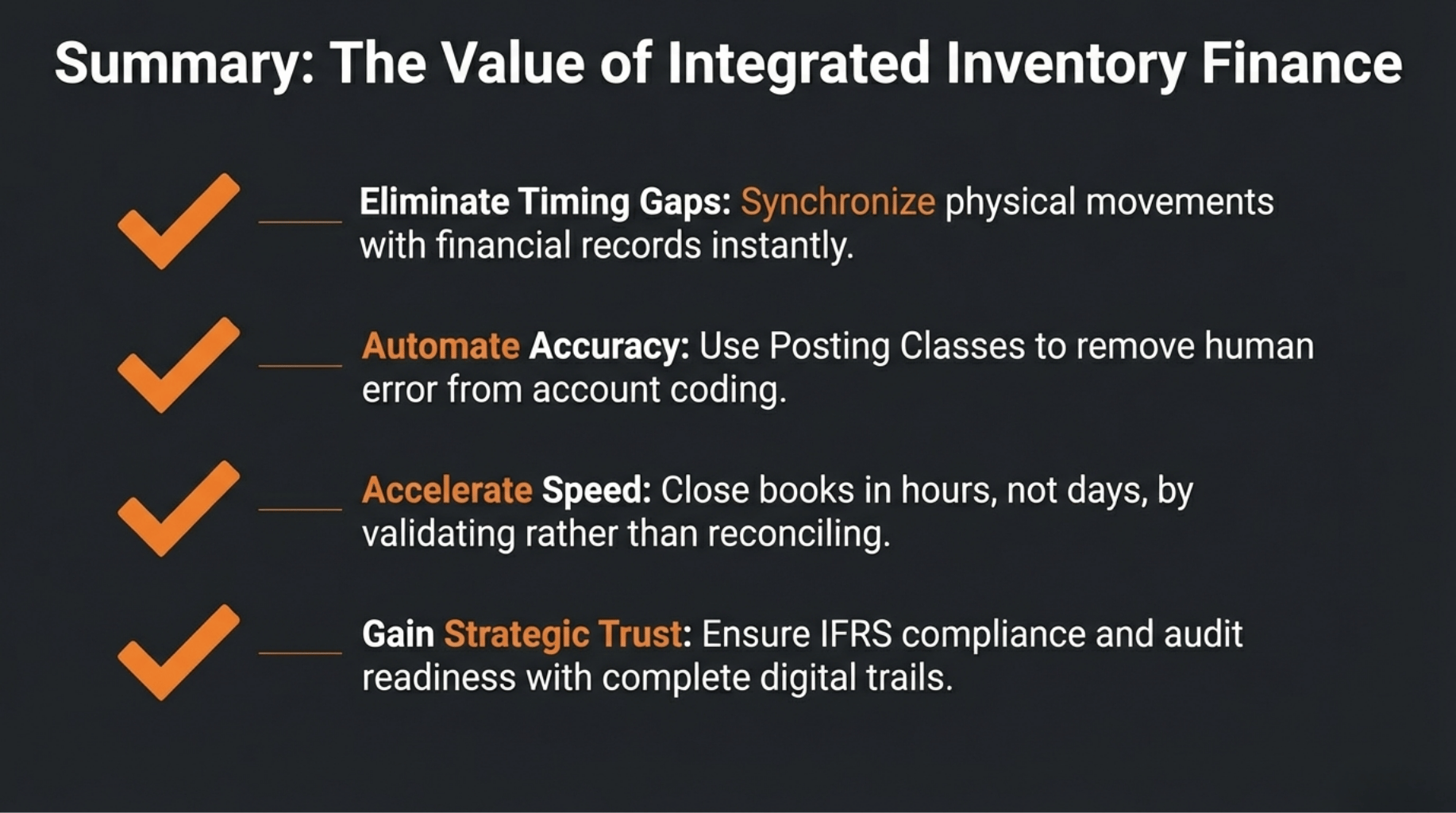
Wrapping Up
Inventory-finance integration transforms reconciliation from a recurring nightmare into an automated process that delivers accurate financial statements and strategic insights. When inventory movements post to the general ledger in real time, businesses eliminate timing gaps, reduce manual errors, and cut month-end close time from days to hours.
Integrated ERP systems ensure every inventory pound matches financial records perfectly, supporting IFRS compliance, audit readiness, and margin reporting accuracy that drives confident strategic decisions. CFOs stop wasting time validating numbers and start spending time on analysis that grows the business.
Stop wasting valuable finance resources on manual inventory reconciliation. Discover how native inventory-finance integration can transform your month-end close process and deliver accurate financial insights you can trust. Contact Astaria for a customised demo showing how integrated systems eliminate reconciliation gaps and support strategic financial management that drives growth.
FAQ Section
Q1: What causes inventory and finance records to not match?
A: Discrepancies usually come from separate systems that do not post in real time, timing differences between physical movements and financial postings, manual journal entries that introduce errors, and inconsistent cost allocation methods. Integrated ERP systems address this by posting inventory and financial transactions together.
Q2: How long should month-end inventory close take with integrated ERP?
A: Many organisations cut close time from days to a few hours because inventory transactions post to GL automatically throughout the month. The focus shifts to validation and exception review instead of manual reconciliation.
Q3: Which inventory costing method is best for IFRS compliance in South Africa?
A: IFRS allows FIFO and weighted average, and does not allow LIFO. FIFO can better reflect current replacement cost in inventory values during inflation, while weighted average can smooth price swings. The best choice depends on your operations and reporting goals.
Q4: How do integrated ERP systems handle landed costs?
A: They can automatically allocate freight, duties, and handling charges to inventory using configurable rules such as weight, volume, or value. Those costs update inventory values and GL postings at the same time, so capitalisation is consistent without manual journals.
Q5: What audit trail requirements exist for inventory-GL reconciliation?
A: Auditors expect traceability from GL balances to journal entries, then to source inventory transactions and supporting documents. Integrated ERPs typically keep this trail automatically using timestamps, user IDs, approvals, and document links.