



Summary
The text explains why ESG is now essential in manufacturing and how factories can start building a credible ESG baseline. It covers the meaning of ESG, why it matters to buyers and investors, key emissions scopes, important social/governance metrics, and how Acumatica can simplify ESG data collection and reporting.
Key Points
- ESG is now a business requirement for manufacturers to win contracts, secure funding, and meet regulatory demands.
- Manufacturers must track environmental, social, and governance data, including Scope 1, 2, and especially Scope 3 emissions.
- Common frameworks like GRI, CDP, and TCFD help standardise reporting for buyers and investors.
- Acumatica is presented as a solution that connects plant, finance, HR, and supplier data to automate ESG tracking and reporting across multiple sites.
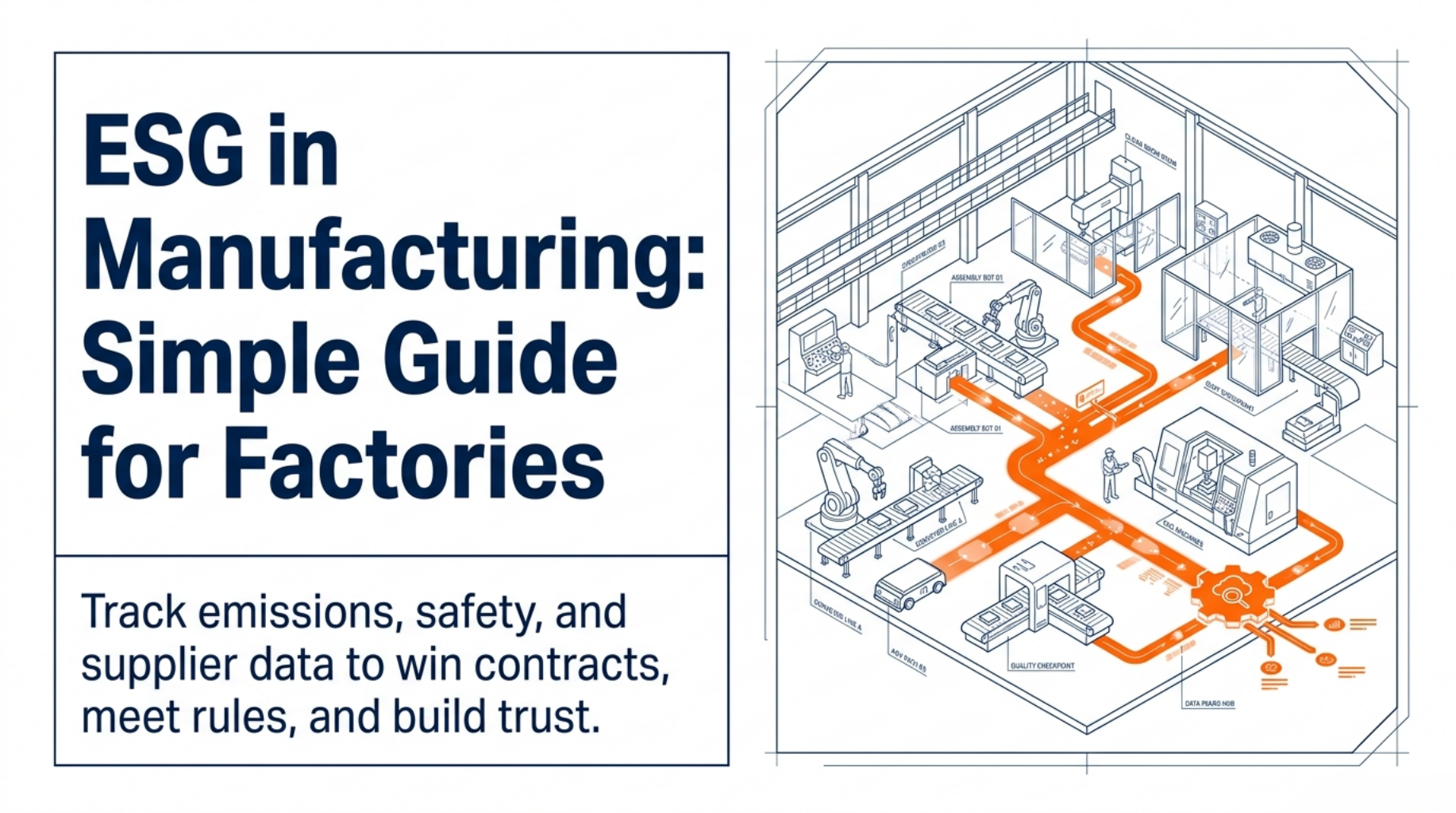
ESG in manufacturing is no longer a side project. It is now a core part of how factories win contracts, secure funding, and stay compliant with new rules. Customers, investors, and regulators all want proof that a plant runs clean, treats workers fairly, and follows sound governance.
This guide breaks ESG into plain parts. You will learn what it means for a factory floor, why it matters right now, and how to build your first baseline without getting lost in jargon.
What Is ESG in Manufacturing?
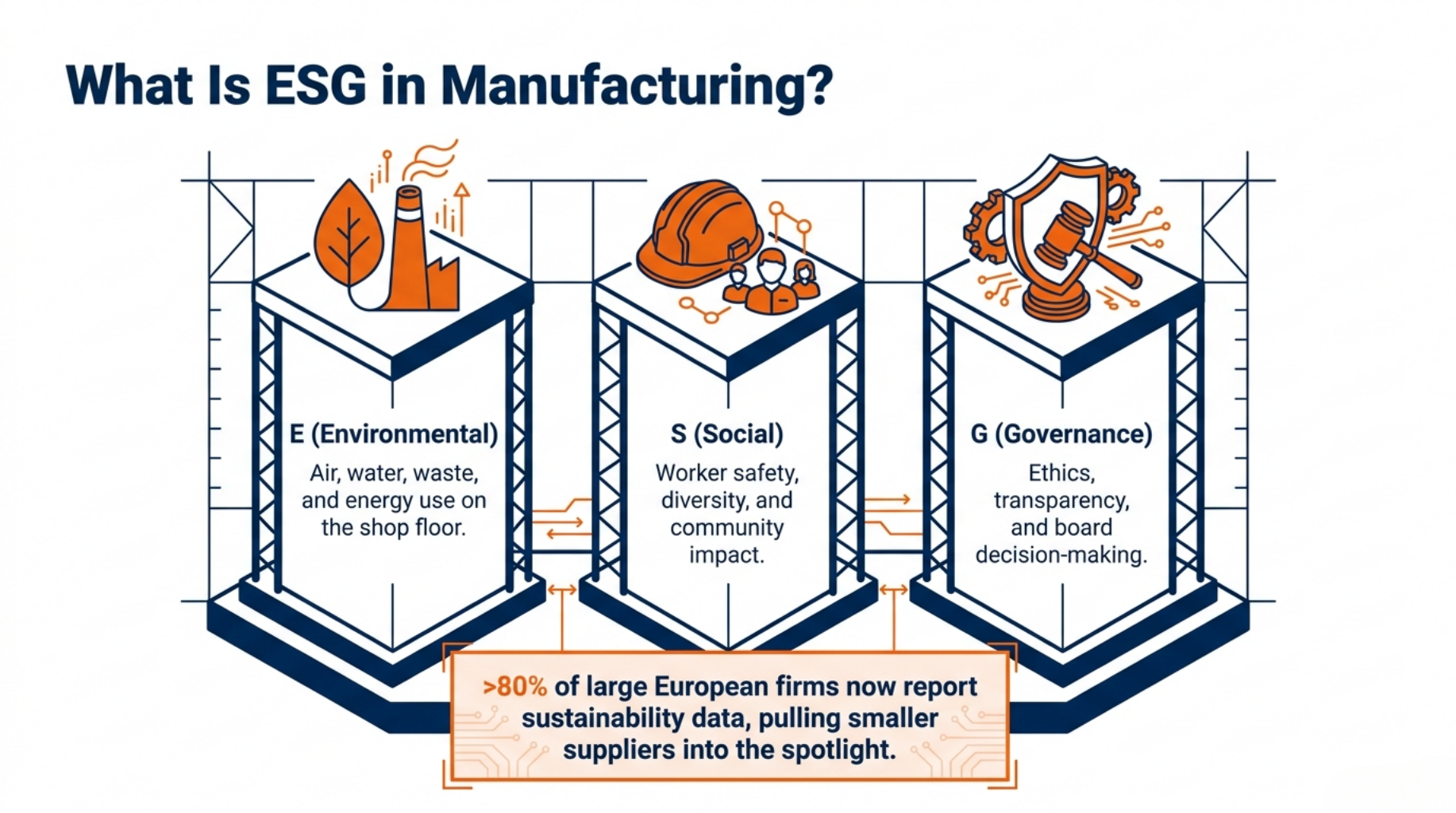
ESG stands for Environmental, Social, and Governance. For a manufacturer, it means tracking three things: what your plant puts into the air and water, how you treat your workers, and how honest your leadership is.
Environmental covers emissions, waste, and energy use on the shop floor. Social cover worker safety, diversity, and how your plant affects the local community. Governance covers ethics, transparency, and how your board makes decisions.
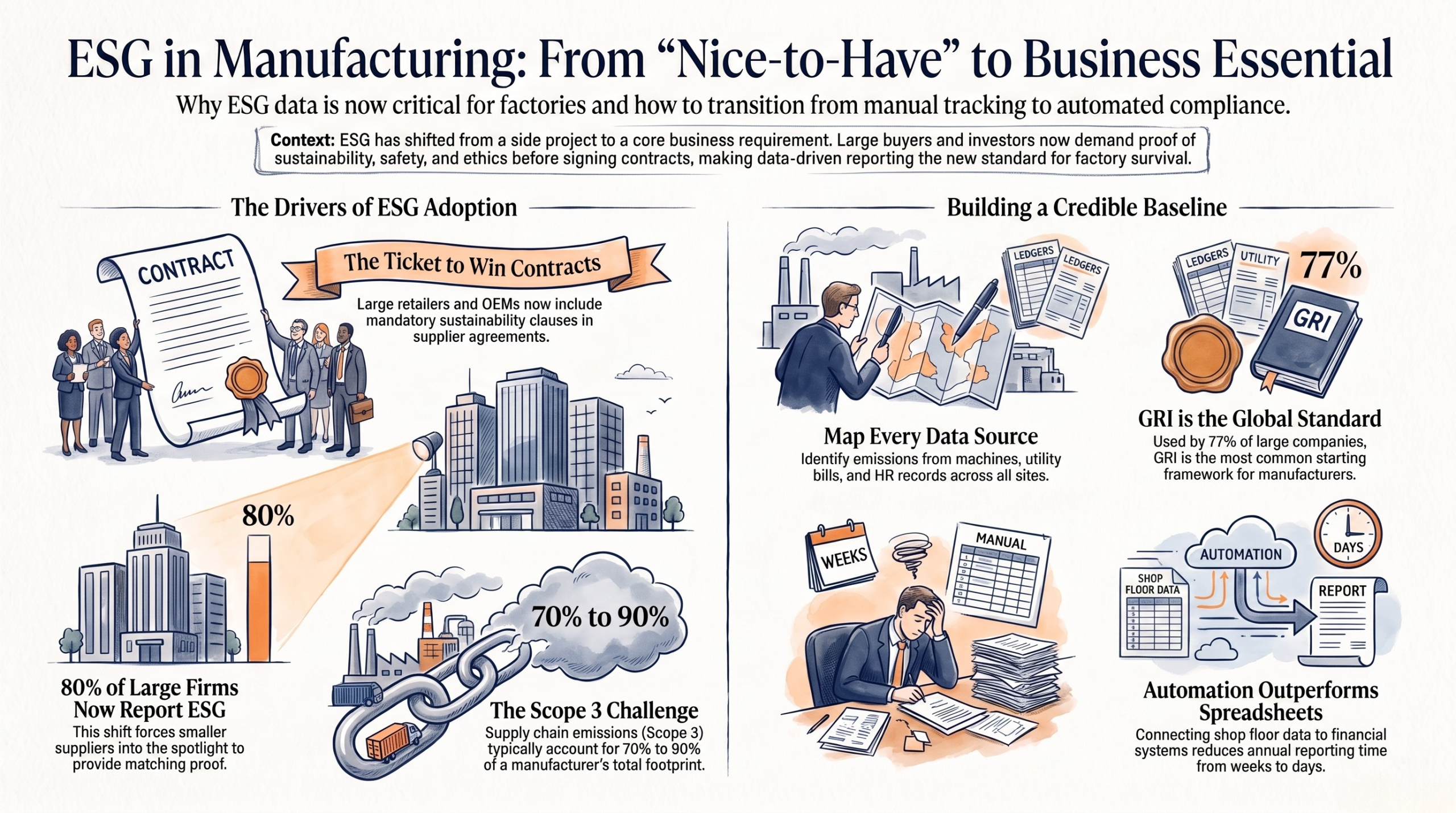
More than 80% of large firms in Europe now report sustainability data, up from under 10% two decades ago. That shift has pulled smaller manufacturers into the same spotlight, since big buyers now ask their suppliers for the same proof.
Why ESG Matters for Manufacturers Now
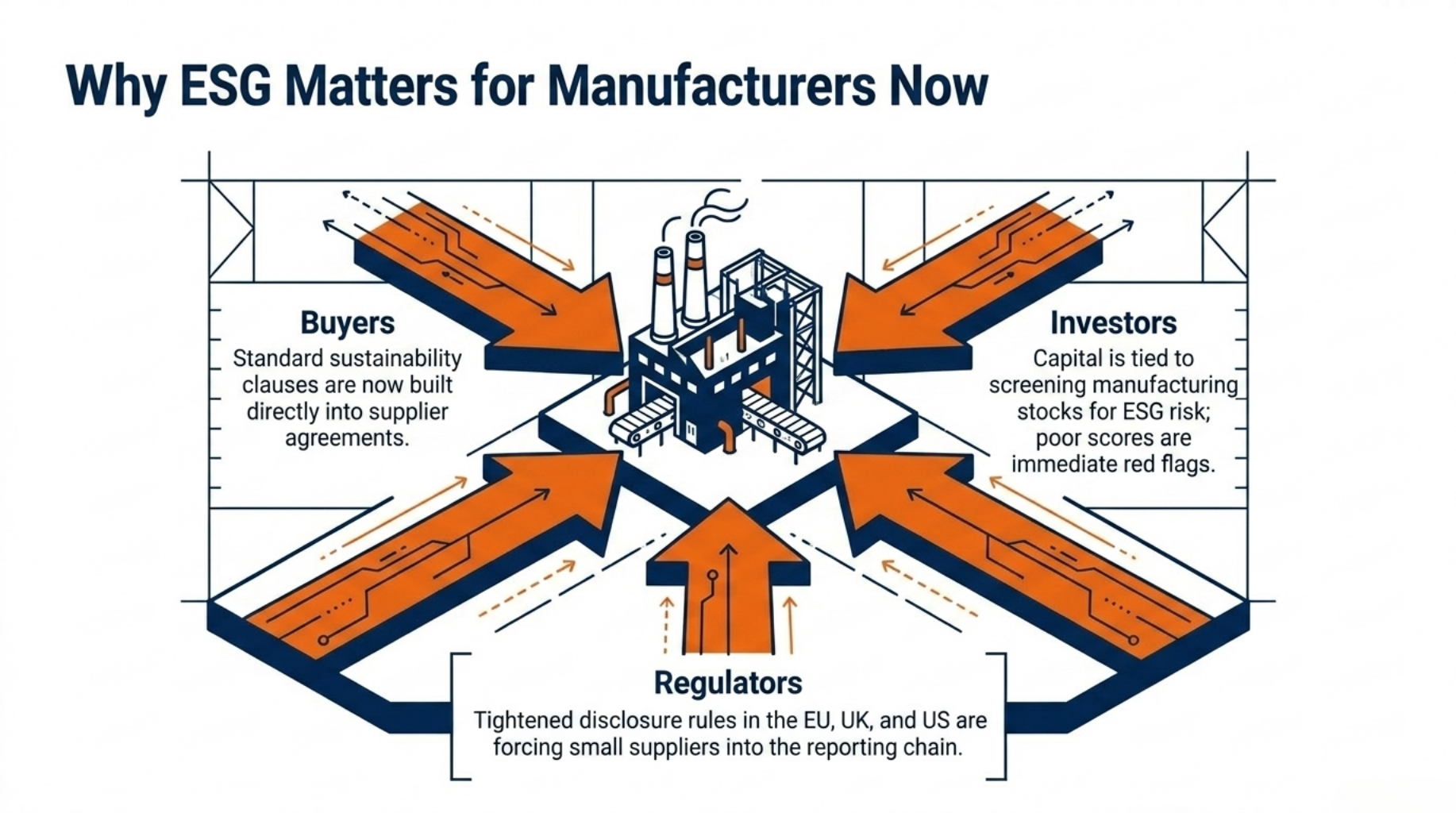
Buyers no longer take your word for it. They want data, and they want it before they sign a contract.
Large retailers and OEMs now build sustainability clauses into supplier agreements as standard practice. Investors screen manufacturing stocks for ESG risk before they commit capital, treating weak scores as a red flag. Regulators in the EU, UK, and US have tightened disclosure rules, forcing many suppliers into the reporting chain even if they are small.
The Cost of Falling Behind
A plant that cannot show clean data risks losing contracts to a rival that can. Poor ESG scores also raise the cost of borrowing, since lenders now price sustainability risk into loan terms. One missed audit can cost more than the reporting itself.
Scope 1, 2, and 3 Emissions Explained
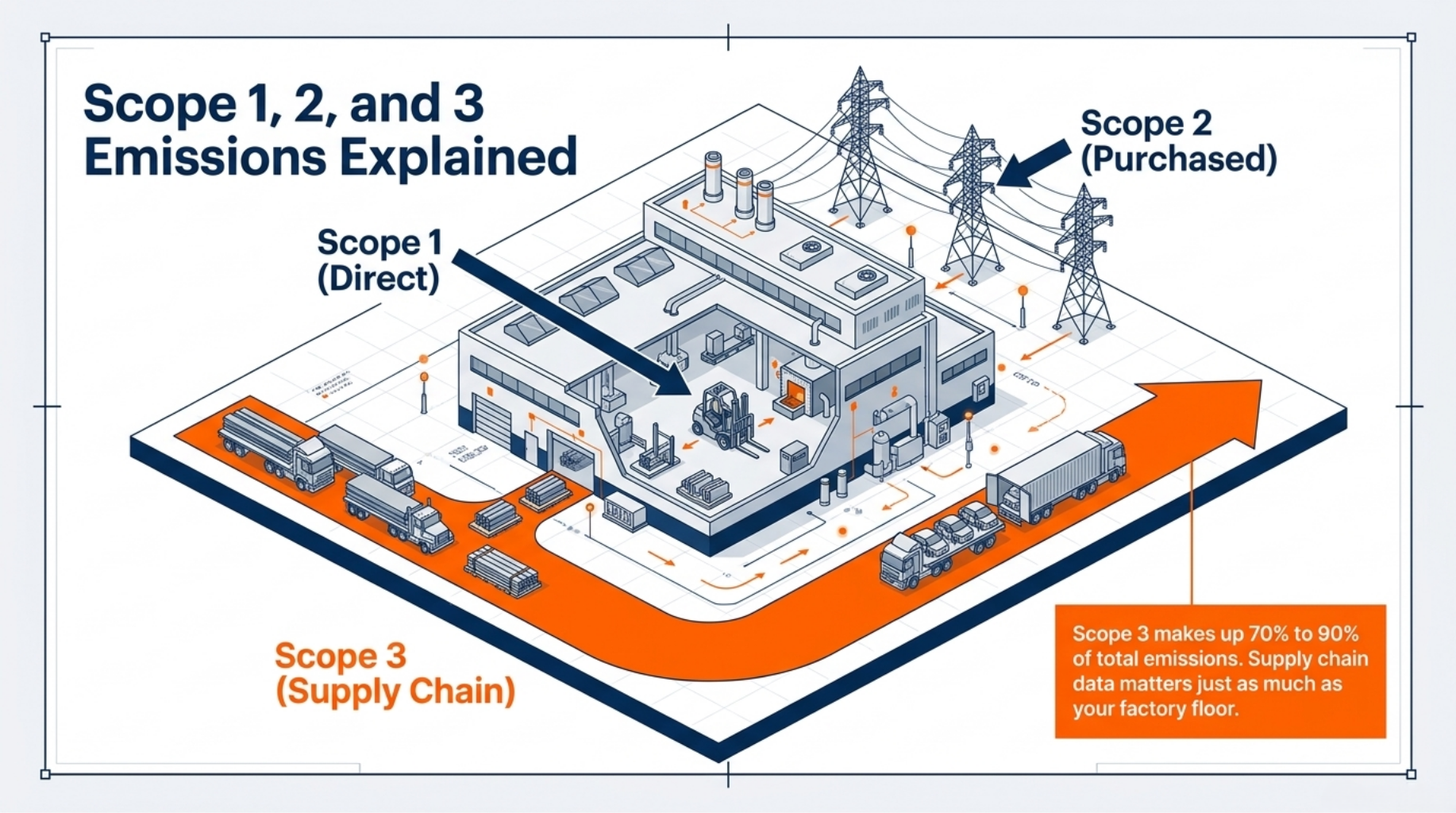
Scope emissions sort your carbon footprint into three buckets, based on where the emissions come from. Getting this right is the base of any ESG report.
- Scope 1: Direct emissions from things you own, like a furnace or a delivery van
- Scope 2: Emissions from the electricity and energy you buy to run your plant
- Scope 3: Emissions from your supply chain, from raw material suppliers to how customers use your product
Picture a car parts factory. Scope 1 is the diesel burned in its own forklifts. Scope 2 is the grid power lighting the assembly line. Scope 3 is the steel it buys, and the fuel burned by trucks that ship the finished parts.
Scope 3 is the biggest bucket by far. For most manufacturers, it makes up 70% to 90% of total emissions, while Scope 1 and 2 combined make up the rest. That is why supply chain data matters as much as your own factory floor.
Social and Governance Metrics That Matter
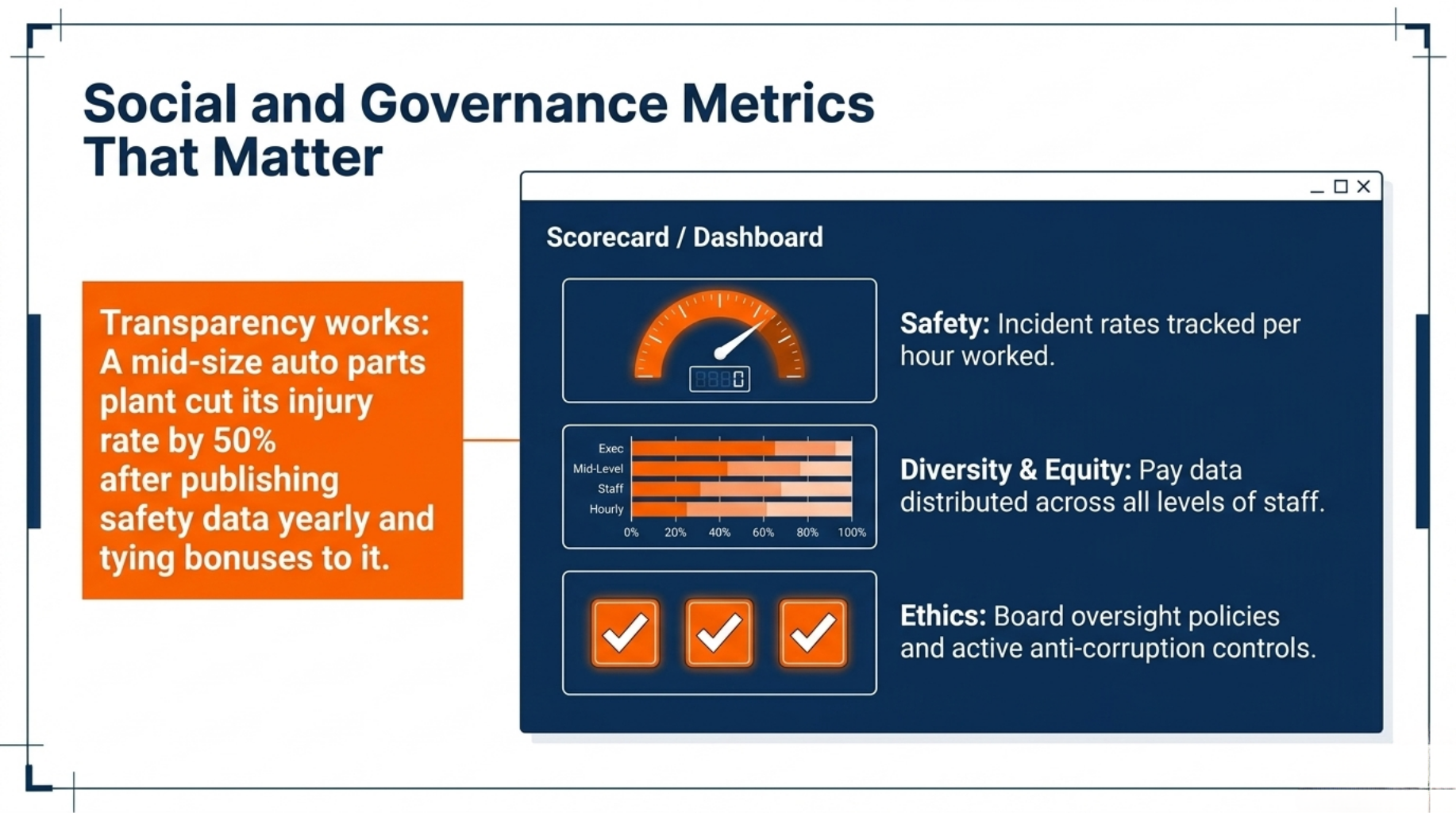
Social and governance metrics prove your plant treats people fairly and runs with integrity. Buyers and investors check both before they trust your environmental numbers.
- Worker safety incident rates, tracked per hour worked
- Diversity and pay equity data across all levels of staff
- Board oversight of ethics policies and anti-corruption controls
A factory with a strong safety record and a transparent board earns trust faster than one that only talks about emissions. One mid-size auto parts plant cut its injury rate by half after publishing safety data yearly and tying bonuses to it. That kind of open reporting builds the trust ESG reporting is meant to create.
Common ESG in Manufacturing Frameworks
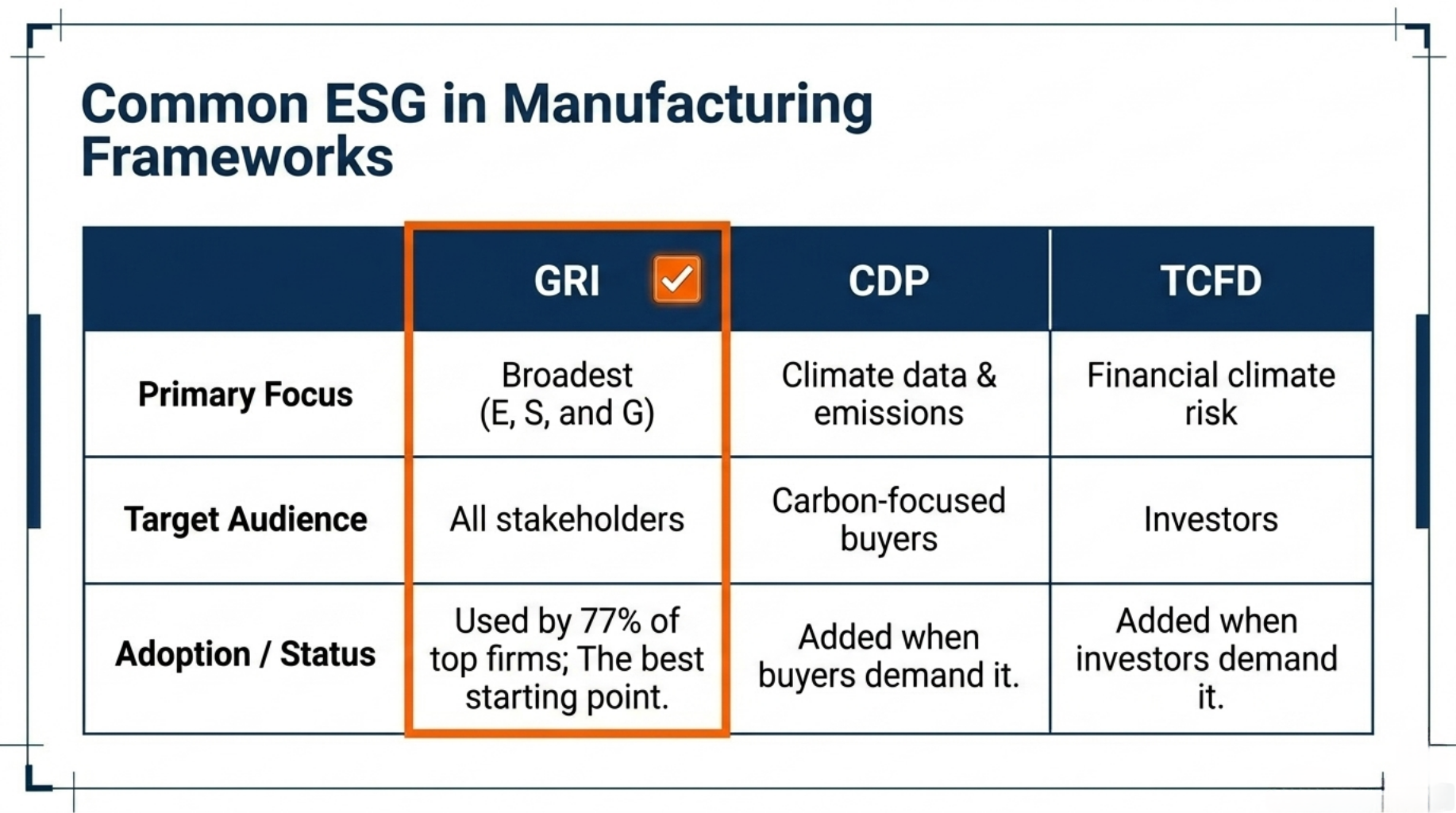
Frameworks give your data a shared structure, so buyers and investors can compare it across companies. Three names come up most in manufacturing: GRI, CDP, and TCFD.
GRI is the broadest choice, covering environmental, social, and governance topics in one system. CDP focuses tightly on climate data and emissions disclosure, making it a good fit if buyers ask about carbon first. TCFD zooms in on climate risk as it relates to your finances, which investors often want to see.
GRI leads by a wide margin, used by 77% of the world’s largest companies and 71% of top national firms surveyed by KPMG. Most manufacturers start with GRI, then add CDP or TCFD once a specific buyer or investor asks for it.
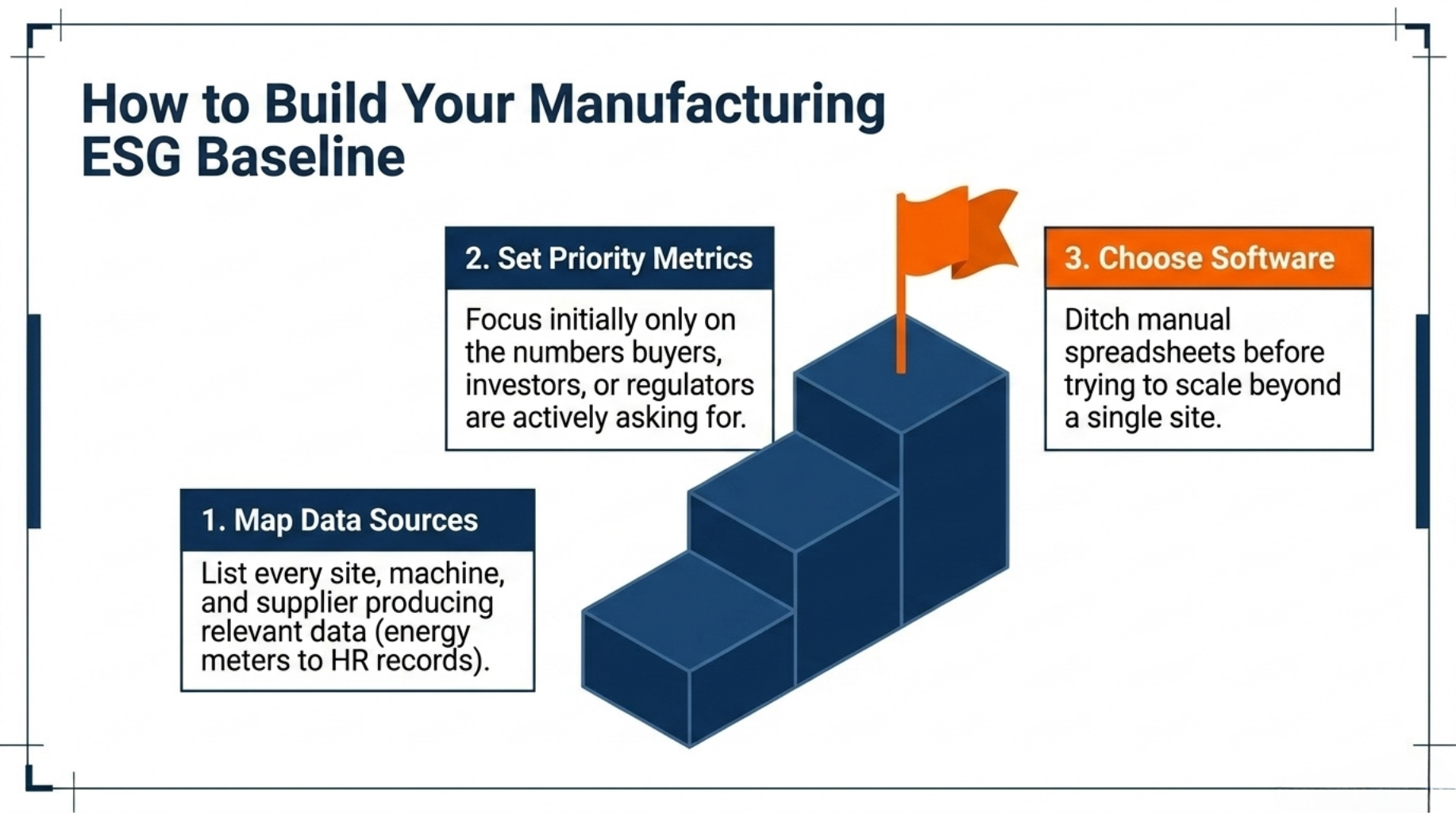
How to Build Your Manufacturing ESG Baseline
A baseline is your starting point. It is the set of numbers you measure now so you can prove progress later. Building one does not need to take months if you follow a clear order.
- Map your data sources. List every site, machine, and supplier that produces relevant data, from energy meters to HR records.
- Set priority metrics. Pick the numbers your buyers, investors, or regulators ask for most, rather than tracking everything at once.
- Choose software to track and report. Manual spreadsheets break down fast once you add more than one site or metric.
Most companies spend several months building their first full baseline, since data often sits scattered across different systems and teams. Starting with one site and a short list of metrics keeps the project manageable.
Using Acumatica to Simplify ESG Tracking
Acumatica pulls emissions, safety, and governance data into one system instead of scattered spreadsheets. That single view makes it far easier to spot gaps before an audit or a buyer request lands on your desk.
The platform also maps your data to GRI, CDP, and TCFD formats, cutting the manual work of reformatting numbers for each framework. For a manufacturer juggling multiple sites, that kind of automation turns a slow, error-prone task into a routine one.
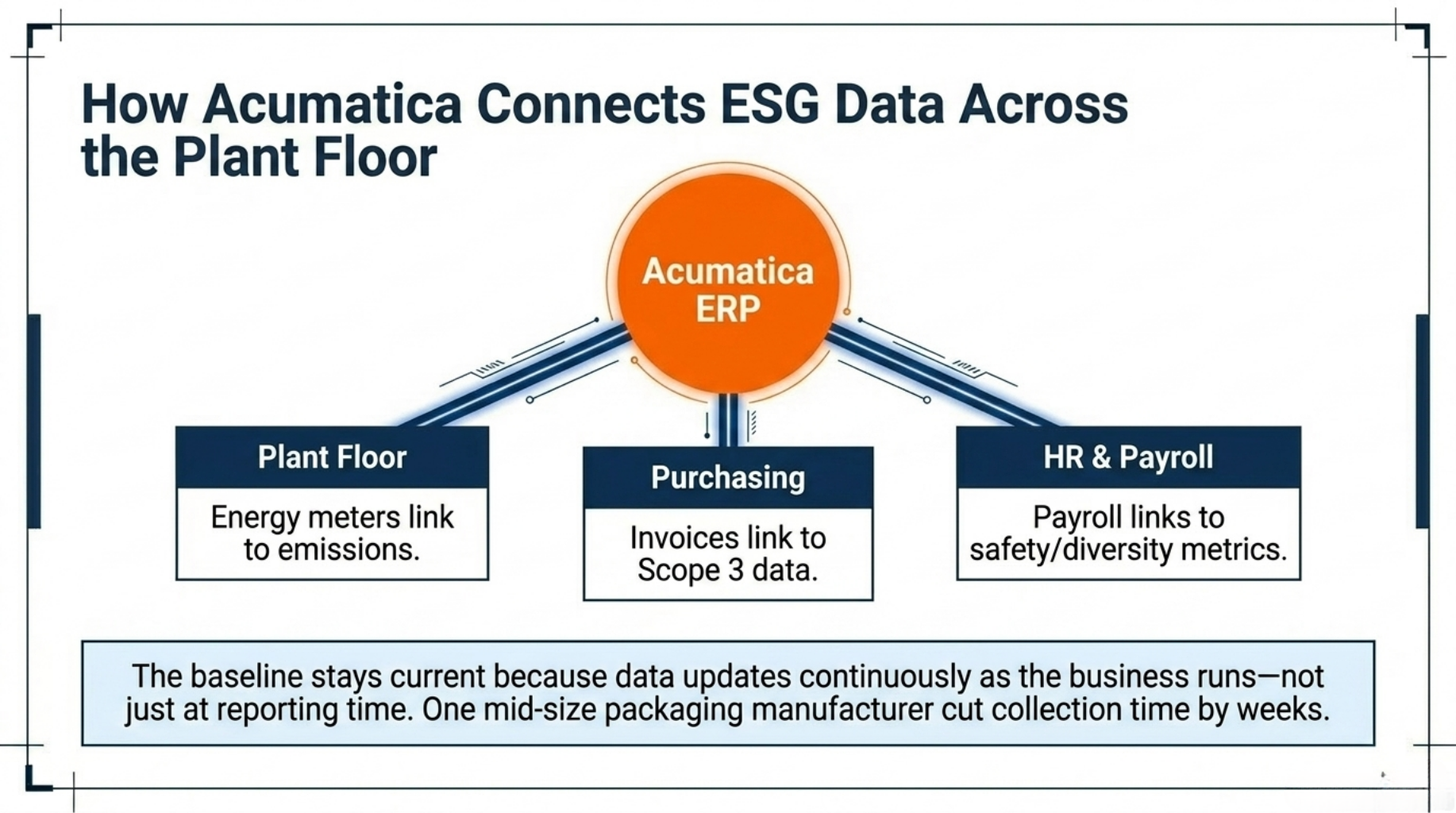
How Acumatica Connects ESG Data Across the Plant Floor
Most manufacturers store emissions, safety, and finance data in separate systems that never talk to each other. That gap creates gaps in reports and slows down every audit. Acumatica solves this by linking production, inventory, and financial modules to one shared database.
When a plant logs energy use on the shop floor, that number feeds straight into the same system tracking payroll, purchasing, and supplier contracts. This matters most for Scope 2 and Scope 3 data, since energy bills and supplier invoices already flow through the finance module. A mid-size packaging manufacturer cut its data collection time by weeks after moving from spreadsheets to a connected system like this.
- Energy meters and utility bills feed directly into emissions tracking
- Supplier purchase orders link to Scope 3 supply chain data
- HR and payroll records connect to social metrics like safety and diversity
This kind of connection removes the guesswork that comes from chasing numbers across five different tools. It also means your baseline stays current, since the data updates as the business runs, rather than only at reporting time.
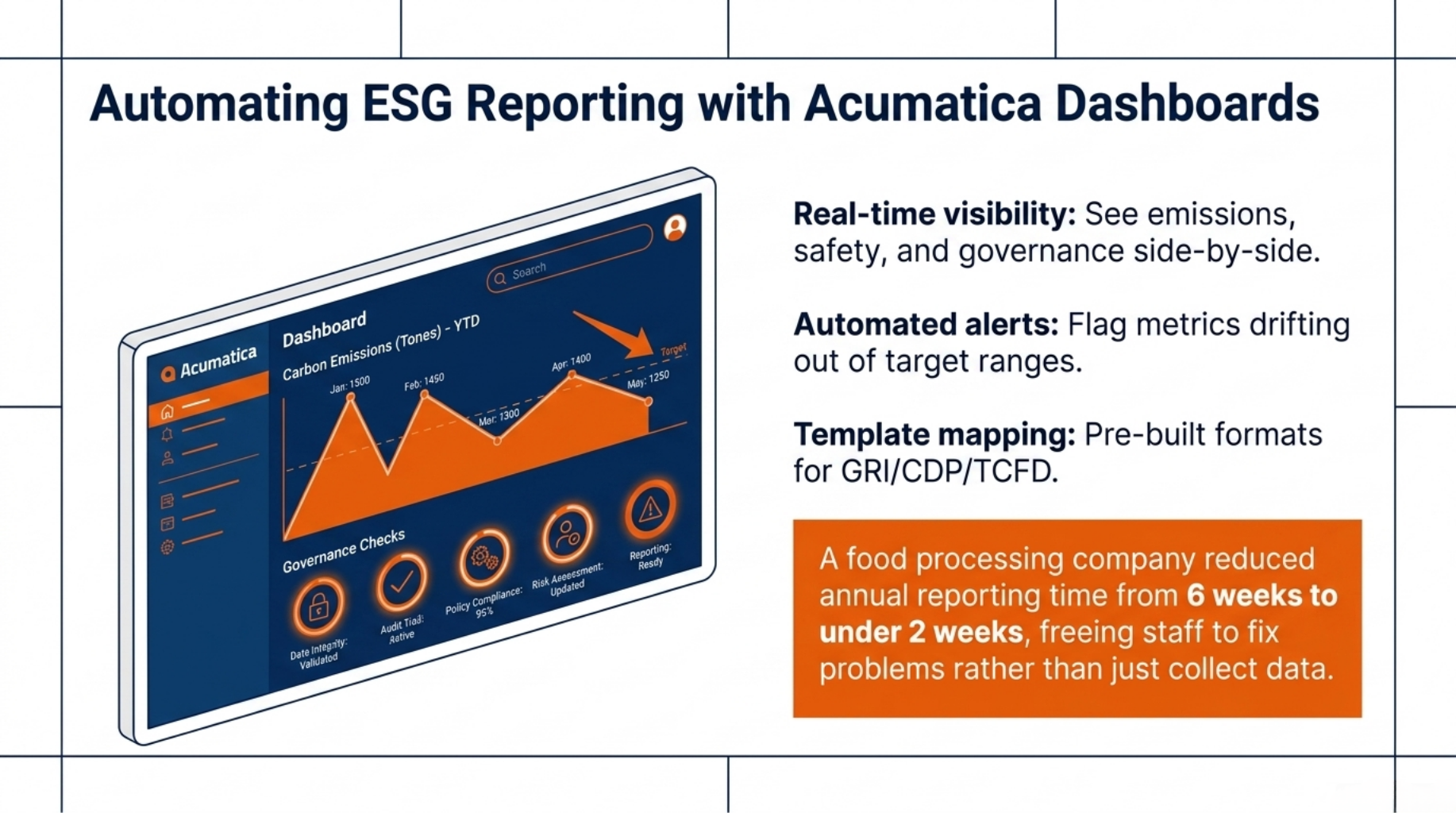
Automating ESG Reporting with Acumatica Dashboards
Building a report by hand takes days of pulling numbers from different teams and formatting them to fit a framework. Acumatica dashboards remove most of that manual step by updating in real time as new data comes in.
A plant manager can open one screen and see emissions, safety incidents, and governance flags side by side, rather than waiting on three separate reports. This live view helps catch problems early, such as a spike in Scope 1 emissions from a machine running hot, before it shows up in a year-end audit. Dashboards also cut down on the back-and-forth between finance, operations, and compliance teams, since everyone works from the same numbers.
- Real-time dashboards show emissions, safety, and governance data together
- Automated alerts flag numbers that drift outside target ranges
- Pre-built templates map data straight to GRI, CDP, or TCFD formats
One food processing company reduced its annual reporting time from six weeks to under two after switching to automated dashboards. That freed staff to focus on fixing problems the data revealed, rather than just collecting it.
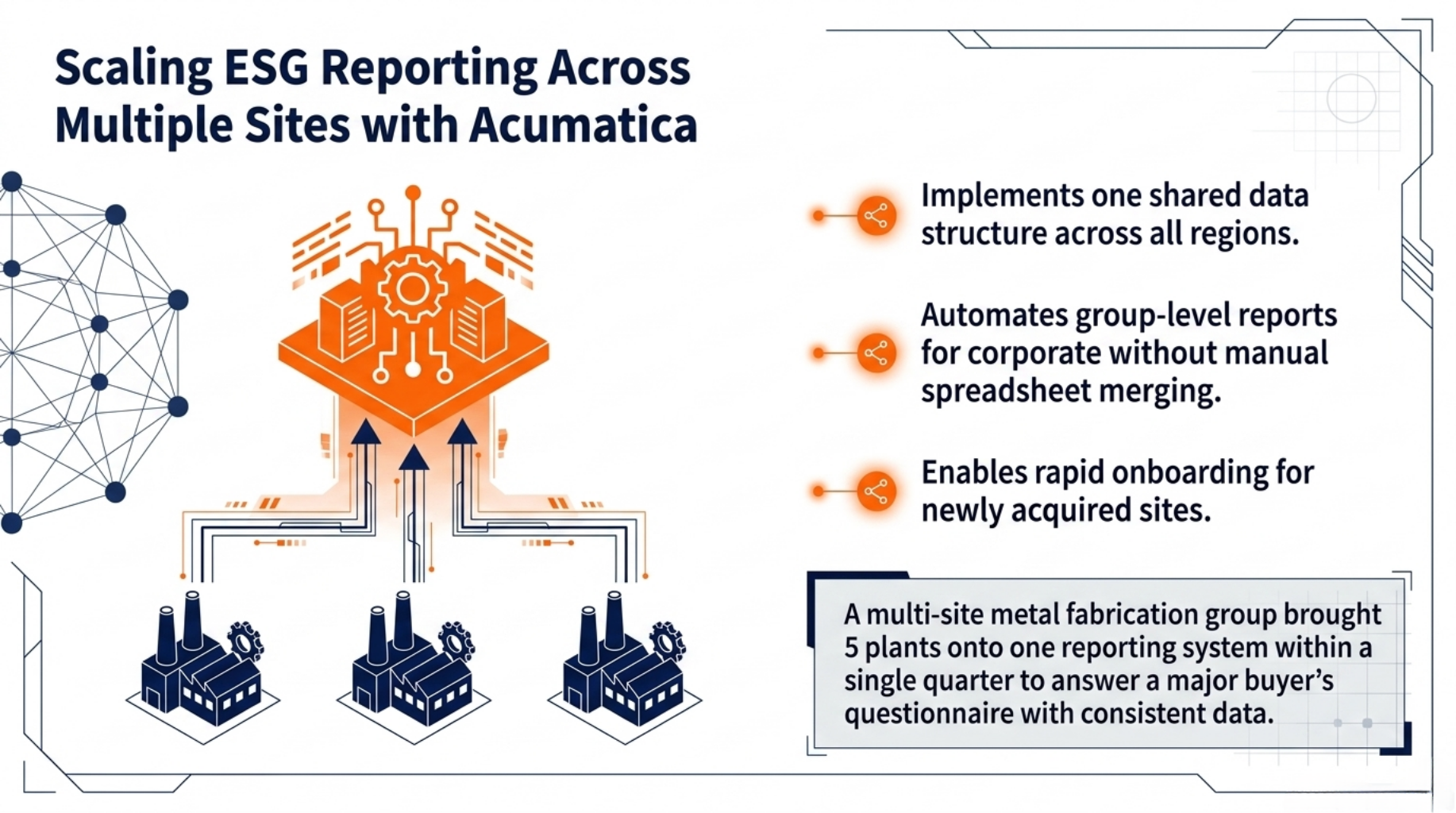
Scaling ESG Reporting Across Multiple Sites with Acumatica
A single-site manufacturer can track ESG data with a fairly simple system. Once a company runs three, five, or ten plants, the picture gets far harder to manage without a shared platform.
Acumatica handles this by giving every site the same data structure, so head office can compare plants side by side instead of merging different spreadsheets by hand. This matters most for companies expanding through acquisition, where each new plant often arrives with its own systems and reporting habits. Standardising on one platform means a new site can start feeding clean data into the group report within weeks rather than months.
- One shared data structure across every plant and region
- Group-level reports that roll up site data automatically
- Faster onboarding for new sites joining after acquisition or expansion
A multi-site metal fabrication group used this approach to bring five plants onto one reporting system within a single quarter. That let them answer a major buyer’s ESG questionnaire with one consistent data set instead of five conflicting ones.
Wrapping Up
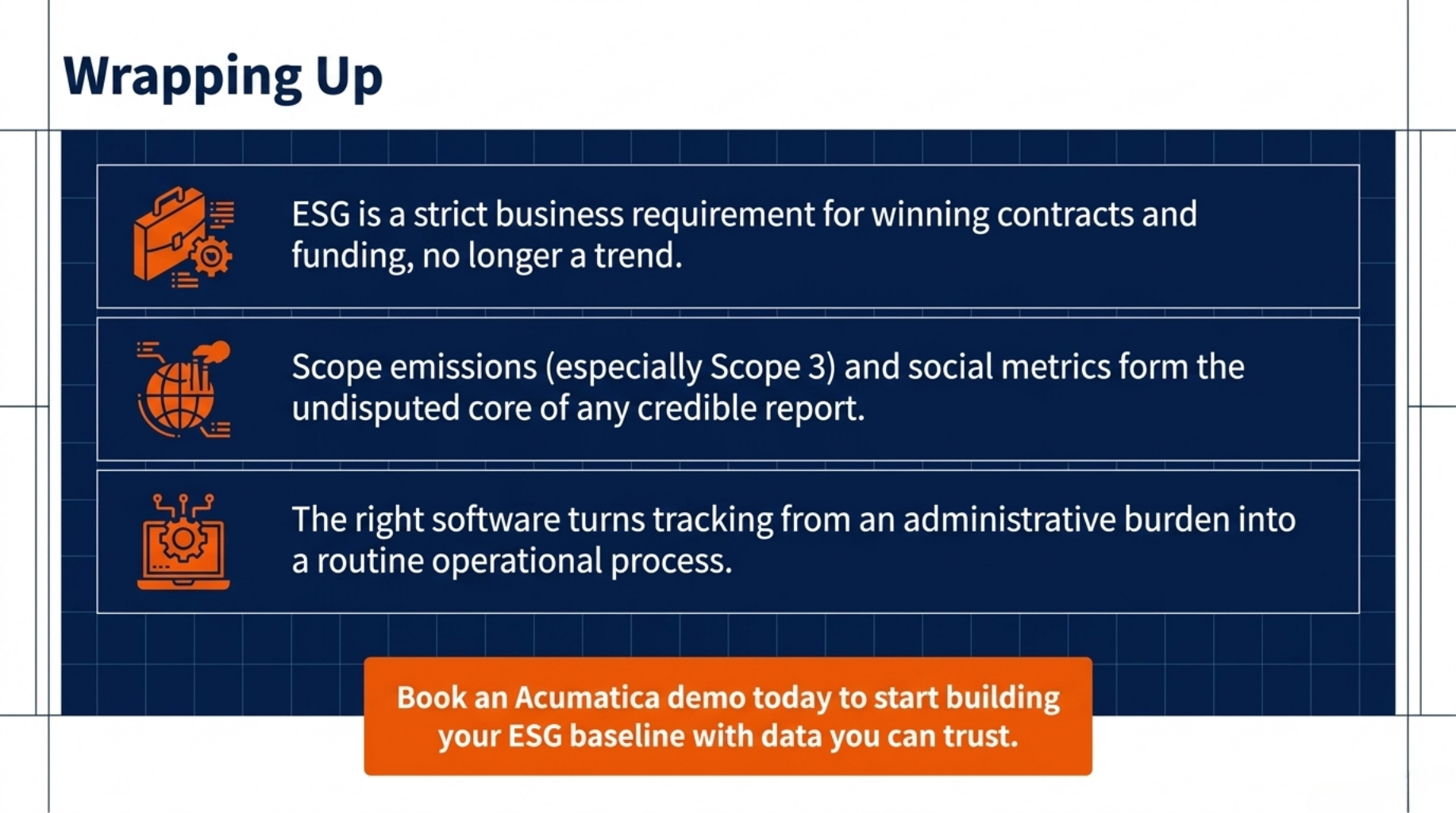
ESG in manufacturing has moved from a nice-to-have to a basic requirement for winning contracts and funding. Scope emissions, worker safety, and governance data form the backbone of any credible report. The right software turns that tracking from a burden into a routine part of running your plant.
- ESG in manufacturing is now a business requirement, not a trend
- Scope emissions and social metrics form the core of any report
- The right software turns ESG tracking into a simple process
Book an Acumatica demo today to start building your ESG baseline with data you can trust.
FAQ
Q1: What is ESG in manufacturing?
A: ESG in manufacturing means tracking environmental, social, and governance performance across factory operations and supply chains.
Q2: What are scope 1, 2, and 3 emissions?
A: Scope 1 covers direct emissions, scope 2 covers purchased energy, and scope 3 covers supply chain emissions.
Q3: Which ESG framework should manufacturers use?
A: Most manufacturers start with GRI for broad reporting and add CDP or TCFD for climate-specific disclosure.
Q4: How do manufacturers start ESG reporting?
A: Manufacturers start by mapping data sources, setting priority metrics, and choosing software to track progress.
Q5: Why do manufacturers need ESG compliance?
A: Customers, investors, and regulators now require proof of sustainability performance before signing contracts or funding growth.