




Summary
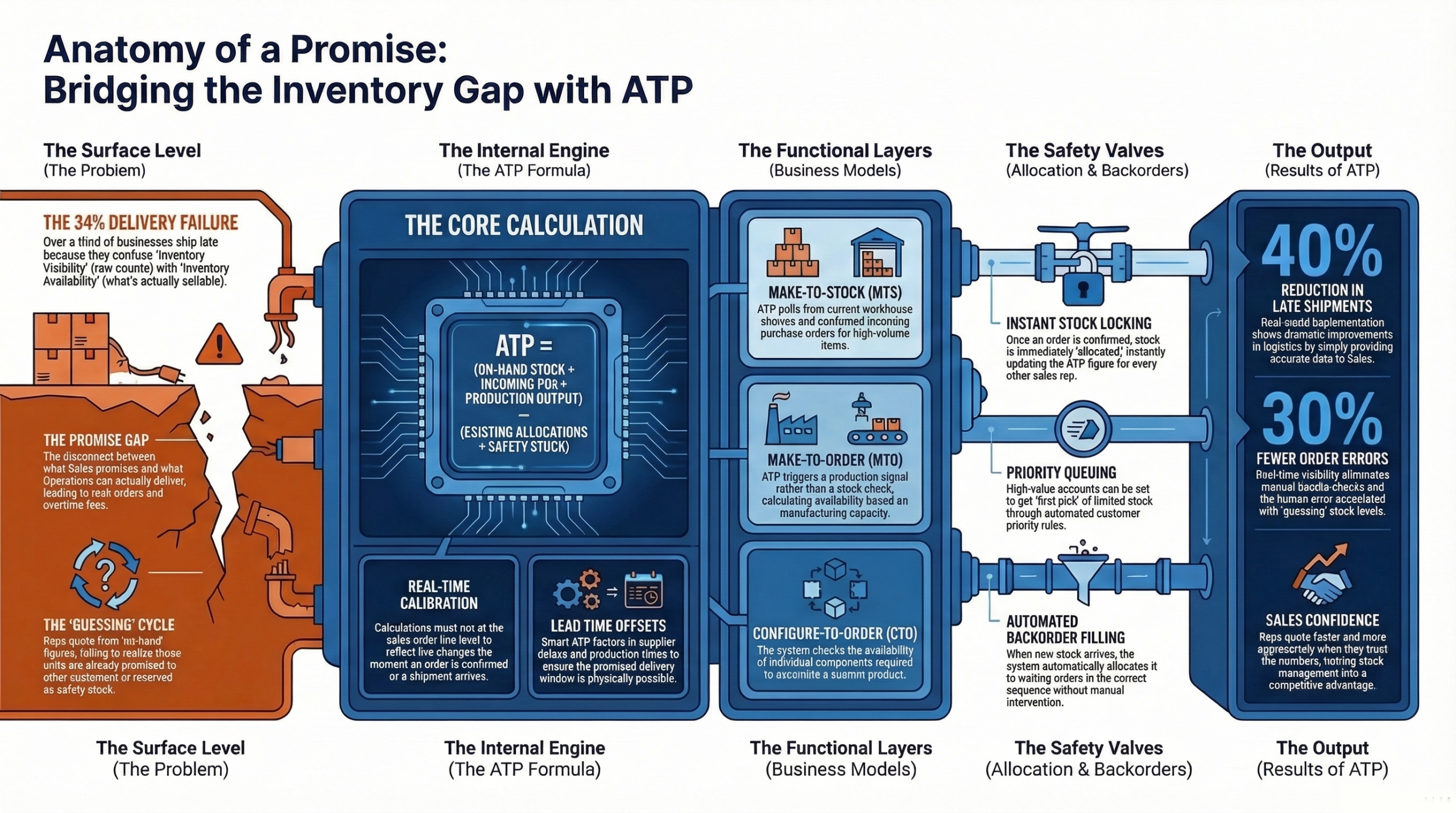
The text explains how the mismatch between sales promises and actual inventory (the “promise gap”) costs businesses through late shipments, refunds, and lost customers. Available-to-promise (ATP) inventory ; a real-time calculation that subtracts allocations and safety stock and adds incoming supply ; gives sales accurate availability so they quote realistic delivery dates. Implementing ATP rules (in systems like Acumatica) plus smart allocation, drop-ship handling, and automated backorder management reduces errors, speeds quoting, and improves customer trust.
Key points
- The problem: Sales often quote on-hand stock instead of available promise, causing double-promises, delays and customer churn.
- ATP formula: Available Promise = On-hand − Allocations − Safety Stock (extended: + Incoming POs + Production Output).
- Real-time ERP/ATP shows true, location-specific availability and updates per sales order line to prevent overcommitment.
- Configure ATP to your model: make-to-stock, make-to-order, configure-to-order, and use drop-ship when appropriate.
- Benefits: fewer late shipments and order errors, faster confident quoting, automated allocations and backorder fulfilment, and better customer satisfaction.
- Practical result: small configuration and real-time visibility (e.g., Acumatica ATP) can cut late shipments and firefighting without major warehouse overhaul.

Picture this: a sales rep closes a great deal and promises delivery by Friday. The warehouse manager gets the order and stares at empty shelves. Sound familiar? That single disconnect costs South African businesses thousands every month ; in lost customers, damaged trust, and teams blaming each other. Available to promise inventory South Africa is the fix most businesses don’t know they’re missing. When your sales team can see real, live availability before they quote, everyone wins ; especially the customer.
Why Sales and Operations Keep Clashing
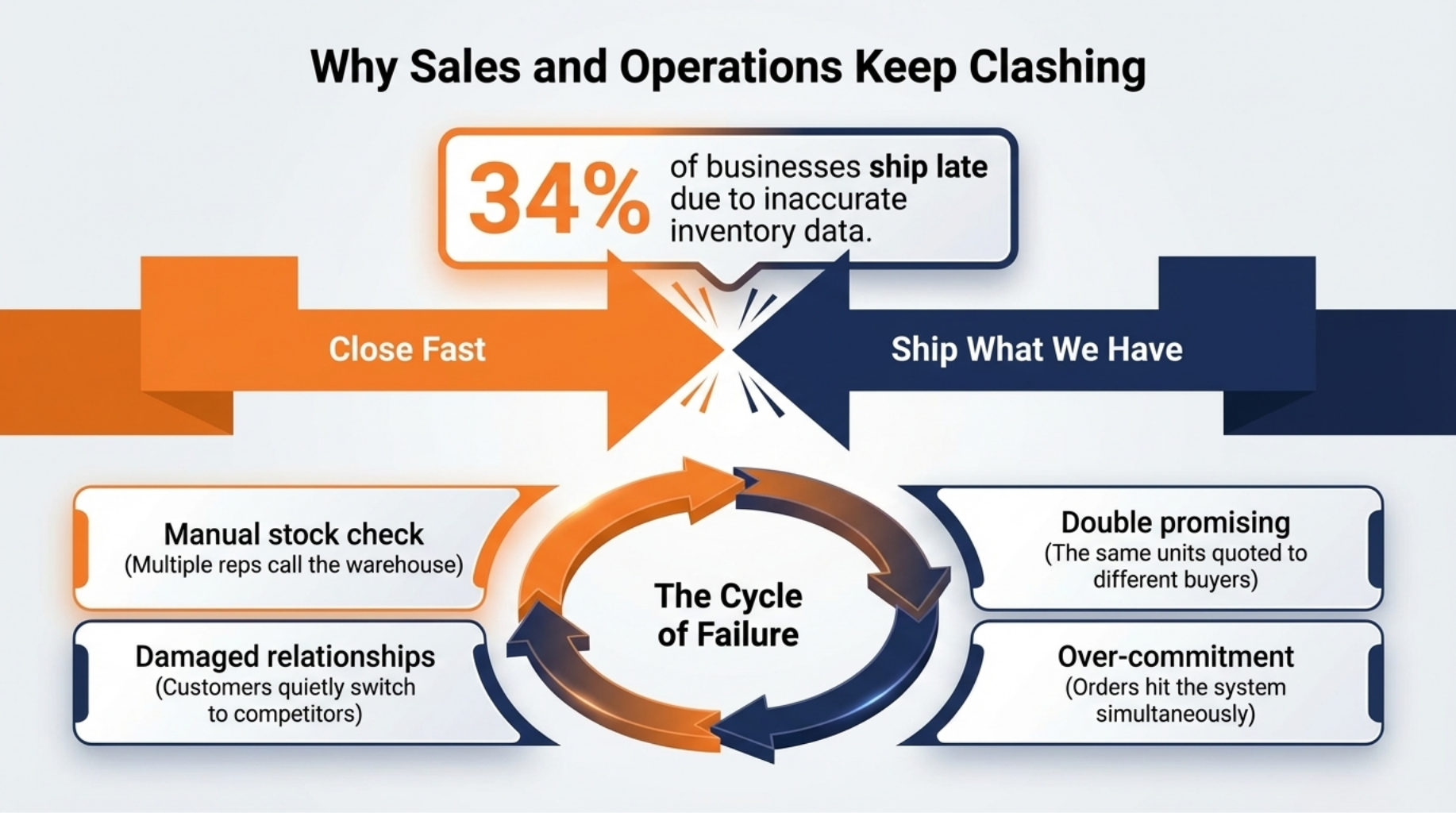
Every sales team wants to close fast. Every operation’s team wants to ship only what it actually has. When those two goals don’t connect, customers get caught in the middle. Stock gets double-promised. Orders get delayed. Relationships break down.
This “promise gap” is one of the biggest ; and most avoidable ; profit leaks in product-based businesses. It’s not about bad people. It’s about bad information flow.
Research shows that 34% of businesses ship late due to inaccurate inventory data.
Manual stock checks make it worse. A sales rep calls the warehouse, gets a number, and quotes based on that. Meanwhile, two other reps are doing the same thing with the same stock. By the time the orders hit the system, the warehouse is over-committed and the customers are already unhappy.
The cost isn’t just a delayed shipment. It’s the return. The chargeback. The customer who quietly switches to a competitor and never tells you why.
Inventory Visibility vs. Availability ; Know the Difference
Seeing stock on a screen doesn’t mean you can sell it. This is where most businesses get it wrong.
Inventory visibility tells you what’s sitting in the warehouse ; the raw count. Inventory availability tells you what’s actually free to promise. Mixing these up is where most sales errors begin.
| Metric | Units |
|---|---|
| On-hand stock | 500 |
| Already allocated | 300 |
| Safety stock (buffer) | 50 |
| Available to promise | 150 |
That’s the ATP formula in action: On-hand − Allocations − Safety Stock = Available to Promise.
Your sales rep needs to see 150 ; not 500. Quoting from the full on-hand figure is how businesses over-promise and under-deliver. Real-time ERP inventory systems make sure everyone sees the right number, every time.
The Hidden Cost of Guessing Stock Levels
When a sales rep guesses availability, the whole business pays the price.
A customer gets a delivery date that can’t be met. Operations scrambles to source stock from somewhere ; anywhere. Finance processes a credit or refund. And the sales rep spends time firefighting instead of selling.
One mid-sized South African distributor reduced late shipments by 40% after implementing ATP rules inside Acumatica. The change wasn’t a warehouse overhaul. It was simply giving the sales team accurate, real-time numbers before they promised anything.
The downstream effects of guessing are ugly: rush orders, overtime wages, expedite fees, and customer churn. None of it shows up on a single invoice, but it adds up fast.
How Available to Promise Inventory Actually Works
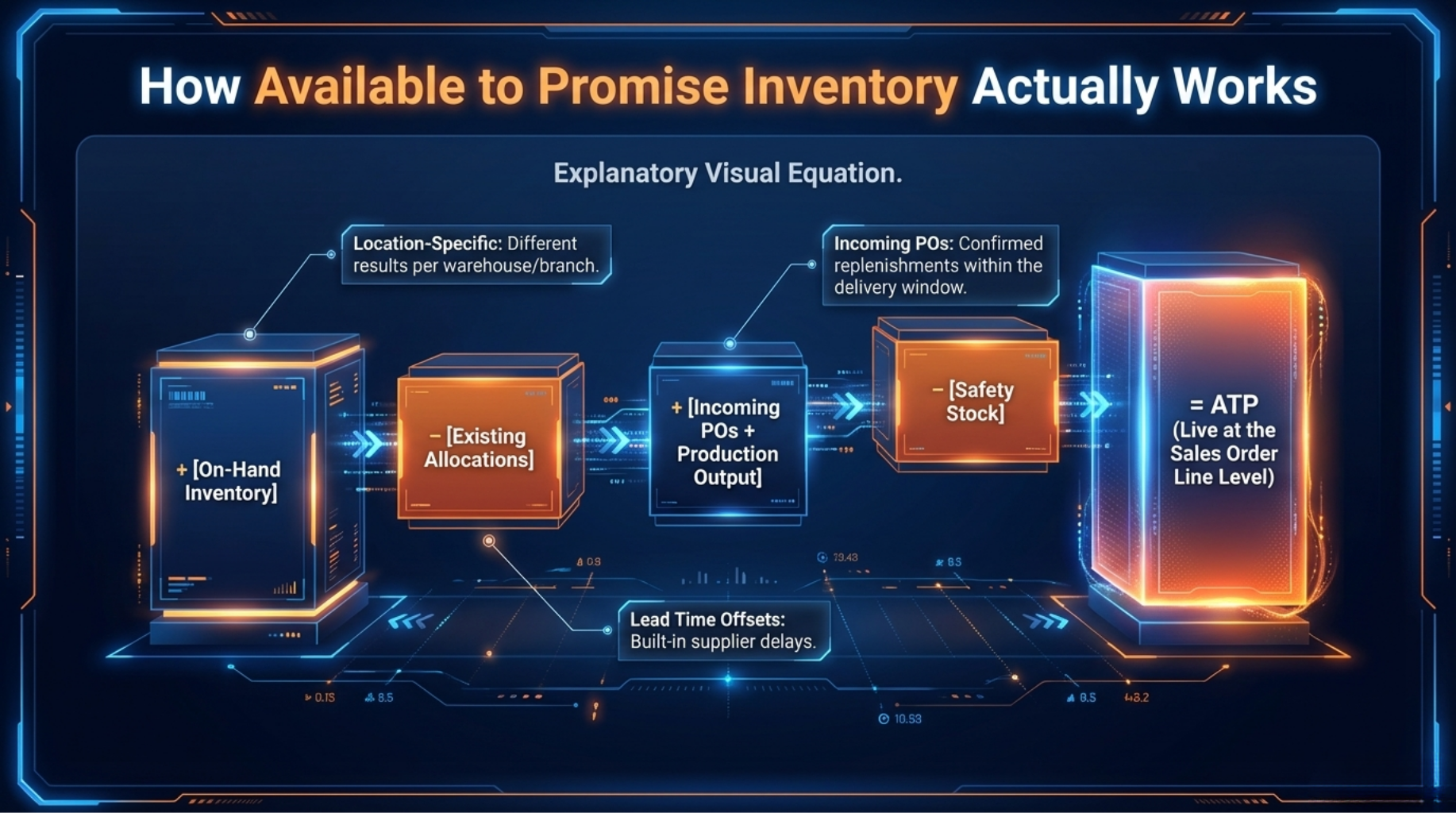
Available to promise inventory isn’t just a static number pulled from a spreadsheet. It’s a live calculation that shifts every time an order is confirmed, a purchase order arrives, or a production run completes.
The full ATP formula looks like this:
ATP = On-Hand − Allocations + Incoming POs + Production Output − Safety Stock
In Acumatica, this calculation runs in real time at the sales order line level. When a rep opens an order and selects a product, the ATP figure reflects the latest data ; not yesterday’s count. It also factors in:
- Lead time offsets ; supplier delays or production times built into the calculation
- Location-specific availability ; different results per warehouse or branch
- Incoming purchase orders ; confirmed POs that will replenish stock within the promised delivery window
The result is a number your sales team can actually trust.
Configuring ATP Rules for Your Business Model
Not every business sells the same way, and your ATP rules shouldn’t pretend otherwise.
- Make-to-stock: ATP pulls from on-hand stock and confirmed incoming POs. Straightforward for high-volume, standard products.
- Make-to-order: ATP triggers production planning rather than warehouse stock checks. The customer’s order effectively creates the demand signal.
- Configure-to-order: ATP checks component availability, not finished goods. Ideal for businesses assembling custom products per order.
Acumatica’s Inventory Preferences let you set lead time buffers and safety stock thresholds ; protecting reserve stock from being promised away accidentally. These settings ensure the ATP figure your sales team sees already has the guardrails built in.
Drop-Ship Orders; Sell Without Touching the Warehouse
Drop-ship orders offer a powerful way to fulfil customer demand without moving warehouse stock at all. The supplier ships directly to your customer. Your ATP calculation stays clean, and your warehouse capacity stays free for other orders.
Use drop-ship when:
- Items are temporarily out of stock
- Goods are bulky or costly to handle through your warehouse
- A supplier has faster lead times than your own fulfilment operation
In Acumatica, sales orders can be flagged for drop-ship at the line level. The system generates a purchase order to the supplier automatically. Risk management comes down to supplier reliability ; so building accurate lead times into your supplier records is essential for this to work smoothly.
Smarter Stock Allocation for Sales Teams
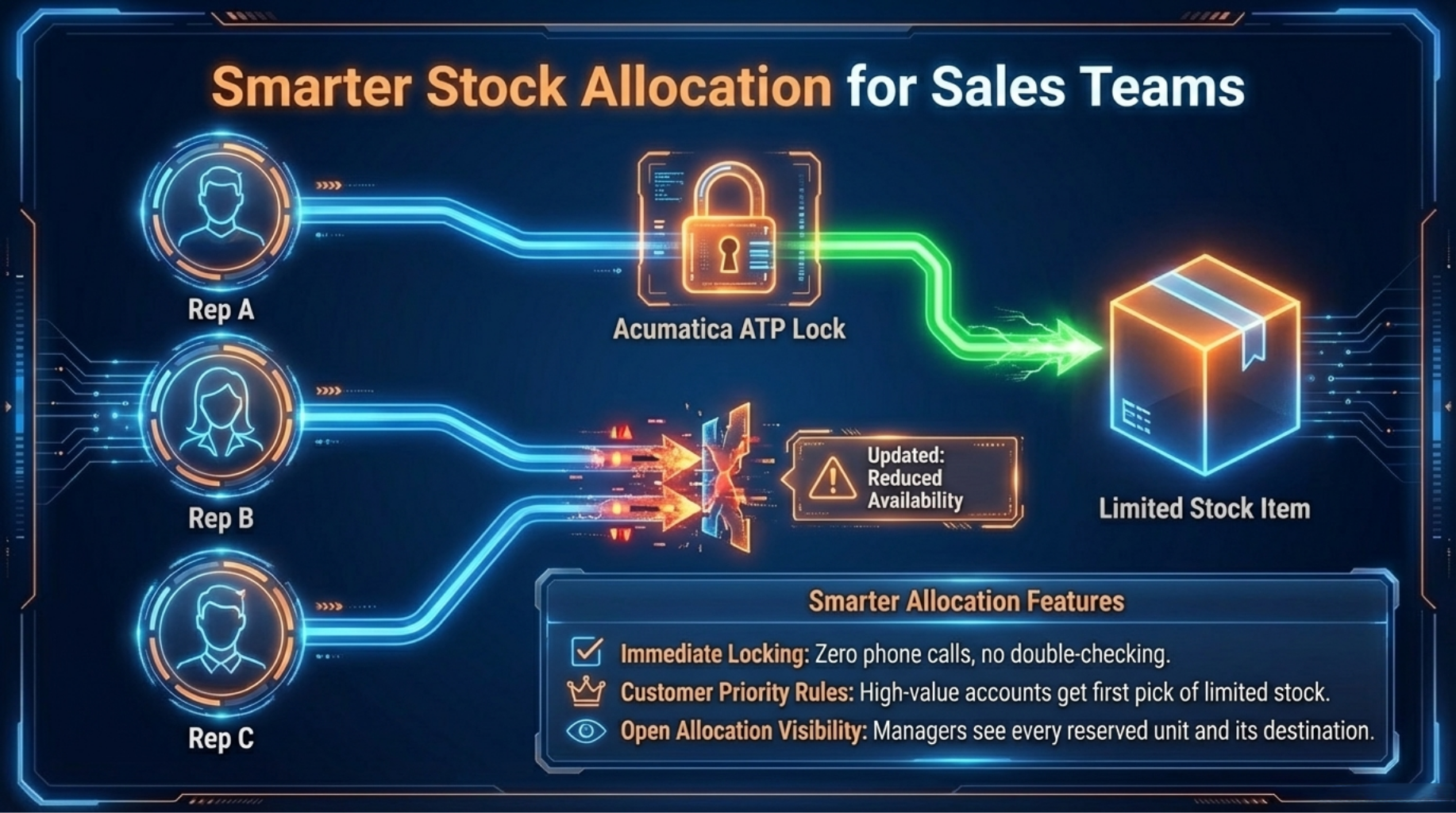
Stock allocation is how you make sure the right inventory goes to the appropriate customer. Without it, two reps can promise the same units to different buyers on the same morning.
When a sales order is confirmed in Acumatica, the allocated stock is immediately locked. Every other sales rep’s ATP figure updates automatically. No phone calls. No double-checking. No awkward conversations with customers later.
Beyond basic reservations, smarter allocation includes:
- Customer priority rules ; high-value accounts get first pick when stock is limited
- Back-order auto-allocation ; when new stock arrives, the system fills waiting orders in priority sequence
- Open allocation visibility ; managers can see every reserved unit and where it’s going
These turns stock management from a daily scramble into a system that runs itself.
Back-order Management That Runs Itself
Backordering isn’t a failure ; it’s a plan. When stock is unavailable, a good back-order system holds the customer’s place in the queue. When new stock arrives, orders fill automatically in the right order ; no manual intervention needed.
Setting up back-order rules in Acumatica means:
- Incoming POs trigger automatic allocation to waiting sales orders
- Priority queuing ensures your best customers get served first
- Customer notifications can be sent automatically when their backorder is resolved
This removes the manual work that typically falls on operations teams and reduces the risk of allocating stock to the wrong order. It also gives customers a simple answer: “Your order is in the queue and will ship when stock arrives” ; instead of an uncomfortable silence.
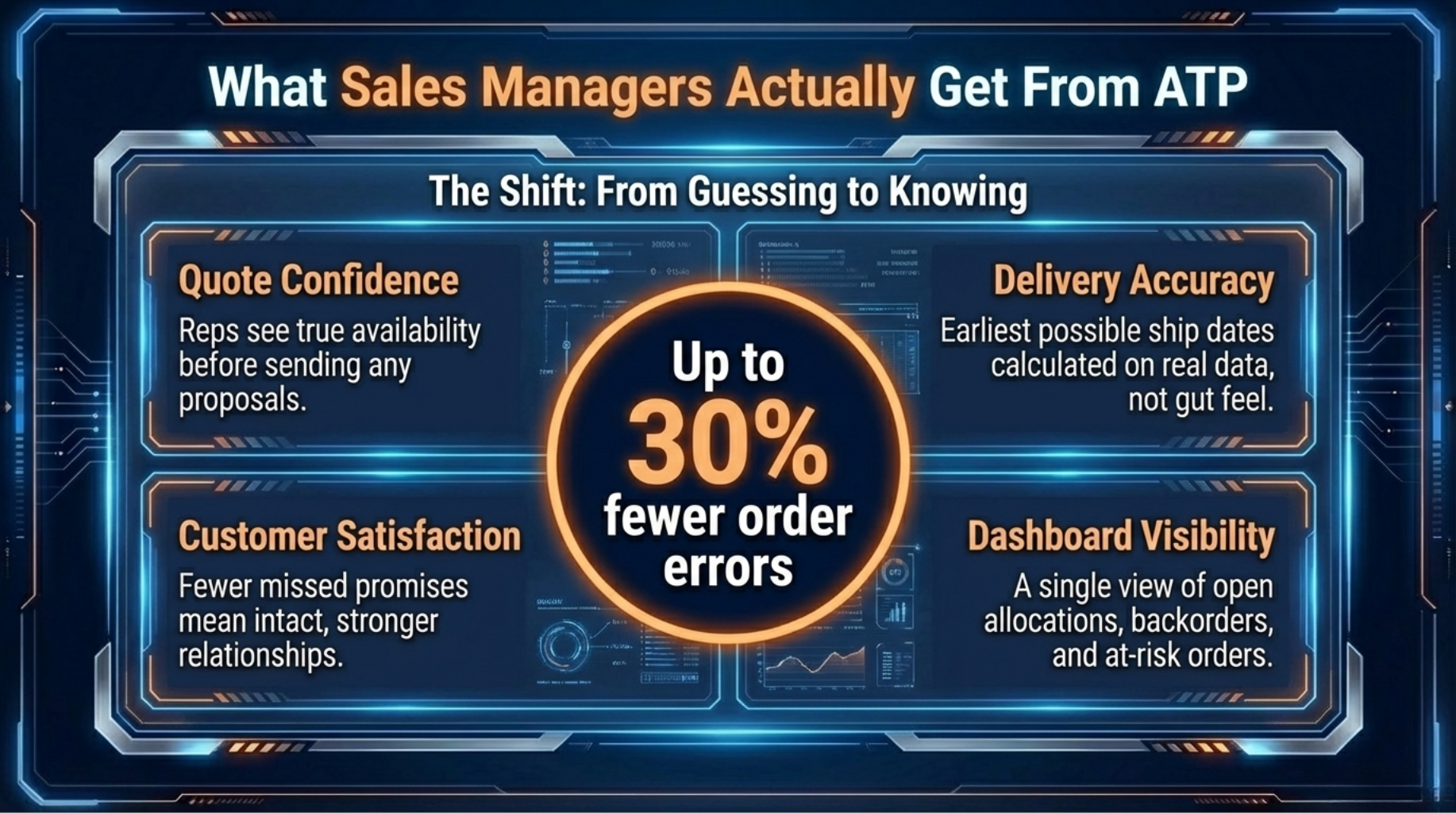
What Sales Managers Actually Get From ATP
ATP isn’t just an operations tool. It’s a sales confidence tool.
When sales reps trust the numbers in front of them, they quote faster and more accurately. Delivery dates are based on real calculations, not gut feel. Customer relationships stay intact because surprises are rare.
Companies with real-time inventory visibility report up to 30% fewer order errors.
For sales managers, the benefits stack up quickly:
- Quote confidence: Reps see true availability before sending any proposal
- Delivery date accuracy: ATP calculates the earliest possible ship date based on real data
- Customer satisfaction: Fewer missed promises, stronger relationships
- Dashboard visibility: See open allocations, backorders, and at-risk orders in one view
The shift is simple: from guessing to knowing. And it shows in the numbers.
Wrapping Up
The gap between what sales promises and what operations deliver is a solvable problem. It doesn’t require a warehouse redesign or a new team ; it requires the right information in the right hands at the right moment.
Available to promise inventory in South Africa is what bridges that gap. When your sales team can see real, live availability before they commit to a customer, the whole business runs smoother ; fewer errors, fewer refunds, and far fewer frustrated customers.
Ready to stop over-promising? Book a free Acumatica ATP demo today and see your real availability in live data.
FAQ ; Quick Answers That Rank
Q1: What is available to promise inventory?
Available to promise (ATP) is the real quantity of stock you can sell ; calculated as on-hand inventory minus existing allocations, plus incoming supply, minus safety stock.
Q2: How does Acumatica calculate ATP?
Acumatica calculates ATP per item and location using on-hand stock, confirmed purchase orders, production orders, existing sales allocations, and configurable safety stock and lead time rules.
Q3: Can ATP work for make-to-order businesses in South Africa?
Yes. Acumatica’s ATP rules can be configured for make-to-order, make-to-stock, and configure-to-order models, each with separate lead time and supply source settings.
Q4: How does stock allocation prevent double-promising?
When a sales order is confirmed, Acumatica reserves that stock against the specific order. Other sales reps see reduced availability instantly, preventing two reps from promising the same units.
Q5: What happens to back-orders when new stock arrives?
Acumatica can automatically allocate incoming stock to existing backorders based on customer priority rules and order date, without any manual intervention needed.